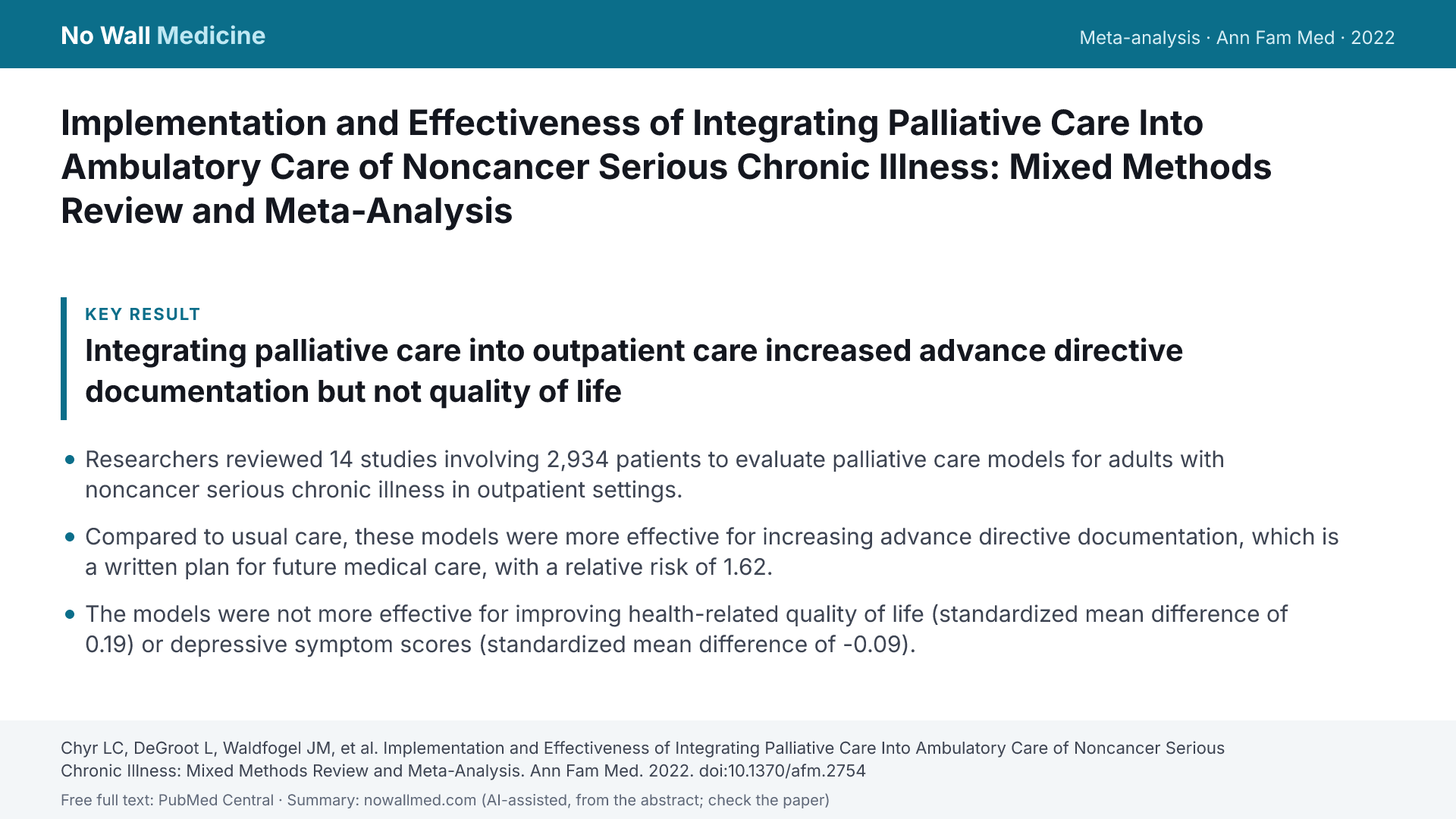
Integrating palliative care into outpatient care increased advance directive documentation but not quality of life
Implementation and Effectiveness of Integrating Palliative Care Into Ambulatory Care of Noncancer Serious Chronic Illness: Mixed Methods Review and Meta-Analysis
Why it matters: It is unknown how effective integrating palliative care into outpatient settings is for improving quality of life or managing symptoms in adults with noncancer serious chronic illness.
Key points
- Researchers reviewed 14 studies involving 2,934 patients to evaluate palliative care models for adults with noncancer serious chronic illness in outpatient settings.
- Compared to usual care, these models were more effective for increasing advance directive documentation, which is a written plan for future medical care, with a relative risk of 1.62.
- The models were not more effective for improving health-related quality of life (standardized mean difference of 0.19) or depressive symptom scores (standardized mean difference of -0.09).
Headline and key points written with AI from the paper’s abstract, with every number checked against it. Read the paper before relying on them.
Was this summary helpful?
Subject terms
Cite this article
Chyr LC, DeGroot L, Waldfogel JM, et al. Implementation and Effectiveness of Integrating Palliative Care Into Ambulatory Care of Noncancer Serious Chronic Illness: Mixed Methods Review and Meta-Analysis. Ann Fam Med. 2022. doi:10.1370/afm.2754
Spotted a mistake? Suggest a correction