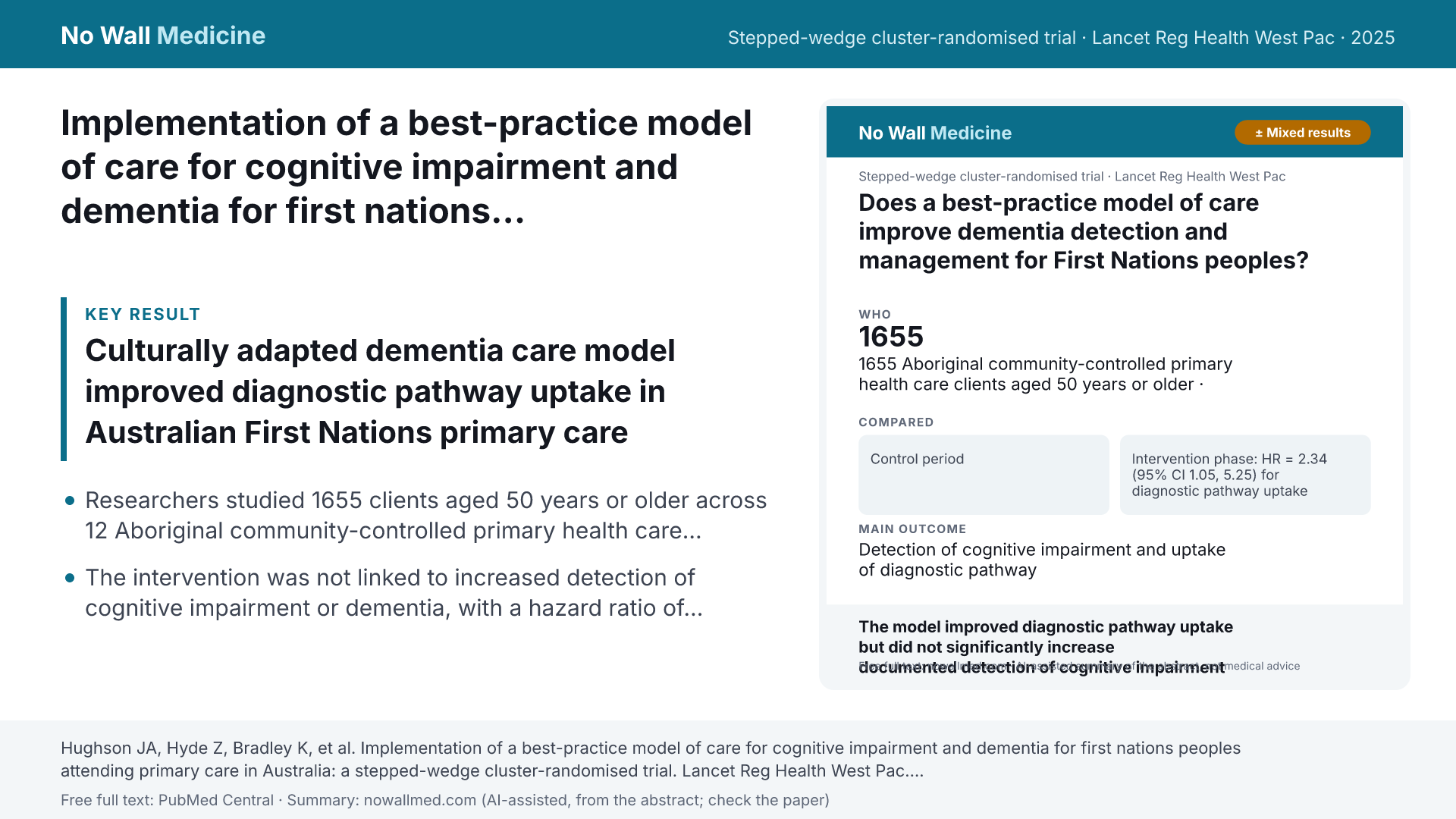
Implementation of a best-practice model of care for cognitive impairment and dementia for first nations peoples attending primary care in Australia: a stepped-wedge cluster-randomised trial
Key result: Culturally adapted dementia care model improved diagnostic pathway uptake in Australian First Nations primary care
Key points
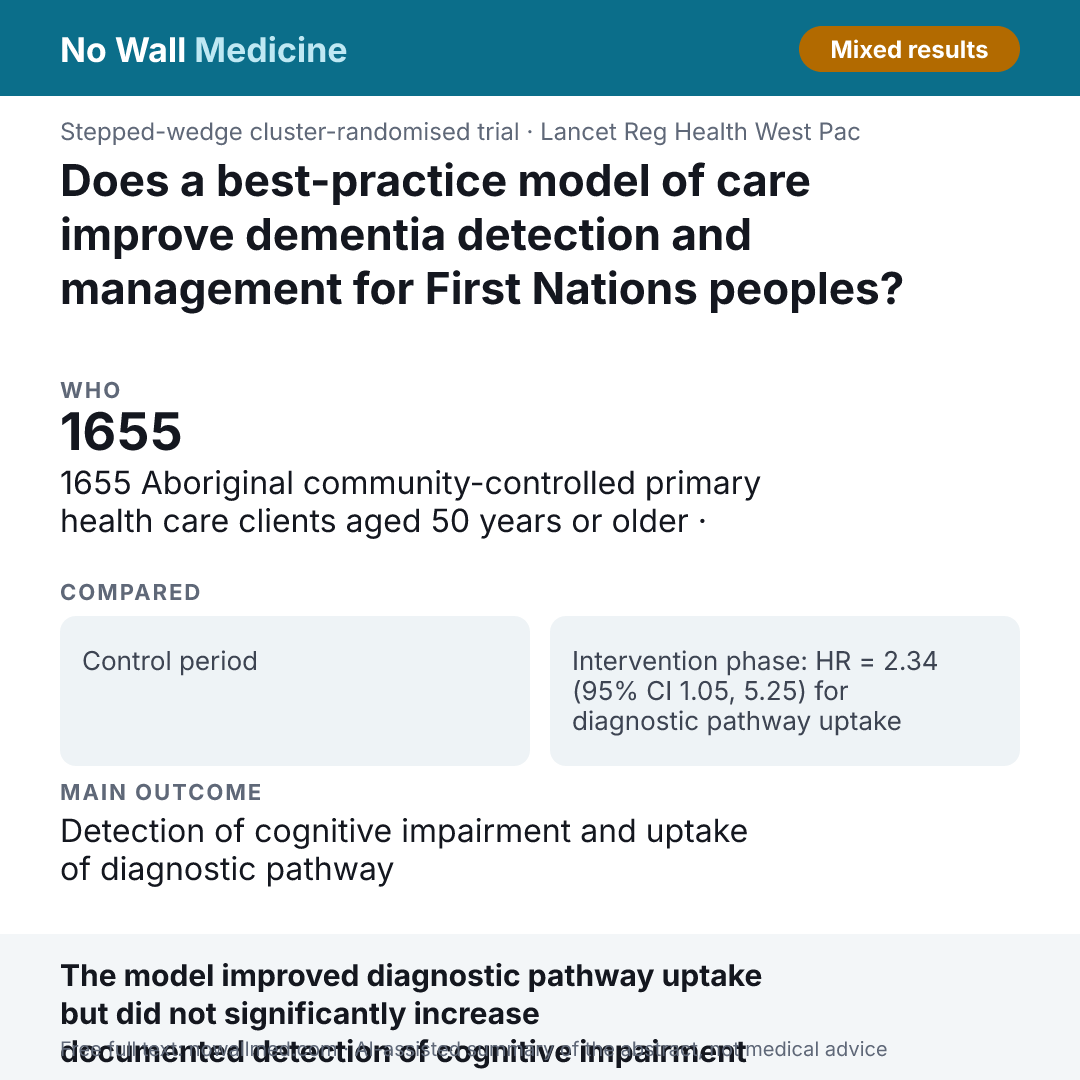
- Researchers studied 1655 clients aged 50 years or older across 12 Aboriginal community-controlled primary health care services in Australia.
- The intervention was not linked to increased detection of cognitive impairment or dementia, with a hazard ratio of 1.53 (95% CI 0.64, 3.65).
- The model was associated with improved uptake of the diagnostic pathway, including cognitive assessments and specialist referrals, with a hazard ratio of 2.34 (95% CI 1.05, 5.25).
Why it matters: Dementia and cognitive impairment not dementia are under-detected among First Nations peoples attending primary care in Australia.
Discussion prompts
- Would these patients look like yours? Who was left out?
- Is the main outcome one that matters to patients?
- Is the difference large enough to change what you do?
Cite: Hughson JA, Hyde Z, Bradley K, et al. Implementation of a best-practice model of care for cognitive impairment and dementia for first nations peoples attending primary care in Australia: a stepped-wedge cluster-randomised trial. Lancet Reg Health West Pac. 2025;57:101529. doi:10.1016/j.lanwpc.2025.101529
Free full text: PubMed Central · Summary and visual abstract: nowallmed.com/a/implementation-of-a-best-practice-model-of-care-for-cognitive-9j5f3n/ (AI-assisted from the abstract; check the paper before relying on it).