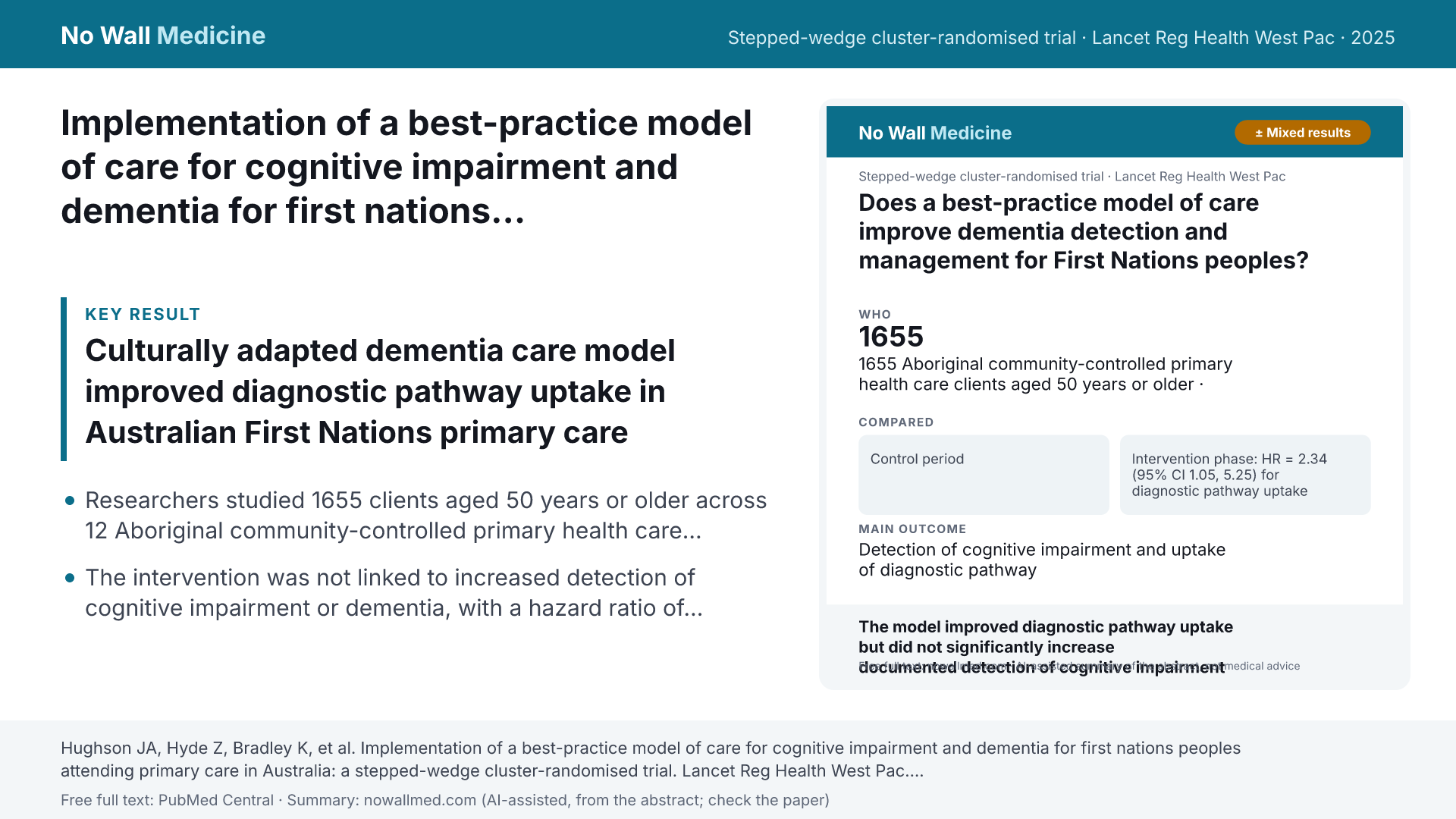
Culturally adapted dementia care model improved diagnostic pathway uptake in Australian First Nations primary care
Implementation of a best-practice model of care for cognitive impairment and dementia for first nations peoples attending primary care in Australia: a stepped-wedge cluster-randomised trial
Stepped-wedge cluster-randomised trialMixed results
Does a best-practice model of care improve dementia detection and management for First Nations peoples?
Who
1655
1655 Aboriginal community-controlled primary health care clients aged 50 years or older · 12 Aboriginal community-controlled primary health care services in Australia
Compared
Control period
Intervention phase: HR = 2.34 (95% CI 1.05, 5.25) for diagnostic pathway uptake
Main outcome
Detection of cognitive impairment and uptake of diagnostic pathway
Result: HR = 2.34 (95% CI 1.05, 5.25) for diagnostic pathway uptake
Bottom line: The model improved diagnostic pathway uptake but did not significantly increase documented detection of cognitive impairment or dementia.
Funded by: National Health and Medical Research Council and Dementia Training Australia
Lancet Reg Health West Pac · 2025-04-03Download image
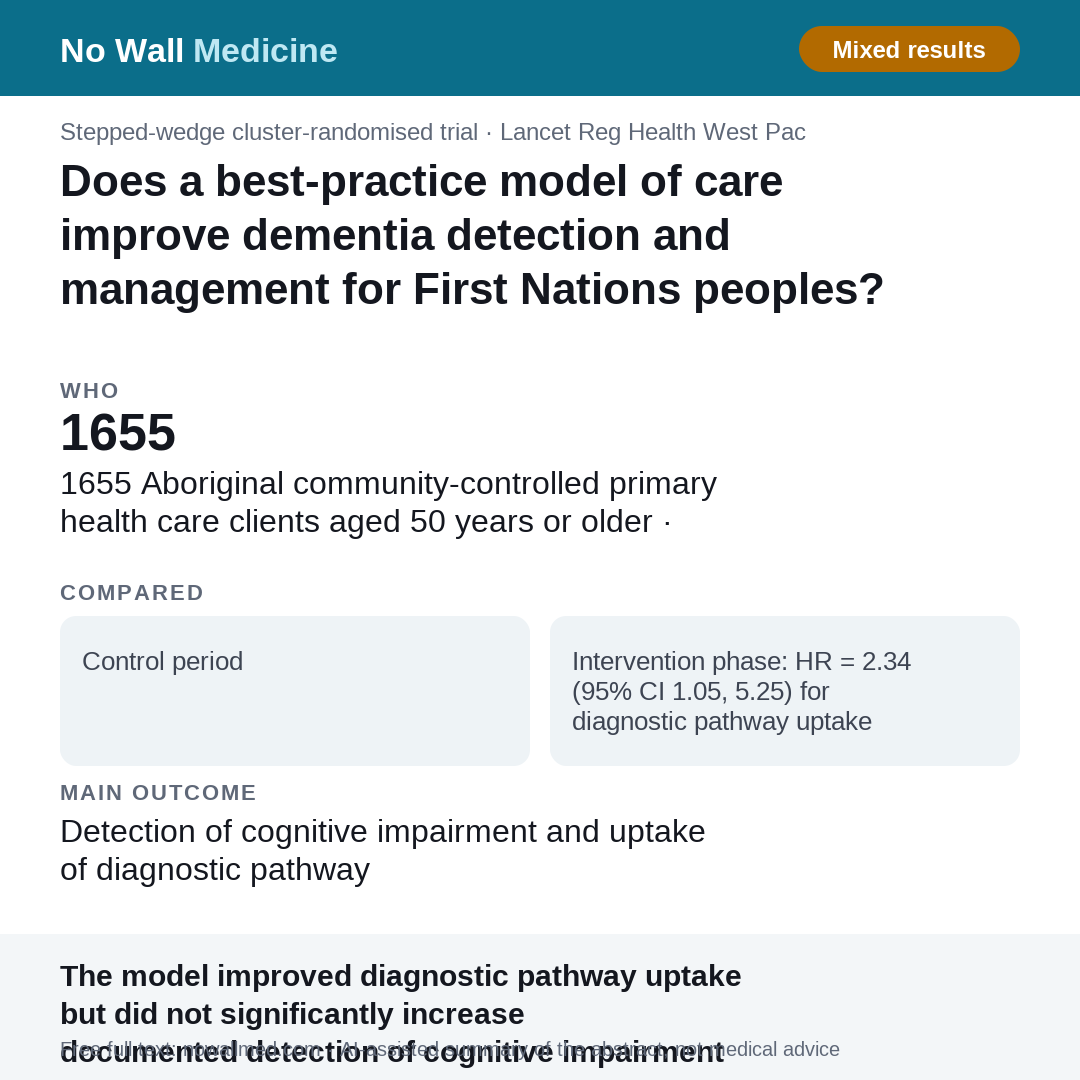
Clinical question: Does a best-practice model of care improve dementia detection and management for First Nations peoples?
Why it matters: Dementia and cognitive impairment not dementia are under-detected among First Nations peoples attending primary care in Australia.
Key points
- Researchers studied 1655 clients aged 50 years or older across 12 Aboriginal community-controlled primary health care services in Australia.
- The intervention was not linked to increased detection of cognitive impairment or dementia, with a hazard ratio of 1.53 (95% CI 0.64, 3.65).
- The model was associated with improved uptake of the diagnostic pathway, including cognitive assessments and specialist referrals, with a hazard ratio of 2.34 (95% CI 1.05, 5.25).
Headline and key points written with AI from the paper’s abstract, with every number checked against it. Read the paper before relying on them.
Was this summary helpful?
Cite this article
Hughson JA, Hyde Z, Bradley K, Malay R, Douglas H, Rind S. Implementation of a best-practice model of care for cognitive impairment and dementia for first nations peoples attending primary care in Australia: a stepped-wedge cluster-randomised trial. Lancet Reg Health West Pac. 2025. doi:10.1016/j.lanwpc.2025.101529
Spotted a mistake? Suggest a correction