Nurse-enabled shared care model shows no difference in quality of life for breast cancer survivors
Implementing a nurse-enabled, integrated, shared-care model involving specialists and general practitioners in early breast cancer post-treatment follow-up (EMINENT): a single-centre, open-label, phase 2, parallel-group, pilot, randomised, controlled trial
Single-centre, open-label, phase 2, pilot, randomised, controlled trialNo clear difference
Is a nurse-enabled, shared-care model feasible and effective for early breast cancer follow-up?
Who
61
Individuals diagnosed with early-stage breast cancer (Stage 0-III) · Single-centre
Compared
Intervention: 0.69 average post-treatment radiation oncology appointments
Usual care: 1.27 average post-treatment radiation oncology appointments
Main outcome
Health-related quality of life
Bottom line: The nurse-enabled shared-care model is feasible and safe, though it showed no differences in health-related quality of life.
Funded by: Metro South Health Research Support Scheme Project Grant
eClinicalMedicine · 2025-02-05Download image
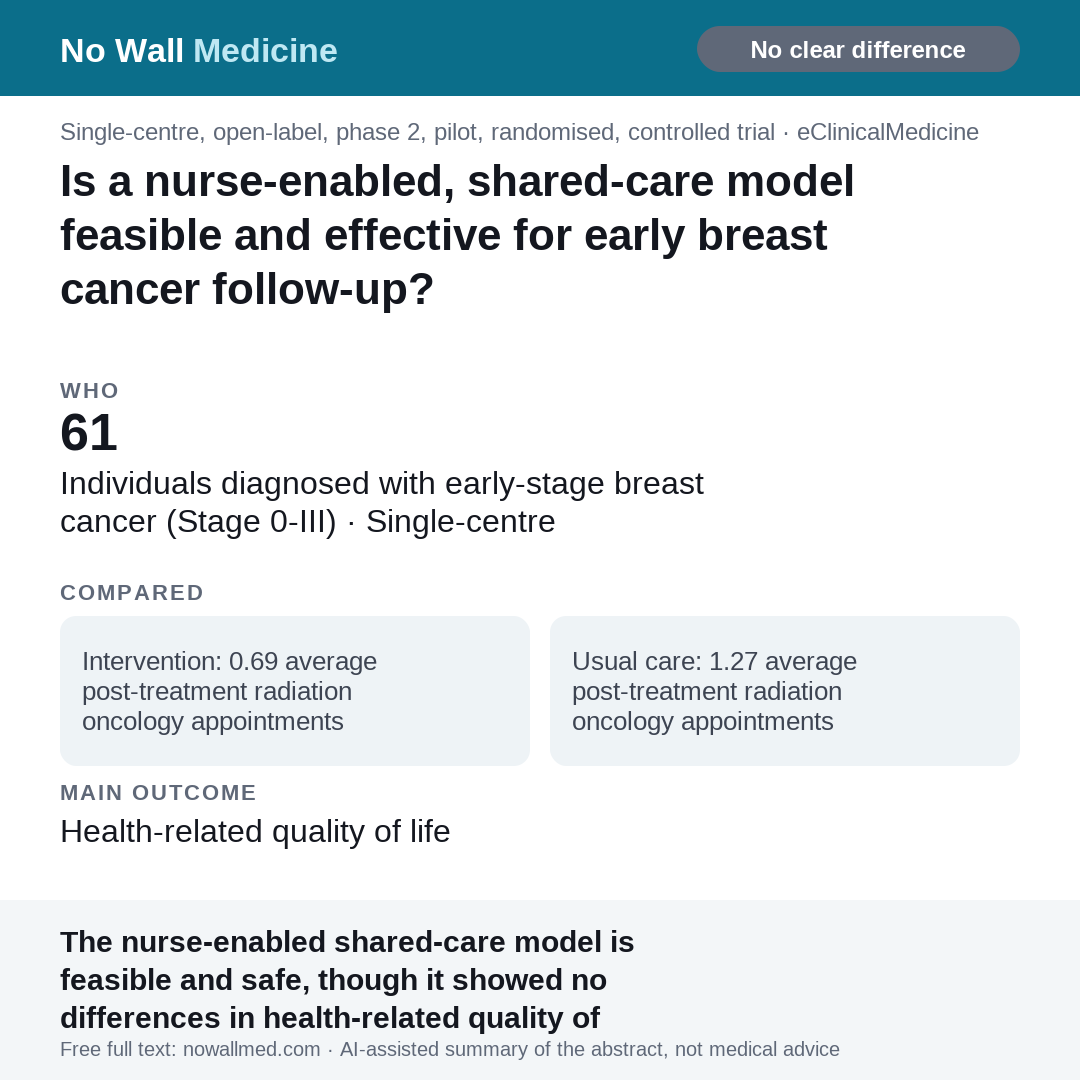
Clinical question: Is a nurse-enabled, shared-care model feasible and effective for early breast cancer follow-up?
Why it matters: Current post-treatment cancer care relies heavily on hospital-based specialists and may not sufficiently use primary care to meet the ongoing needs of breast cancer survivors.
Key points
- Researchers randomized 61 participants with early-stage breast cancer to either usual care or an intervention involving nurse, pharmacist, and general practitioner consultations.
- The intervention was associated with fewer average post-treatment radiation oncology appointments at 24-months, with 0.69 in the intervention group versus 1.27 in the control group.
- No significant differences were observed between the two groups for health-related quality of life or other effectiveness measures at any timepoint.
Limitation the authors note: This was a single-centre, phase 2, pilot, randomized, controlled trial.
Headline and key points written with AI from the paper’s abstract, with every number checked against it. Read the paper before relying on them.
Cite this article
Chan RJ, Crawford-Williams F, Han CY, Jones L, Chan A, McKavanagh D. Implementing a nurse-enabled, integrated, shared-care model involving specialists and general practitioners in early breast cancer post-treatment follow-up (EMINENT): a single-centre, open-label, phase 2, parallel-group, pilot, randomised, controlled trial. eClinicalMedicine. 2025. doi:10.1016/j.eclinm.2025.103090
Spotted a mistake? Suggest a correction
Top studies every Monday
The week’s key trials and guidelines in your specialties, by email. Free.
Get the weekly digest