Primary care pulmonary rehabilitation increased walking distance and reduced fatigue in long COVID patients
Improved functional exercise capacity after primary care pulmonary rehabilitation in patients with long COVID (PuRe-COVID): a pragmatic randomised controlled trial
Pragmatic randomised controlled trialBenefit found
Does primary care pulmonary rehabilitation improve functional exercise capacity and symptoms in long COVID?
Who
76
Patients with long COVID
Compared
Primary care pulmonary rehabilitation: +39 m
Control group
Main outcome
Change in 6 minute walk distance from baseline to 12 weeks
Result: +39 m (95% CI 18 to 59)
Bottom line: Primary care pulmonary rehabilitation improves functional exercise capacity, fatigue, and dyspnoea in patients with long COVID.
BMJ Open Respir Res · 2025-11-17Download image
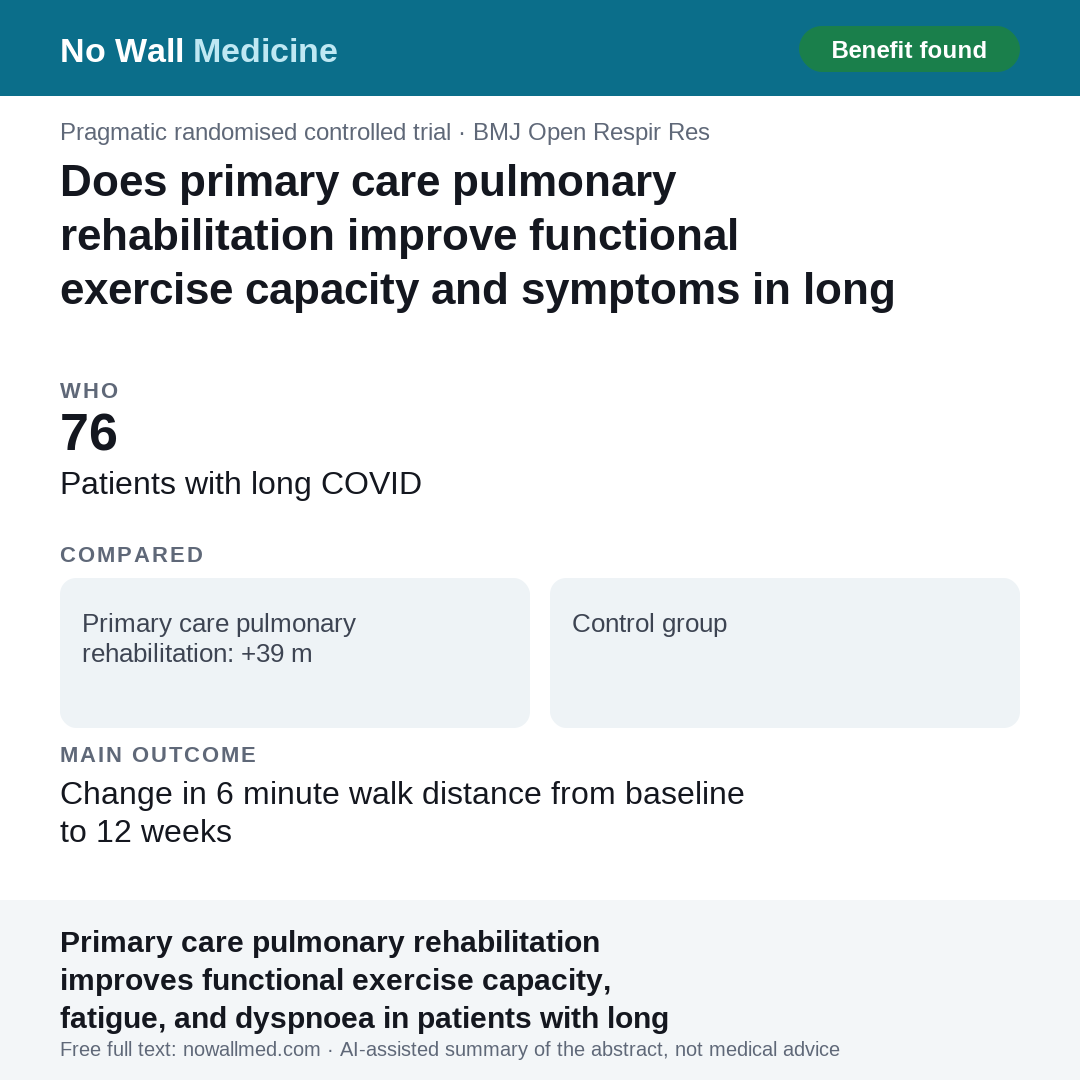
Clinical question: Does primary care pulmonary rehabilitation improve functional exercise capacity and symptoms in long COVID?
Why it matters: Access to specialized hospital-based pulmonary rehabilitation centers is challenging for patients experiencing long COVID symptoms.
Key points
- Researchers conducted a randomized controlled trial with 76 patients with long COVID, comparing a 12-week stepwise pulmonary rehabilitation program to a control group.
- The pulmonary rehabilitation group had a 6-minute walk distance increase of +39 m compared to the control group at 12 weeks (p<0.001).
- Patients in the rehabilitation group were more likely to show clinically significant improvements in fatigue, breathing difficulty, and maximal inspiratory pressure, which measures inhaled breathing strength.
Headline and key points written with AI from the paper’s abstract, with every number checked against it. Read the paper before relying on them.
Abstract
Background
Pulmonary rehabilitation (PR) improves physical status and symptoms in patients with long COVID, but access to specialised hospital-based centres is challenging. This trial studied the effect of primary care PR on functional exercise capacity and symptoms in patients with long COVID. Methods
In this pragmatic randomised controlled trial (PuRe-COVID), patients with long COVID were randomised to a 12-week stepwise PR programme in primary care, or to a control group without PR. The primary end point was change in 6 min walk distance (6MWD) from baseline to 12 weeks. Additional outcomes, measured at 6, 12, 24 and 36 weeks, included patient-reported outcomes, physical activity, maximal inspiratory (MIP) and expiratory pressures and hand grip strength. Results
In total, 76 patients were randomised (PR/control group (n=39/37); mean age 49±13 years). The change in 6MWD at 12 weeks was estimated to be +39 m in the PR group compared with the control group (95% CI (18 to 59), p<0.001). Furthermore, a decrease in Checklist Individual Strength (CIS)-fatigue was found for the PR group (-6 points; 95% CI (-10 to -2), p=0.011). At 12 weeks, patients in the intervention group were more likely to have a clinically significant improvement in 6MWD (OR 5.7, 95% CI (2.0 to 16.1), p=0.001), CIS-fatigue (OR 3.8, 95% CI (1.2 to 12.0), p=0.020), MIP (OR 3.7, 95% CI (1.05 to 12.7), p=0.036) and modified Medical Research Council dyspnoea score (OR 5.2, 95% CI (1.6 to 16.4), p=0.003). Conclusions
Primary care stepwise individual PR may improve functional exercise capacity, fatigue and dyspnoea in patients with long COVID. It therefore may be a promising treatment option in primary care for patients with long COVID experiencing fatigue and/or respiratory symptoms. Trial registration number
NCT05244044.
Abstract reproduced under the article’s CC BY NC licence.
Topics
Cite this article
Volckaerts T, Ruttens D, Quadflieg K, Burtin C, Cops D, De Soomer K. Improved functional exercise capacity after primary care pulmonary rehabilitation in patients with long COVID (PuRe-COVID): a pragmatic randomised controlled trial. BMJ Open Respir Res. 2025. doi:10.1136/bmjresp-2025-003653
Spotted a mistake? Suggest a correction