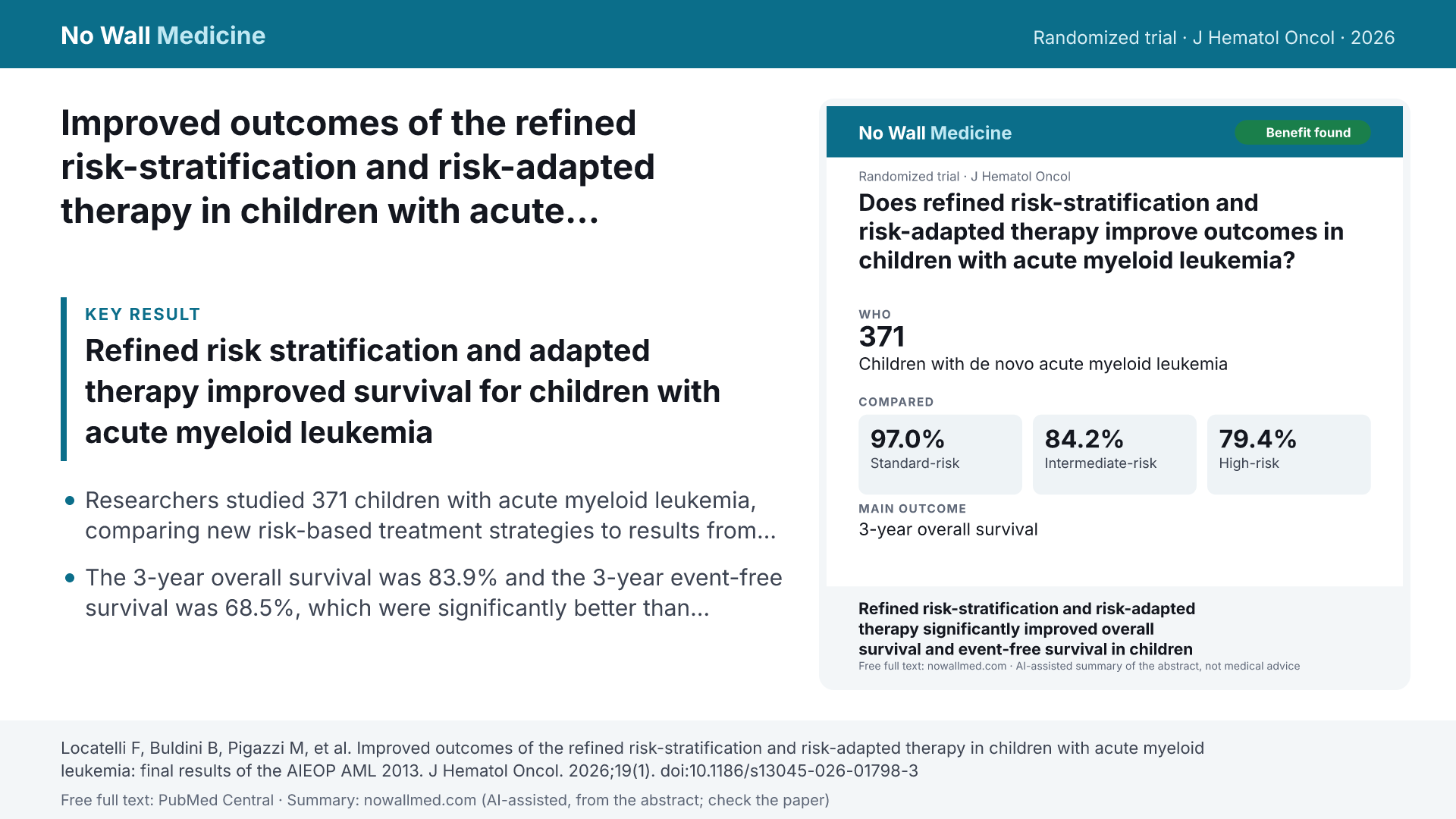
Refined risk stratification and adapted therapy improved survival for children with acute myeloid leukemia
Improved outcomes of the refined risk-stratification and risk-adapted therapy in children with acute myeloid leukemia: final results of the AIEOP AML 2013
Randomized trialBenefit found
Does refined risk-stratification and risk-adapted therapy improve outcomes in children with acute myeloid leukemia?
Who
371
Children with de novo acute myeloid leukemia
Compared
97.0%Standard-risk
84.2%Intermediate-risk
79.4%High-risk
Main outcome
3-year overall survival
Bottom line: Refined risk-stratification and risk-adapted therapy significantly improved overall survival and event-free survival in children with acute myeloid leukemia.
J Hematol Oncol · 2026-04-20 · Save PNG
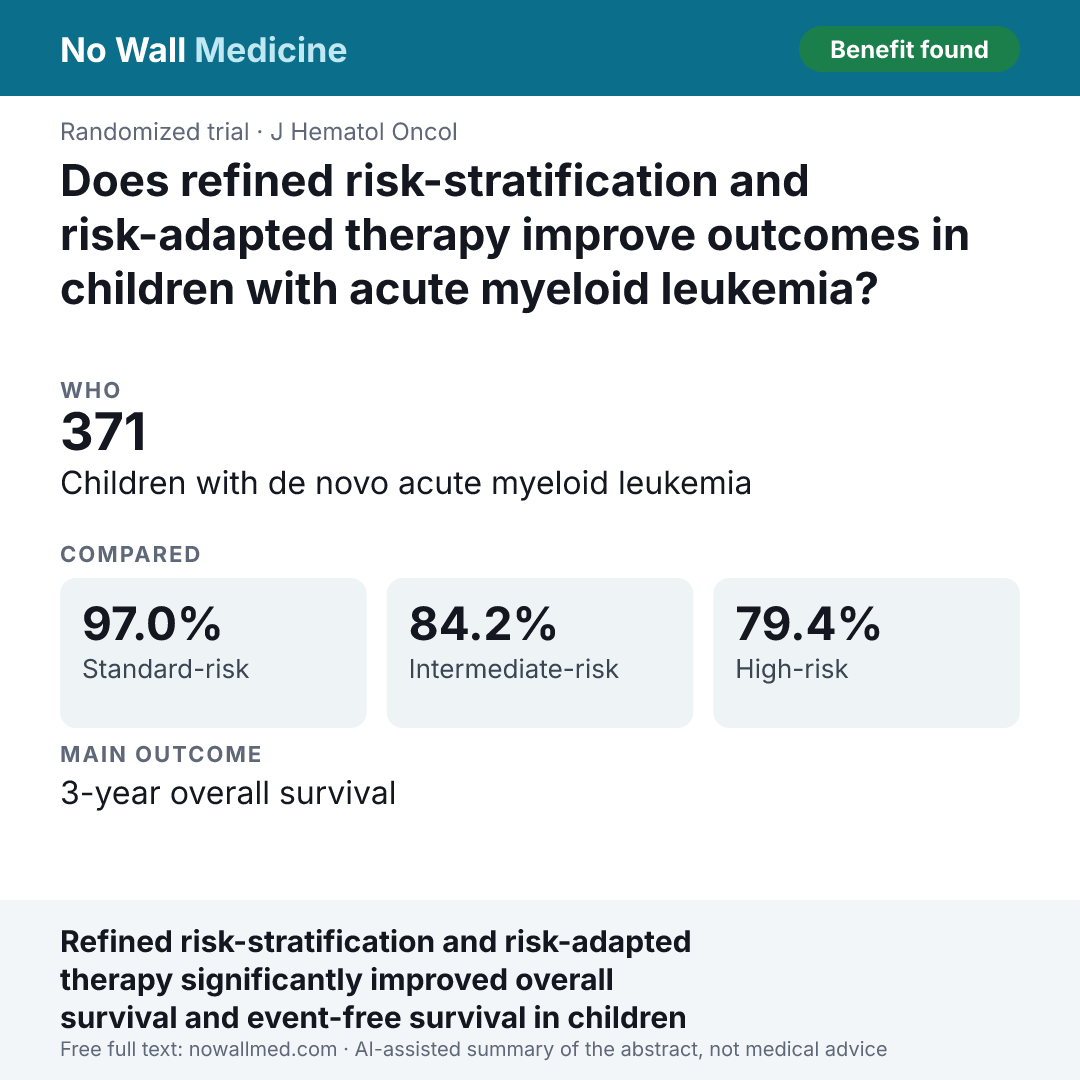
Clinical question: Does refined risk-stratification and risk-adapted therapy improve outcomes in children with acute myeloid leukemia?
Why it matters: Doctors wanted to see if refined patient grouping and randomized second induction courses could improve outcomes for children with acute myeloid leukemia.
Key points
- Researchers studied 371 children with acute myeloid leukemia, comparing new risk-based treatment strategies to results from a previous national trial.
- The 3-year overall survival was 83.9% and the 3-year event-free survival was 68.5%, which were significantly better than the previous study.
- The probability of event-free survival did not differ between intermediate and high-risk patients receiving either a second ICE or FLA-My induction course.
Headline and key points written with AI from the paper’s abstract, with every number checked against it. Read the paper before relying on them.
Was this summary helpful?
Subject terms
Headline, design, result, key points, caveat and citation as plain text.
Cite this article
Locatelli F, Buldini B, Pigazzi M, et al. Improved outcomes of the refined risk-stratification and risk-adapted therapy in children with acute myeloid leukemia: final results of the AIEOP AML 2013. J Hematol Oncol. 2026;19(1). doi:10.1186/s13045-026-01798-3
Spotted a mistake? Suggest a correction