Intensified chemotherapy did not improve overall survival for older patients with acute myeloid leukemia
Treatment Intensification With Either Fludarabine, AraC, G-CSF and Idarubicin, or Cladribine Plus Daunorubicin and AraC on the Basis of Residual Disease Status in Older Patients With AML: Results From the NCRI AML18 Trial
Why it matters: It is unknown if intensifying chemotherapy for older patients with acute myeloid leukemia who still have detectable leukemia after first treatment improves survival.
Key points
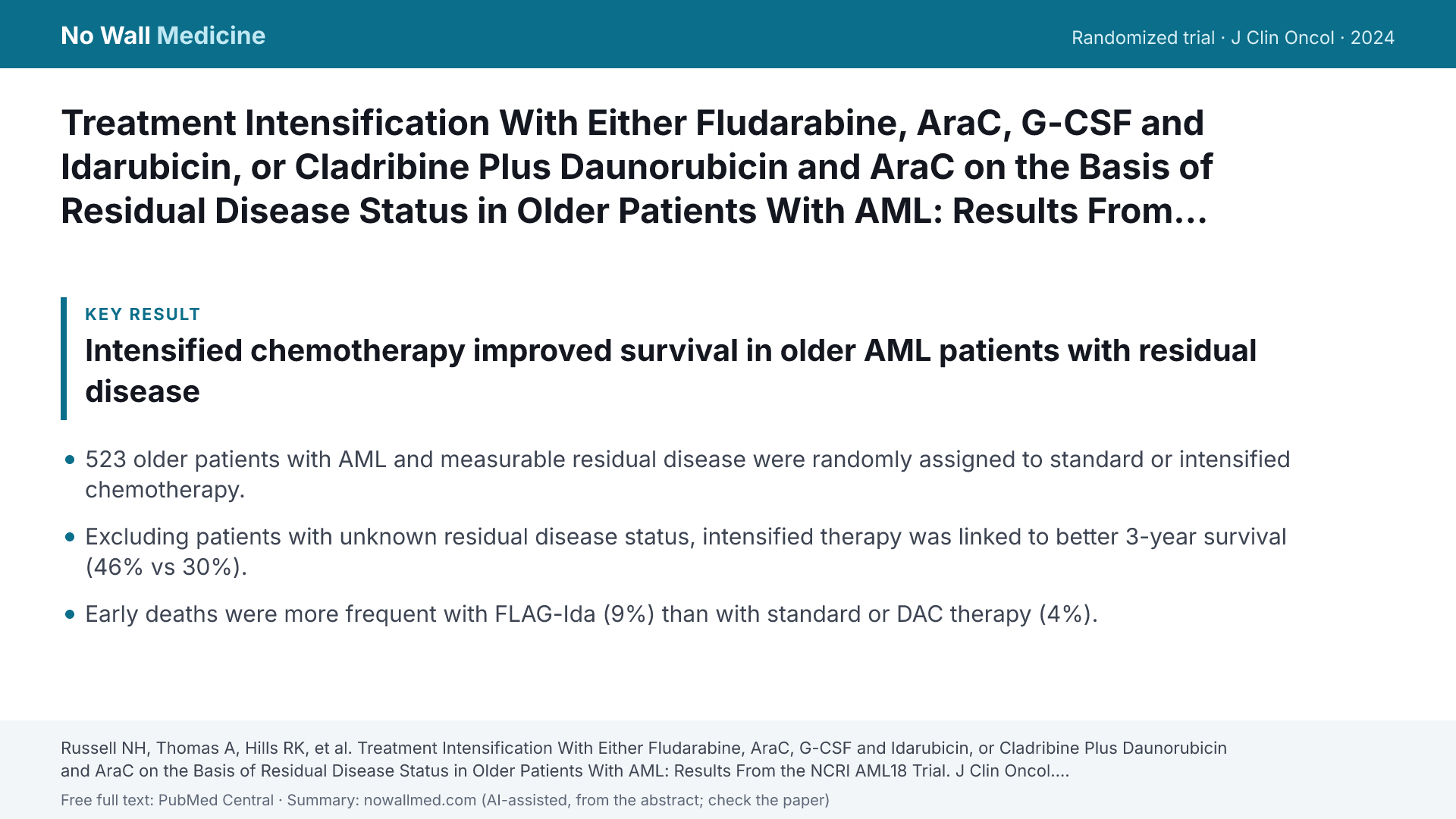
- Researchers studied 523 older patients with acute myeloid leukemia who did not achieve a measurable residual disease-negative remission after initial treatment.
- Overall survival at 3 years was 34% for daunorubicin and cytarabine, 46% for cladribine, daunorubicin, and cytarabine, and 42% for fludarabine, cytarabine, granulocyte colony-stimulating factor, and idarubicin.
- Early deaths by day 60 were more frequent with the fludarabine, cytarabine, granulocyte colony-stimulating factor, and idarubicin regimen at 9% compared to 4% for the other groups.
Headline and key points written with AI from the paper’s abstract, with every number checked against it. Read the paper before relying on them.
Was this summary helpful?
Subject terms
Cite this article
Russell NH, Thomas A, Hills RK, et al. Treatment Intensification With Either Fludarabine, AraC, G-CSF and Idarubicin, or Cladribine Plus Daunorubicin and AraC on the Basis of Residual Disease Status in Older Patients With AML: Results From the NCRI AML18 Trial. J Clin Oncol. 2024. doi:10.1200/JCO.24.00259
Spotted a mistake? Suggest a correction