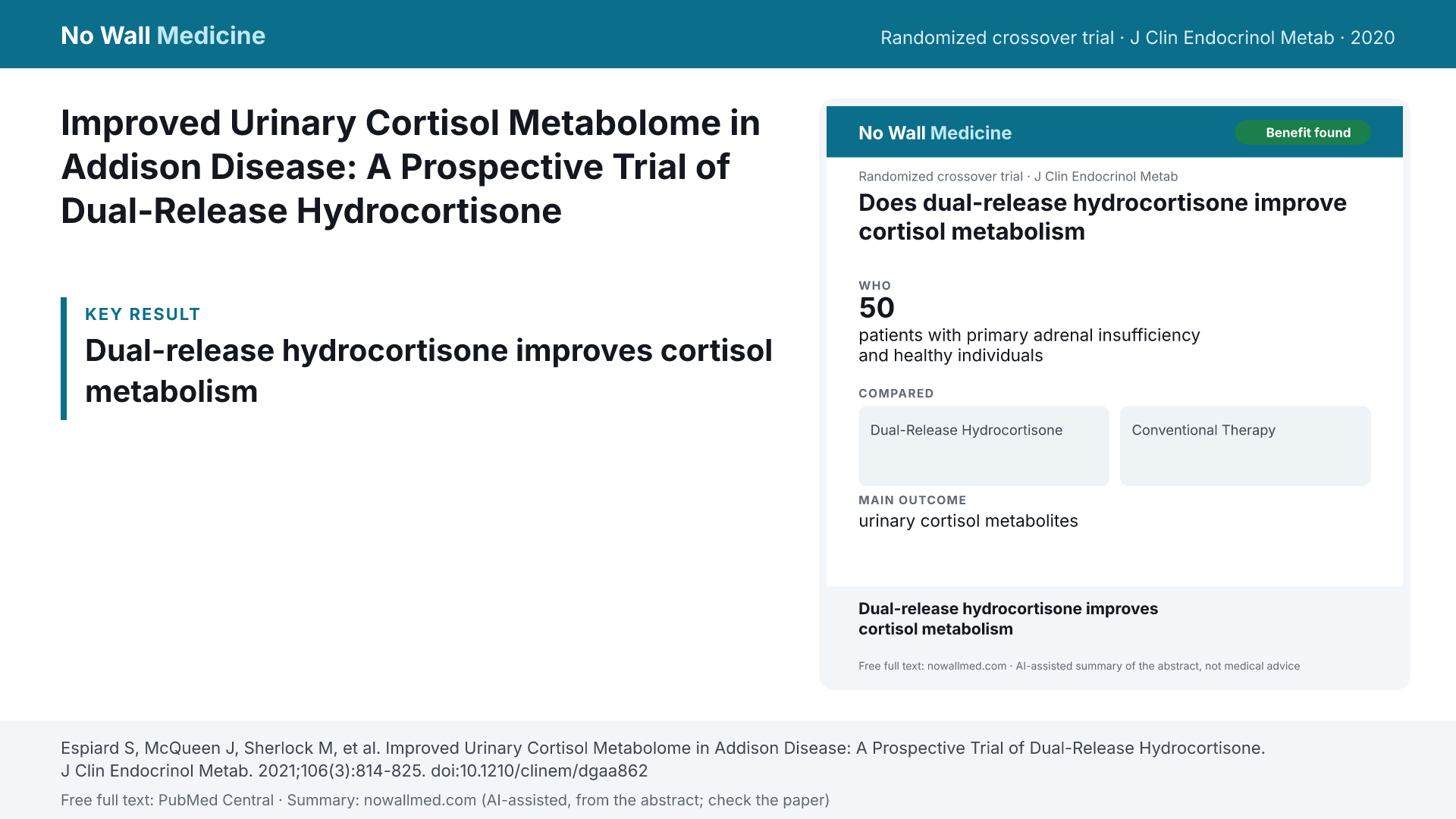
Improved Urinary Cortisol Metabolome in Addison Disease: A Prospective Trial of Dual-Release Hydrocortisone
Randomized crossover trialBenefit found
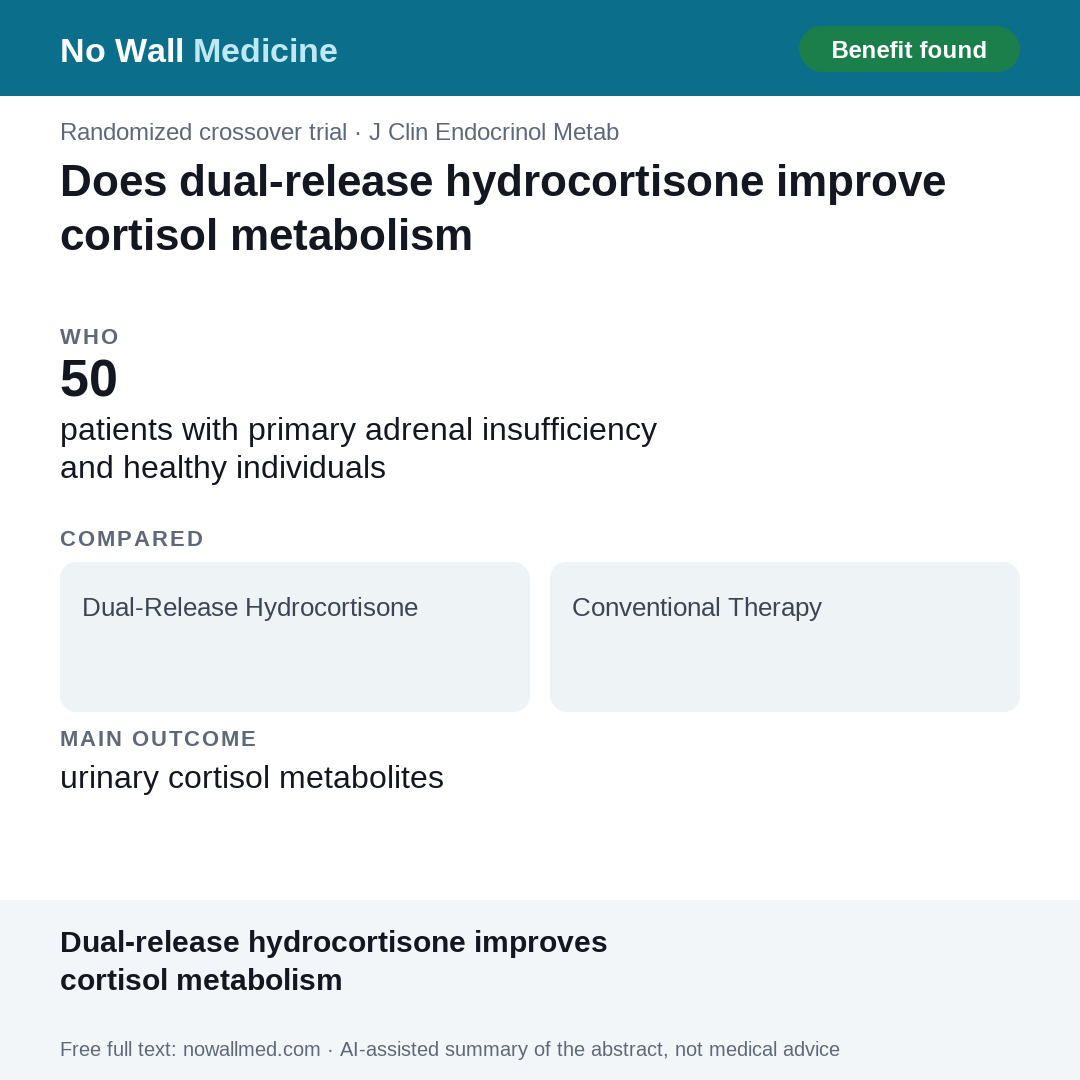
Does dual-release hydrocortisone improve cortisol metabolism
Who
50
patients with primary adrenal insufficiency and healthy individuals
Compared
Dual-Release Hydrocortisone
Conventional Therapy
Main outcome
urinary cortisol metabolites
Bottom line: Dual-release hydrocortisone improves cortisol metabolism
J Clin Endocrinol Metab · 2020-11-26Download image
Abstract
Context
Oral once-daily dual-release hydrocortisone (DR-HC) replacement therapy has demonstrated an improved metabolic profile compared to conventional 3-times-daily (TID-HC) therapy among patients with primary adrenal insufficiency. This effect might be related to a more physiological cortisol profile, but also to a modified pattern of cortisol metabolism. Objective
This work aimed to study cortisol metabolism during DR-HC and TID-HC. Design
A randomized, 12-week, crossover study was conducted. Intervention and participants
DC-HC and same daily dose of TID-HC were administered to patients with primary adrenal insufficiency (n = 50) vs healthy individuals (n = 124) as controls. Main outcome measures
Urinary corticosteroid metabolites were measured by gas chromatography/mass spectrometry at 24-hour urinary collections. Results
Total cortisol metabolites decreased during DR-HC compared to TID-HC (P < .001) and reached control values (P = .089). During DR-HC, 11β-hydroxysteroid dehydrogenase type 1 (11β-HSD1) activity measured by tetrahydrocortisol + 5α-tetrahydrocortisol/tetrahydrocortisone ratio was reduced compared to TID-HC (P < .05), but remained increased vs controls (P < .001). 11β-HSD2 activity measured by urinary free cortisone/free cortisol ratio was decreased with TID-HC vs controls (P < .01) but normalized with DR-HC (P = .358). 5α- and 5β-reduced metabolites were decreased with DR-HC compared to TID-HC. Tetrahydrocortisol/5α-tetrahydrocortisol ratio was increased during both treatments, suggesting increased 5β-reductase activity. Conclusions
The urinary cortisol metabolome shows striking abnormalities in patients receiving conventional TID-HC replacement therapy, with increased 11β-HSD1 activity that may account for the unfavorable metabolic phenotype in primary adrenal insufficiency. Its change toward normalization with DR-HC may mediate beneficial metabolic effects. The urinary cortisol metabolome may serve as a tool to assess optimal cortisol replacement therapy.
Subject terms
Cite this article
Espiard S, McQueen J, Sherlock M, Ragnarsson O, Bergthorsdottir R, Burman P. Improved Urinary Cortisol Metabolome in Addison Disease: A Prospective Trial of Dual-Release Hydrocortisone. J Clin Endocrinol Metab. 2020. doi:10.1210/clinem/dgaa862
Spotted a mistake? Suggest a correction
Top studies every Monday
The week’s key trials and guidelines in your specialties, plus any topics you follow. By email, free.
Get the weekly digest