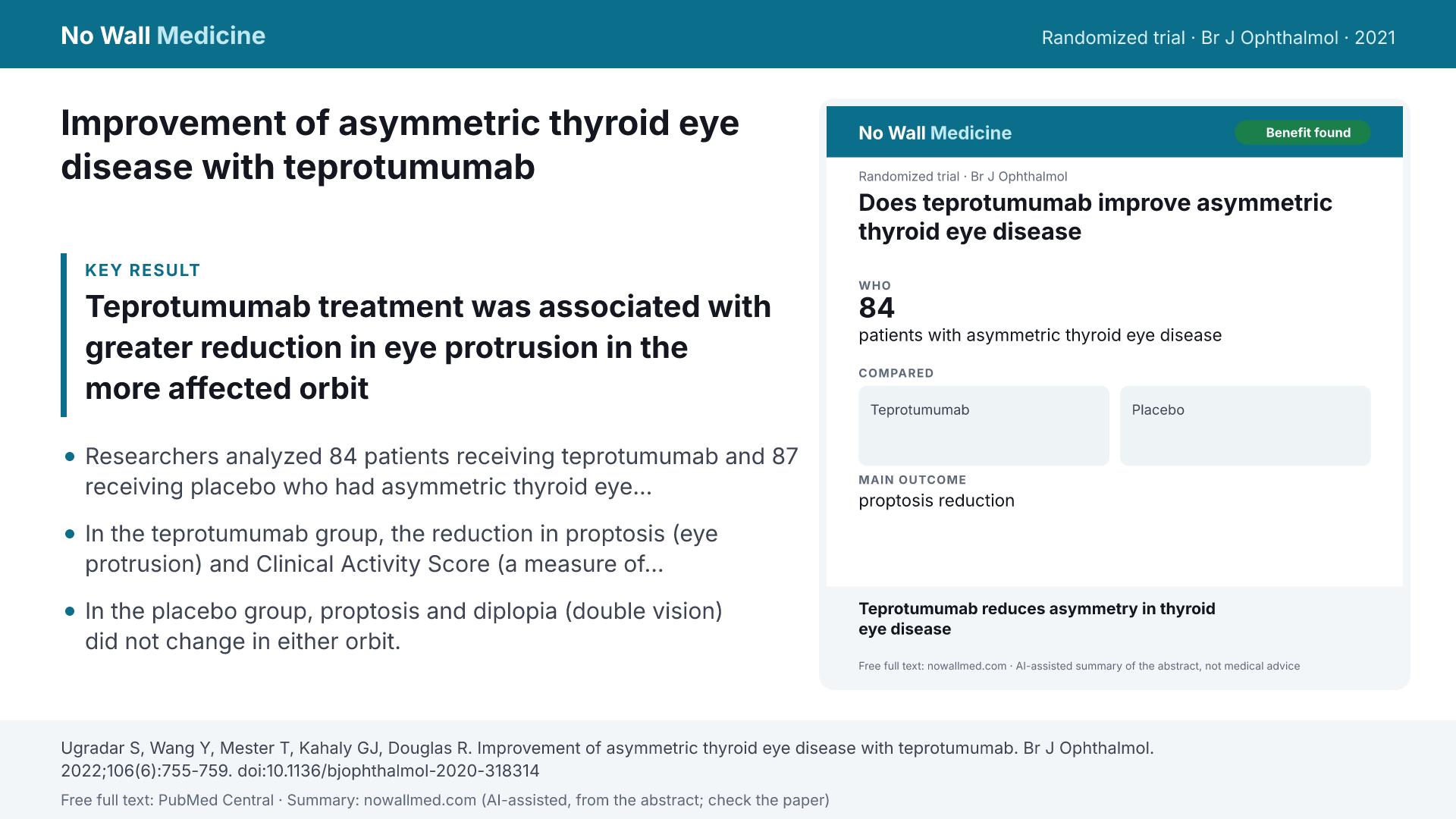
Teprotumumab treatment was associated with greater reduction in eye protrusion in the more affected orbit
Improvement of asymmetric thyroid eye disease with teprotumumab
Randomized trialBenefit found
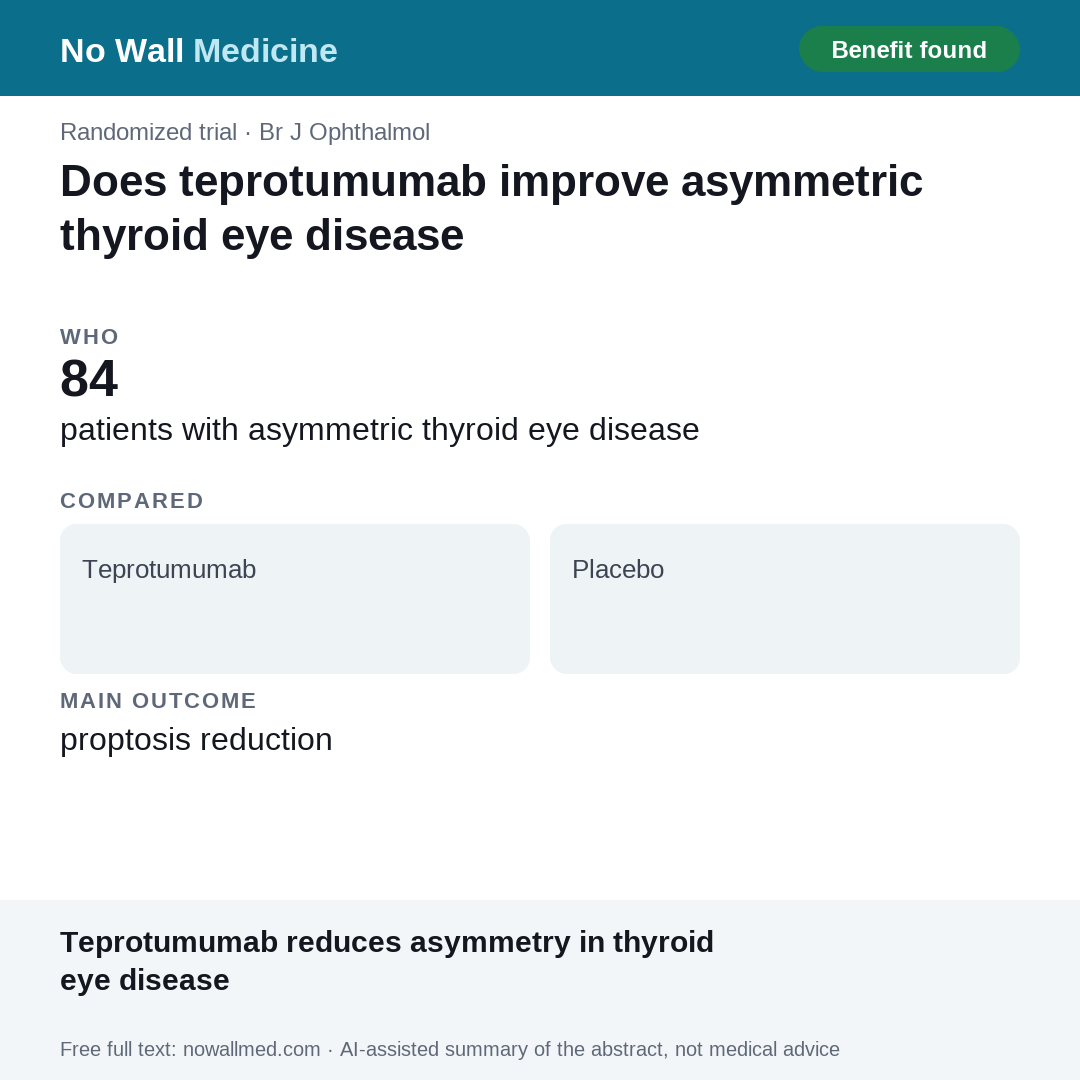
Does teprotumumab improve asymmetric thyroid eye disease
Who
84
patients with asymmetric thyroid eye disease
Compared
Teprotumumab
Placebo
Main outcome
proptosis reduction
Bottom line: Teprotumumab reduces asymmetry in thyroid eye disease
Br J Ophthalmol · 2021-02-12Download image
Why it matters: It was unknown if teprotumumab would demonstrate greater efficacy in the more severely affected orbit of patients with asymmetric thyroid eye disease.
Key points
- Researchers analyzed 84 patients receiving teprotumumab and 87 receiving placebo who had asymmetric thyroid eye disease, defined as a difference in eye protrusion of ≥3 mm.
- In the teprotumumab group, the reduction in proptosis (eye protrusion) and Clinical Activity Score (a measure of disease activity) was significantly greater in the worse affected orbit.
- In the placebo group, proptosis and diplopia (double vision) did not change in either orbit.
Headline and key points written with AI from the paper’s abstract, with every number checked against it. Read the paper before relying on them.
Was this summary helpful?
Abstract
Purpose
Teprotumumab, a specific blocking antibody to the insulin like growth factor 1 receptor, significantly reduced proptosis in patients with thyroid eye disease (TED) in recent clinical trials. Given its specificity, we expect it to demonstrate greater efficacy on the worse affected orbit, in patients with asymmetric TED. Herein, we investigate the differential impact of teprotumumab on the orbits of such patients. Methods
In this pooled analysis of patients who were enrolled in the recent phase 2 (NCT01868997) and phase 3 (NCT03298867) trials, all patients with asymmetric TED (difference in exophthalmometry of ≥3 mm) were screened for eligibility. The primary outcomes of the trials, proptosis, diplopia and Clinical Activity Score (CAS) response, were evaluated in both orbits of patients who had received treatment or placebo, to examine the differential response from baseline to week 24. Results
From a pooled group of 84 patients randomised to receive teprotumumab and 87 randomised to placebo, 10 (12%) and 12 (14%), respectively, met the inclusion criteria. The teprotumumab-treated patients demonstrated significant reductions in proptosis, CAS and diplopia in both orbits of each patient and this was not seen with placebo. The reduction in proptosis and CAS was significantly greater in the worse affected orbit, improving symmetry. In the placebo arm, while the mean CAS in the study eye reduced over time, proptosis and diplopia did not change in either orbit. Conclusion
The findings in this study suggest the differential impact of teprotumumab on orbits that are clinically more affected by TED, suggesting that teprotumumab reduces asymmetry.
Abstract reproduced under the article’s CC BY NC licence.
Subject terms
Cite this article
Ugradar S, Wang Y, Mester T, Kahaly GJ, Douglas R. Improvement of asymmetric thyroid eye disease with teprotumumab. Br J Ophthalmol. 2021. doi:10.1136/bjophthalmol-2020-318314
Spotted a mistake? Suggest a correction