Improvement of asymmetric thyroid eye disease with teprotumumab
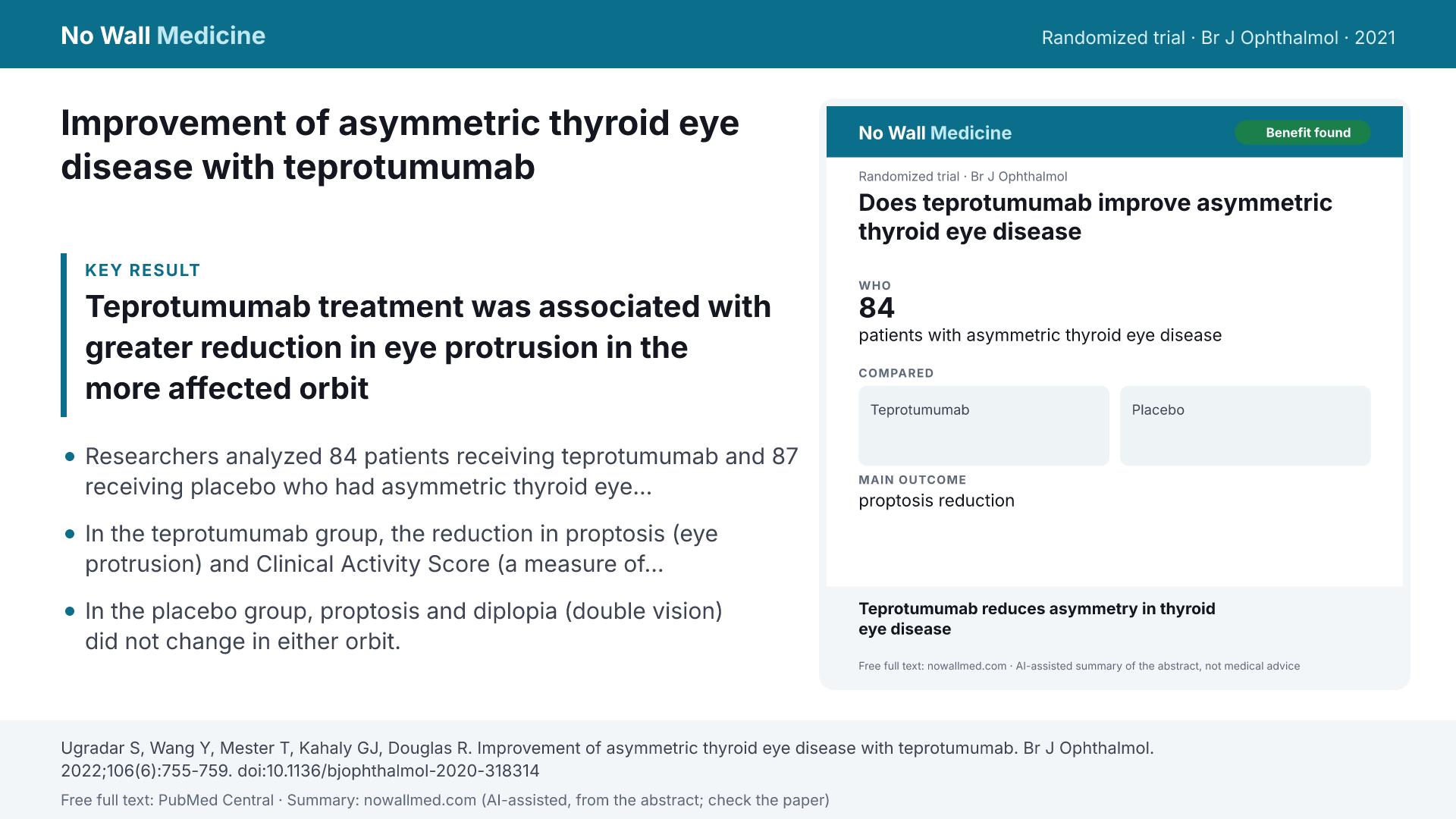
Key result: Teprotumumab treatment was associated with greater reduction in eye protrusion in the more affected orbit
Randomized trialBenefit found
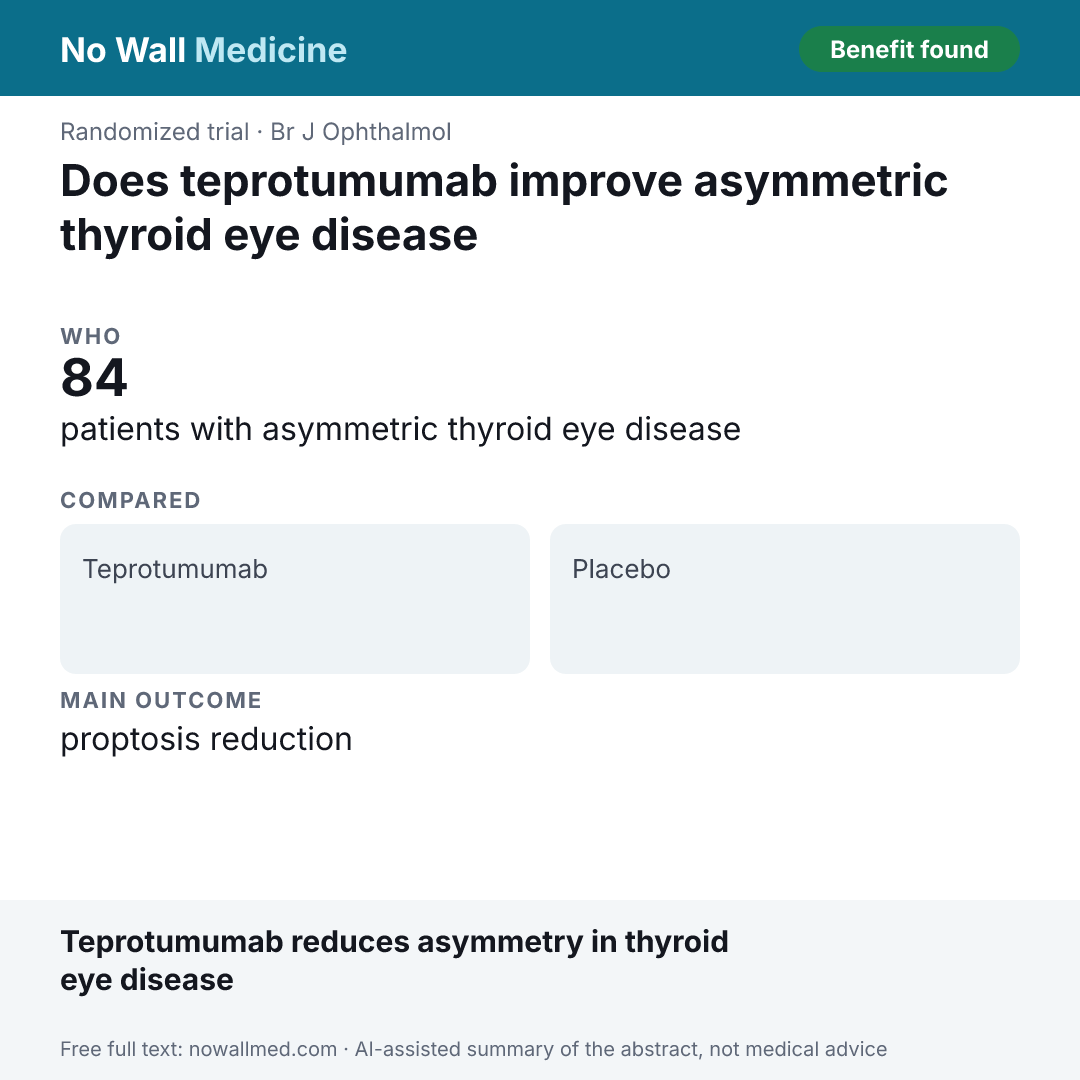
Does teprotumumab improve asymmetric thyroid eye disease
Who
84
patients with asymmetric thyroid eye disease
Compared
Teprotumumab
Placebo
Main outcome
proptosis reduction
Bottom line: Teprotumumab reduces asymmetry in thyroid eye disease
Br J Ophthalmol · 2021-02-12 · Save PNG
Key points
- Researchers analyzed 84 patients receiving teprotumumab and 87 receiving placebo who had asymmetric thyroid eye disease, defined as a difference in eye protrusion of ≥3 mm.
- In the teprotumumab group, the reduction in proptosis (eye protrusion) and Clinical Activity Score (a measure of disease activity) was significantly greater in the worse affected orbit.
- In the placebo group, proptosis and diplopia (double vision) did not change in either orbit.
Discussion prompts
- Would these patients look like yours? Who was left out?
- Is the main outcome one that matters to patients?
- Is the difference large enough to change what you do?
Cite: Ugradar S, Wang Y, Mester T, Kahaly GJ, Douglas R. Improvement of asymmetric thyroid eye disease with teprotumumab. Br J Ophthalmol. 2022;106(6):755-759. doi:10.1136/bjophthalmol-2020-318314
Free full text: PubMed Central · Summary and visual abstract: nowallmed.com/a/improvement-of-asymmetric-thyroid-eye-disease-with-1yno4ts/ (AI-assisted from the abstract; check the paper before relying on it).