Medium-chain triglyceride supplementation improved quality of life and pain in rheumatoid arthritis patients
Improvements in quality-of-life dimensions through medium-chain triglyceride (MCT) supplementation in rheumatoid arthritis: updated findings from a randomised clinical trial
Randomised, double-blind, placebo-controlled clinical trialBenefit found
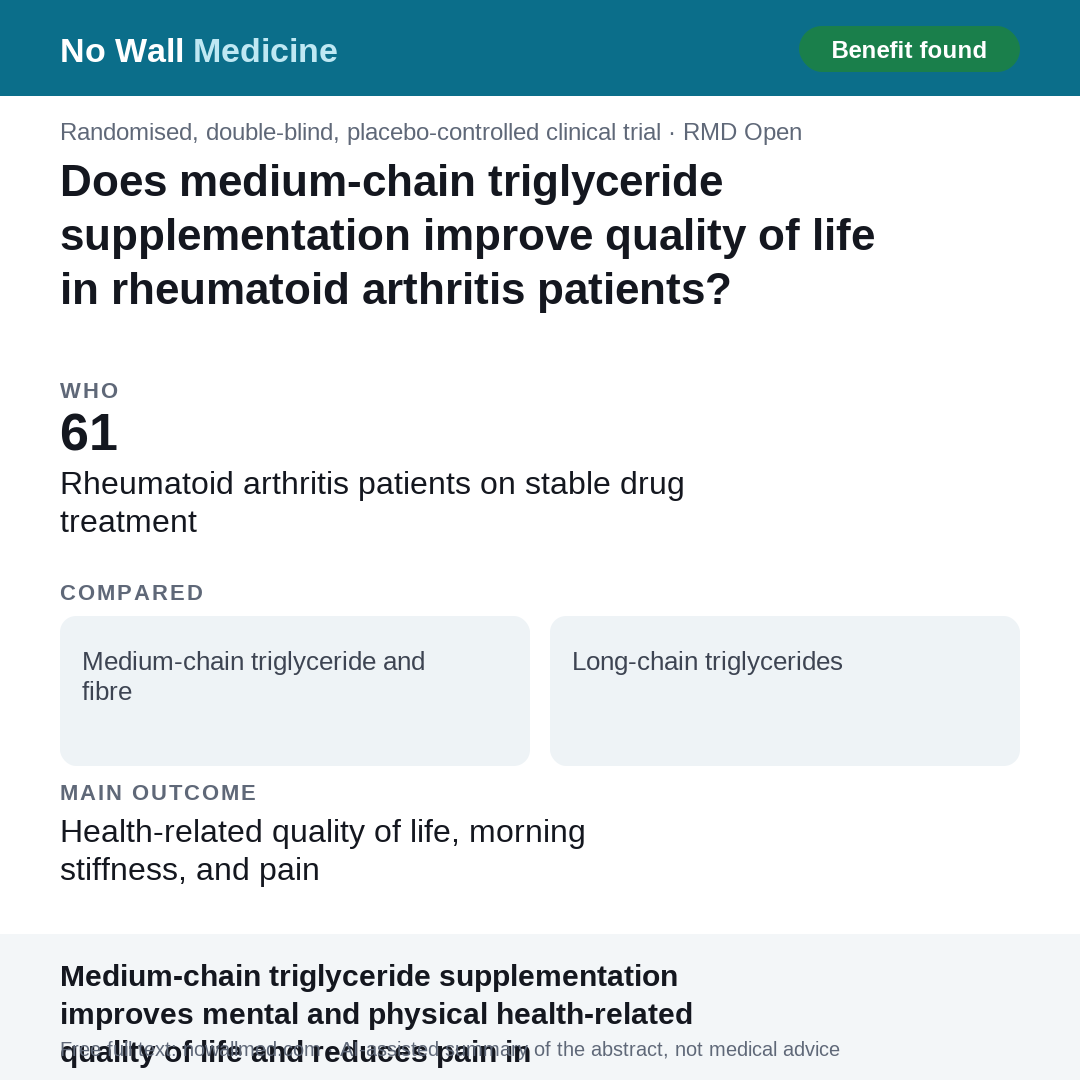
Does medium-chain triglyceride supplementation improve quality of life in rheumatoid arthritis patients?
Who
61
Rheumatoid arthritis patients on stable drug treatment
Compared
Medium-chain triglyceride and fibre
Long-chain triglycerides
Main outcome
Health-related quality of life, morning stiffness, and pain
Bottom line: Medium-chain triglyceride supplementation improves mental and physical health-related quality of life and reduces pain in rheumatoid arthritis.
RMD Open · 2026-02-16Download image
Clinical question: Does medium-chain triglyceride supplementation improve quality of life in rheumatoid arthritis patients?
Why it matters: It is unclear how non-pharmacological approaches like medium-chain triglyceride supplementation might impact quality of life and pain in patients with rheumatoid arthritis.
Key points
- Researchers studied 61 patients with rheumatoid arthritis who received either medium-chain triglycerides or long-chain triglycerides over 16 weeks.
- The medium-chain triglyceride group showed significant improvements in mental and physical health scores, vitality, and motivation compared to the control group.
- Supplementation with medium-chain triglycerides also significantly reduced the intensity and duration of morning stiffness and pain intensity by week 16.
Headline and key points written with AI from the paper’s abstract, with every number checked against it. Read the paper before relying on them.
Abstract
Objective
To assess the impact of medium-chain triglycerides (MCTs) and fibre on health-related quality of life (QOL), morning stiffness and pain in rheumatoid arthritis (RA) patients. Methods
A randomised, double-blind, placebo-controlled clinical trial enrolled 61 RA patients on stable drug treatment. Participants received twice-daily MCT supplementation (30 g/day) for 8 weeks, followed by 8 weeks of MCTs (30 g/day) combined with fibre (30 g/day). The control group received the same supplementation as the test group, with long-chain triglycerides instead of MCTs. QOL parameters, morning stiffness, pain intensity and lipid profile were assessed at baseline (T0), week 8 (T2) and week 16 (T4). Results
After 16 weeks, the test group showed statistically and clinically significant improvements both in mental and physical health-related scores. MCT consumption significantly ameliorated mental health, emotional well-being, social behaviour and vitality (measured using 36-Item Short Form Survey) from baseline to T4 and relative to control. An increased motivation, as assessed with the Multidimensional Fatigue Inventory-20 questionnaire, was reported as well. Regular intake of MCTs significantly reduced the intensity and duration of morning stiffness and pain intensity (assessed using the Visual Analogue Scale) from baseline to T4 compared with control group. Reported effects were maintained after adding fibre to supplementation. Baseline blood lipid profile showed no significant differences. Conclusions
Patients with RA supplemented with MCTs obtained significant improvements in several health-related QOL components compared to control, and fibre inclusion did not interfere with MCT efficacy. These results underscore the importance of targeted non-pharmacological approaches integrated to drug therapy in managing patients with RA. Trial registration number
DRKS00025413.
Abstract reproduced under the article’s CC BY NC licence.
Topics
Cite this article
Gaudioso G, Zanon P, Ciani S, Reuss-Borst M. Improvements in quality-of-life dimensions through medium-chain triglyceride (MCT) supplementation in rheumatoid arthritis: updated findings from a randomised clinical trial. RMD Open. 2026. doi:10.1136/rmdopen-2025-006036
Spotted a mistake? Suggest a correction