Counseling and education were associated with better outcomes across the tuberculosis care cascade
Improving cascade outcomes for active TB: A global systematic review and meta-analysis of TB interventions
Systematic review and meta-analysisBenefit found
What is the impact of various interventions on active tuberculosis care cascade outcomes?
Who
Patients with active tuberculosis · Global, mostly low and middle income countries
Compared
Interventions (e.g. counseling, incentives, community-based)
Standard of care
Main outcome
Tuberculosis care cascade outcomes
Bottom line: Counseling, education, incentives, and community-based interventions significantly improve multiple tuberculosis care cascade outcomes.
Limitation: Did not measure gaps in pre-testing, pretreatment, and post-treatment outcomes.
PLOS Med · 2023-01-03Download image
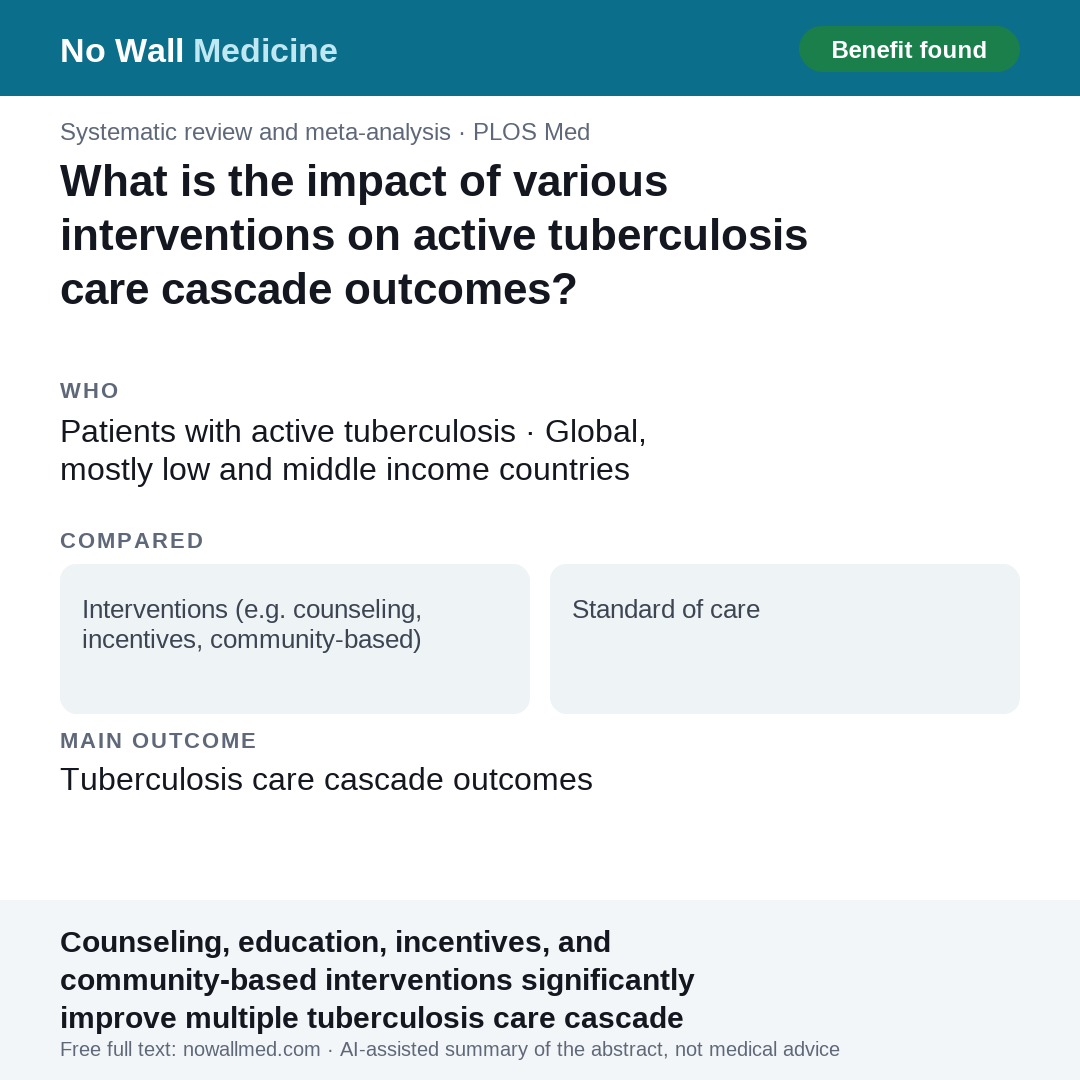
Clinical question: What is the impact of various interventions on active tuberculosis care cascade outcomes?
Why it matters: It was unknown which specific interventions most effectively improve the various stages of the tuberculosis care cascade from diagnosis to successful treatment.
Key points
- Researchers analyzed 144 studies, including 84 randomized controlled trials, to evaluate how different interventions affect the tuberculosis care cascade.
- Counseling and education was associated with higher odds of testing (OR = 8.82), diagnosis (OR = 1.44), linkage to care (OR = 3.10), cure (OR = 2.08), treatment completion (OR = 1.48), and treatment success (OR = 3.24).
- Incentives, multisector collaborations, and community-based interventions were associated with at least three different tuberculosis care cascade outcomes.
Limitation the authors note: The study did not measure gaps in pre-testing, pretreatment, and post-treatment outcomes such as loss to follow-up and tuberculosis recurrence.
Headline and key points written with AI from the paper’s abstract, with every number checked against it. Read the paper before relying on them.
Was this summary helpful?
Subject terms
Cite this article
Marley G, Zou X, Nie J, Cheng W, Xie Y, Liao H. Improving cascade outcomes for active TB: A global systematic review and meta-analysis of TB interventions. PLOS Med. 2023. doi:10.1371/journal.pmed.1004091
Spotted a mistake? Suggest a correction
Top studies every Monday
The week’s key trials and guidelines in your specialties, plus any topics you follow. By email, free.
Get the weekly digest