Physical and digital calendars did not improve accuracy of reported death dates in Guinea-Bissau
Improving retrospective data on recent household deaths: a multi-arm randomized trial in Guinea-Bissau
Public & Global HealthAdult and pediatric
Multi-arm randomized trialNo clear difference
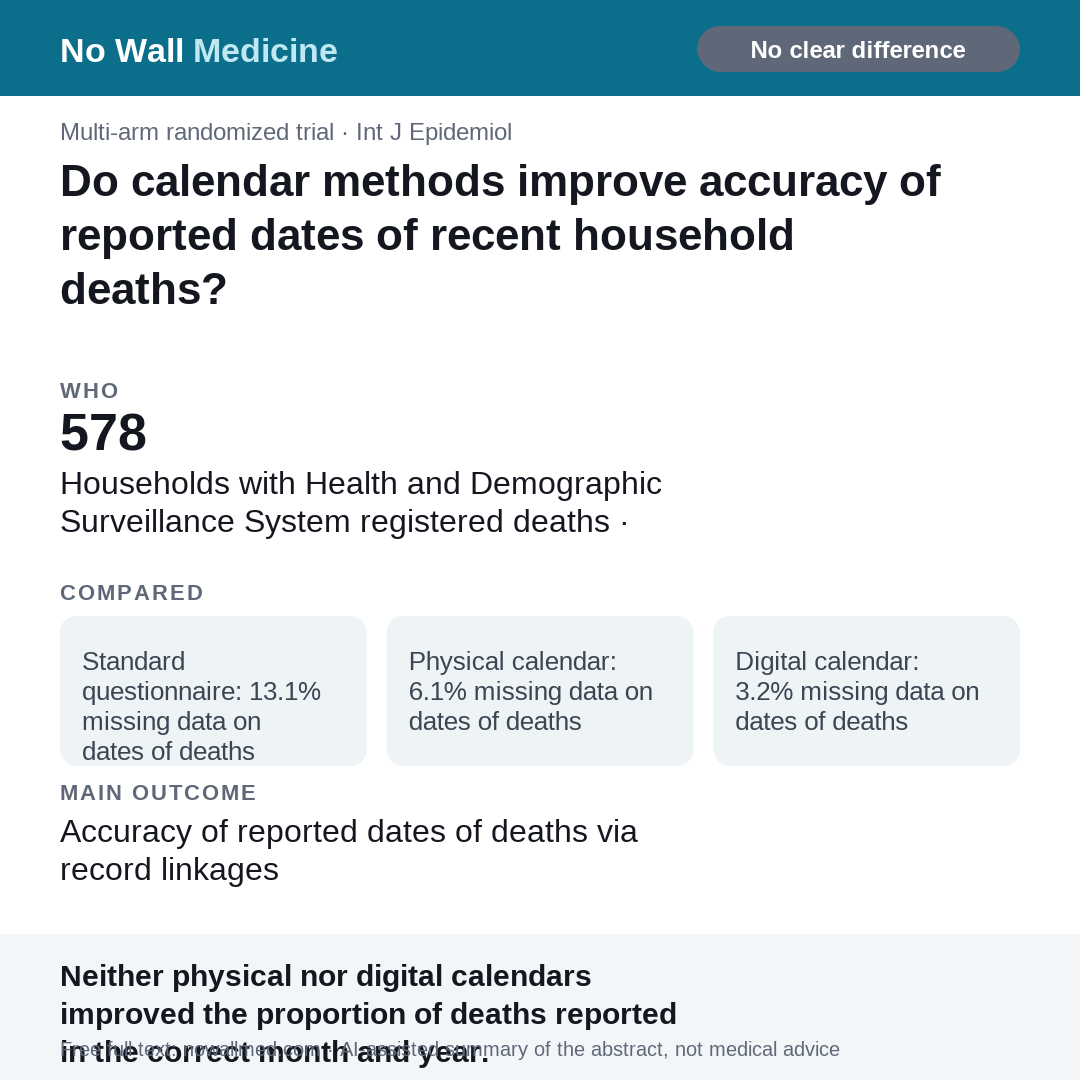
Do calendar methods improve accuracy of reported dates of recent household deaths?
Who
578
Households with Health and Demographic Surveillance System registered deaths · Guinea-Bissau
Compared
Standard questionnaire: 13.1% missing data on dates of deaths
Physical calendar: 6.1% missing data on dates of deaths
Digital calendar: 3.2% missing data on dates of deaths
Main outcome
Accuracy of reported dates of deaths via record linkages
Bottom line: Neither physical nor digital calendars improved the proportion of deaths reported in the correct month and year.
Int J Epidemiol · 2025-02-24Download image
Clinical question: Do calendar methods improve accuracy of reported dates of recent household deaths?
Why it matters: It is unknown if using physical or digital calendars of local events improves the accuracy of retrospective mortality data in areas with limited vital statistics systems.
Key points
- Researchers randomized 578 households in Guinea-Bissau to compare standard questionnaires with those using physical or digital calendars of local events to report recent deaths.
- Neither the physical nor digital calendar improved the proportion of deaths reported in the same month and year as recorded in surveillance data compared to standard questionnaires.
- Physical and digital calendars were associated with less missing data on death dates, at 6.1% and 3.2% respectively, compared to 13.1% for the standard questionnaire.
Headline and key points written with AI from the paper’s abstract, with every number checked against it. Read the paper before relying on them.
Topics
Cite this article
Torrisi O, Fisker AB, Fernandes DAA, Helleringer S. Improving retrospective data on recent household deaths: a multi-arm randomized trial in Guinea-Bissau. Int J Epidemiol. 2025. doi:10.1093/ije/dyaf009
Spotted a mistake? Suggest a correction
Top studies every Monday
The week’s key trials and guidelines in your specialties, by email. Free.
Get the weekly digest