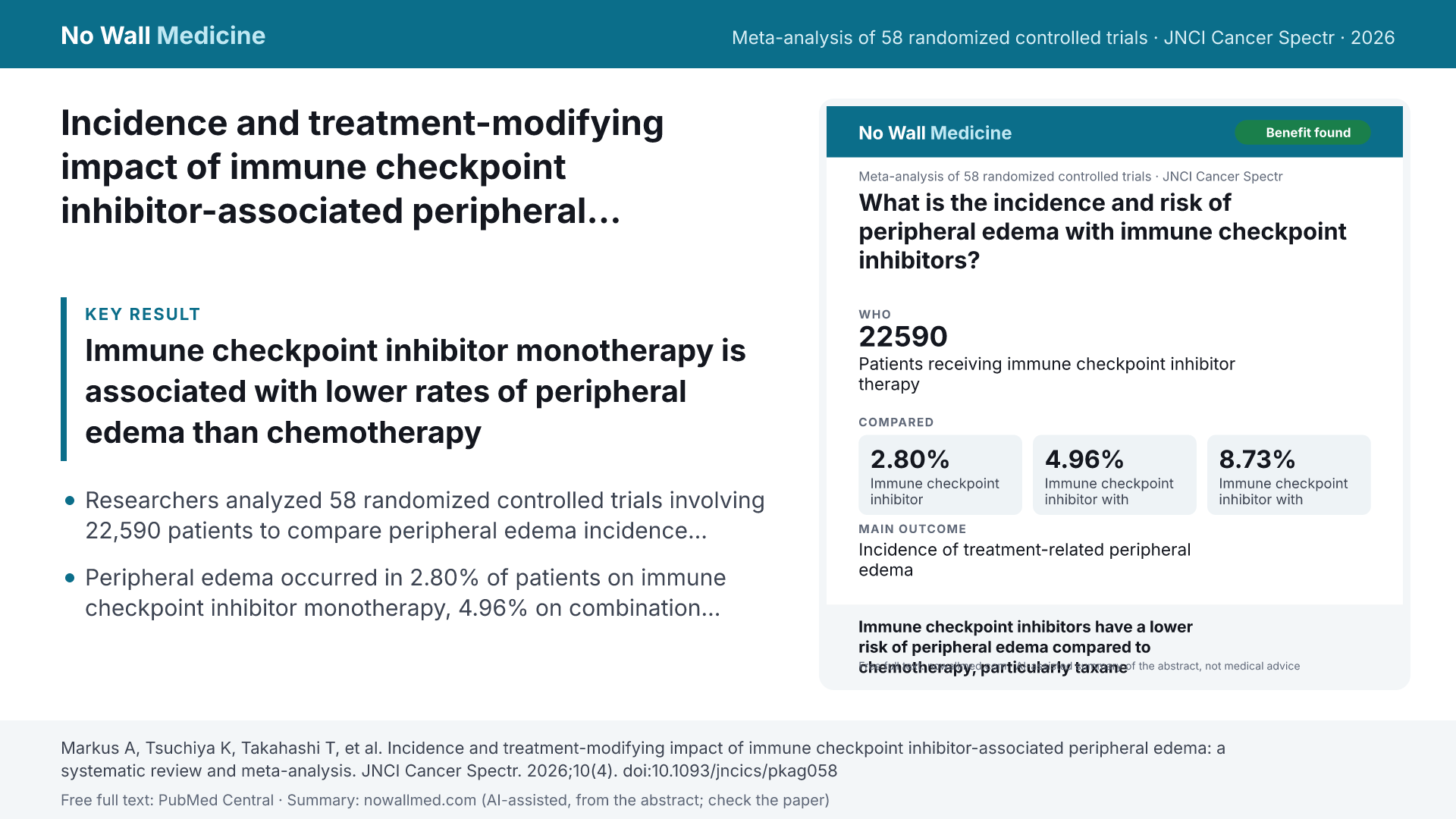
Immune checkpoint inhibitor monotherapy is associated with lower rates of peripheral edema than chemotherapy
Incidence and treatment-modifying impact of immune checkpoint inhibitor-associated peripheral edema: a systematic review and meta-analysis
Meta-analysis of 58 randomized controlled trialsBenefit found
What is the incidence and risk of peripheral edema with immune checkpoint inhibitors?
Who
22590
Patients receiving immune checkpoint inhibitor therapy
Compared
2.80%Immune checkpoint inhibitor monotherapy (n = 195 of 6969)
4.96%Immune checkpoint inhibitor with chemotherapy (n = 112 of 2257)
8.73%Immune checkpoint inhibitor with targeted therapy (n = 205 of 2349)
Main outcome
Incidence of treatment-related peripheral edema
Result: OR = 0.45, 95% CI = 0.27 to 0.73
Bottom line: Immune checkpoint inhibitors have a lower risk of peripheral edema compared to chemotherapy, particularly taxane chemotherapy.
JNCI Cancer Spectr · 2026-06-03 · Save PNG

Clinical question: What is the incidence and risk of peripheral edema with immune checkpoint inhibitors?
Why it matters: It is often unclear if peripheral edema, or swelling in the limbs, is caused by immune checkpoint inhibitors or other drugs in multidrug regimens.
Key points
- Researchers analyzed 58 randomized controlled trials involving 22,590 patients to compare peripheral edema incidence across different cancer treatment patterns.
- Peripheral edema occurred in 2.80% of patients on immune checkpoint inhibitor monotherapy, 4.96% on combination with chemotherapy, and 8.73% on combination with targeted therapy.
- A review of 40 patients showed that 82.5% received glucocorticoid treatment and 35% permanently discontinued their immune checkpoint inhibitor therapy.
Headline and key points written with AI from the paper’s abstract, with every number checked against it. Read the paper before relying on them.
Was this summary helpful?
Subject terms
Headline, design, result, key points, caveat and citation as plain text.
Cite this article
Markus A, Tsuchiya K, Takahashi T, et al. Incidence and treatment-modifying impact of immune checkpoint inhibitor-associated peripheral edema: a systematic review and meta-analysis. JNCI Cancer Spectr. 2026;10(4). doi:10.1093/jncics/pkag058
Spotted a mistake? Suggest a correction