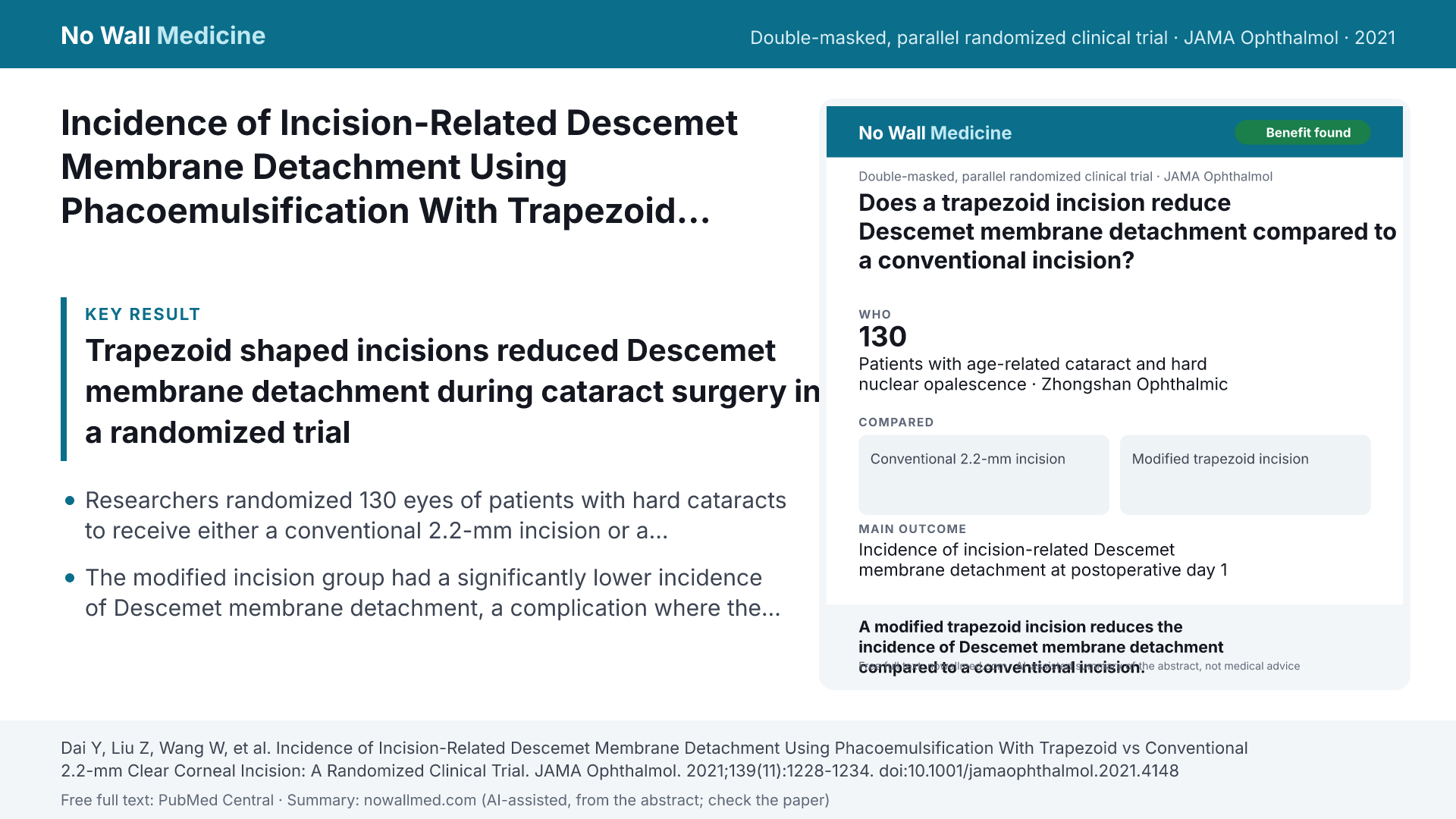
Trapezoid shaped incisions reduced Descemet membrane detachment during cataract surgery in a randomized trial
Incidence of Incision-Related Descemet Membrane Detachment Using Phacoemulsification With Trapezoid vs Conventional 2.2-mm Clear Corneal Incision: A Randomized Clinical Trial
Double-masked, parallel randomized clinical trialBenefit found
Does a trapezoid incision reduce Descemet membrane detachment compared to a conventional incision?
Who
130
Patients with age-related cataract and hard nuclear opalescence · Zhongshan Ophthalmic Center, Guangzhou, China
Compared
Conventional 2.2-mm incision
Modified trapezoid incision
Main outcome
Incidence of incision-related Descemet membrane detachment at postoperative day 1
Result: difference, 26.15 (95% CI, 9.60-42.71)
Bottom line: A modified trapezoid incision reduces the incidence of Descemet membrane detachment compared to a conventional incision.
JAMA Ophthalmol · 2021-10-15 · Save PNG
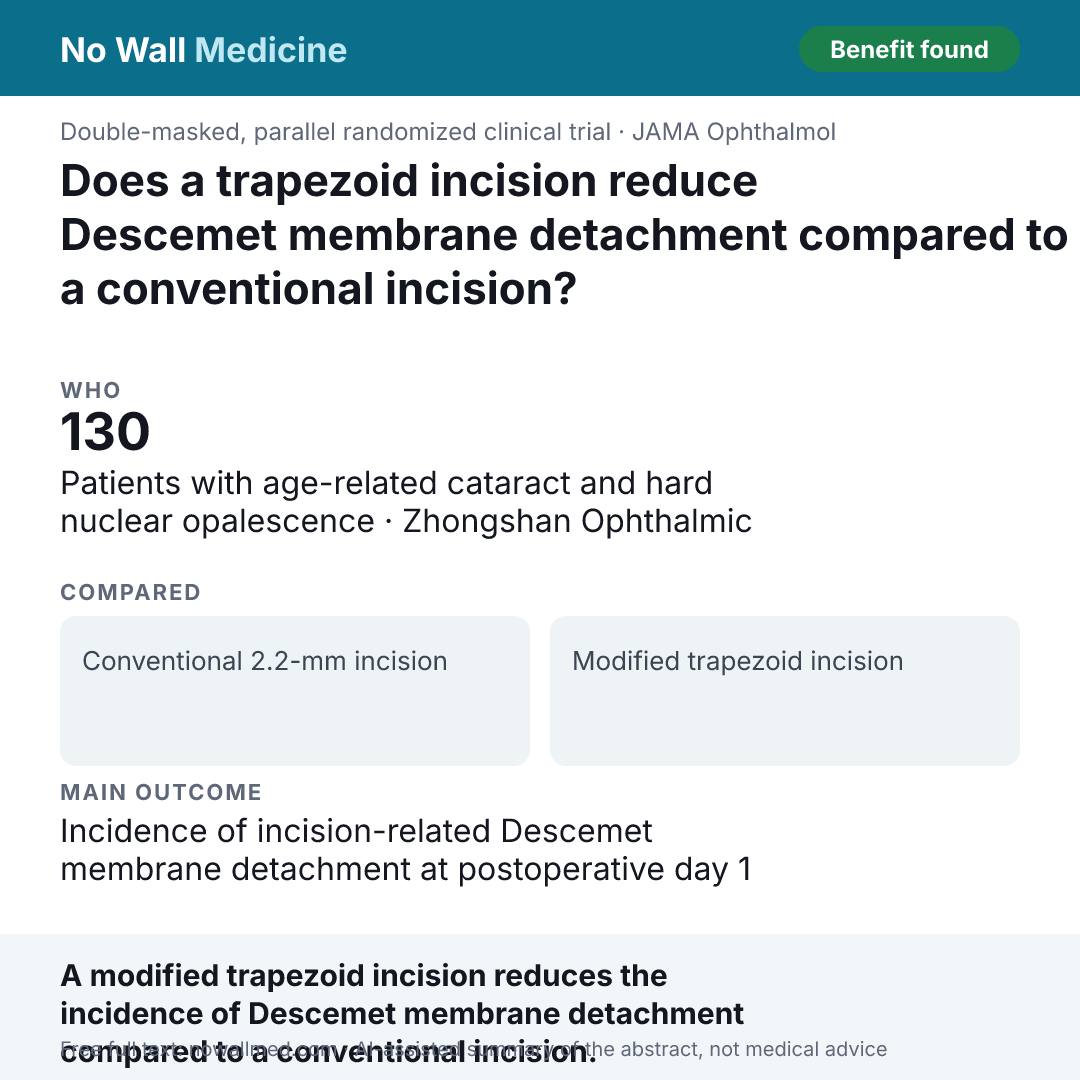
Clinical question: Does a trapezoid incision reduce Descemet membrane detachment compared to a conventional incision?
Why it matters: Conventional narrow incisions may cause friction with surgical instruments, potentially increasing the risk of Descemet membrane detachment during cataract surgery.
Key points
- Researchers randomized 130 eyes of patients with hard cataracts to receive either a conventional 2.2-mm incision or a modified trapezoid incision during phacoemulsification, which is ultrasound-based cataract removal.
- The modified incision group had a significantly lower incidence of Descemet membrane detachment, a complication where the inner corneal layer separates, at postoperative day 1 compared to the conventional group.
- The modified incision group also showed lower maximal corneal thickness at the incision site and higher visual quality modulation transfer function at postoperative day 1.
Headline and key points written with AI from the paper’s abstract, with every number checked against it. Read the paper before relying on them.
Was this summary helpful?
Subject terms
Headline, design, result, key points, caveat and citation as plain text.
Cite this article
Dai Y, Liu Z, Wang W, et al. Incidence of Incision-Related Descemet Membrane Detachment Using Phacoemulsification With Trapezoid vs Conventional 2.2-mm Clear Corneal Incision: A Randomized Clinical Trial. JAMA Ophthalmol. 2021;139(11):1228-1234. doi:10.1001/jamaophthalmol.2021.4148
Spotted a mistake? Suggest a correction