Incisional Hernia After Minimally Invasive Radical Prostatectomy: A Systematic Review
Systematic reviewMixed results
What is the incidence and risk factors of incisional hernia after minimally invasive radical prostatectomy?
Who
56 661
Patients undergoing minimally invasive radical prostatectomy
Compared
Transverse suprapubic extraction
Periumbilical extraction
Main outcome
Incisional hernia proportion
Bottom line: Incisional hernia is a meaningful complication after minimally invasive radical prostatectomy, with extraction site potentially influencing occurrence.
Limitation: Heterogeneity in definitions, follow-up, and risk of bias among included studies.
Eur Urol Open Sci · 2026-09-28Download image
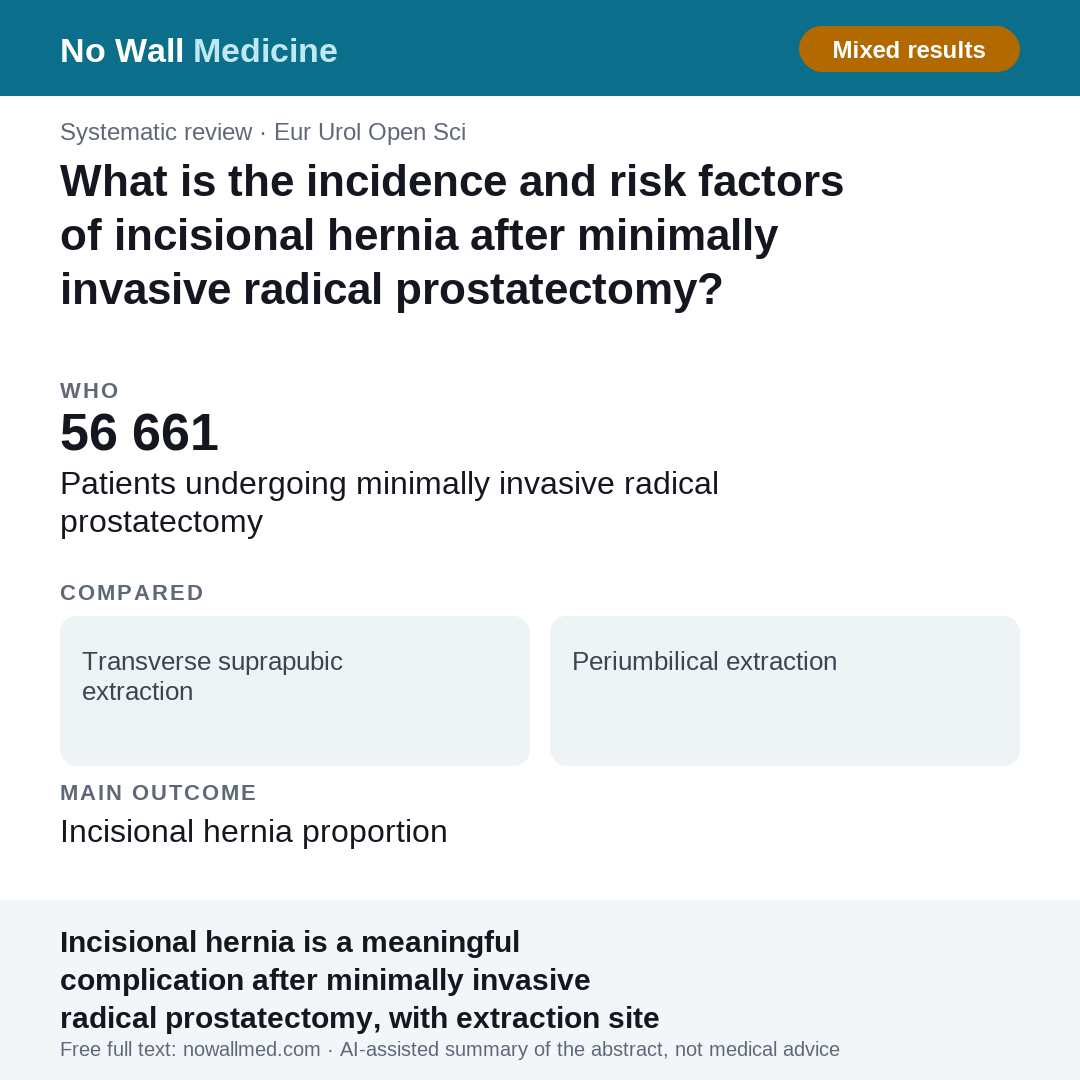
Clinical question: What is the incidence and risk factors of incisional hernia after minimally invasive radical prostatectomy?
Abstract
Purpose
Incisional hernia (IH) is an under-recognized complication after minimally invasive radical prostatectomy (MIRP). Methods
We performed a systematic review according to Preferred Reporting Items for Systematic reviews and Meta-Analyses guidelines to evaluate the proportion, risk factors, and surgical determinants of IH after MIRP. Results
Sixteen studies published between 2010 and 2025 were included, encompassing 56 661 patients. Most were retrospective cohorts, with heterogeneous definitions and diagnostic methods. The reported proportion of IH ranged from 0.04% to 31%, with a median time to diagnosis of 14 mo. Repair was required in up to 80% of cases, and emergency repair in up to 15%. Two comparative studies directly evaluating specimen extraction site consistently reported lower proportions of IH with transverse suprapubic (Pfannenstiel) extraction than with periumbilical extraction, while three registry-based studies similarly reported lower proportions following open compared with MIRP. Evidence regarding the influence of fascial incision orientation on reported IH occurrence was mixed, whereas no clear difference was reported between midline and off-midline extraction sites. Reported factors associated with IH included advanced age, obesity, larger prostate volume, postoperative parietal abscess, and prior abdominal surgery. Limitations include the heterogeneity in the studies included. Conclusions
These findings highlight IH as a clinically meaningful complication of MIRP. Reported IH occurrence differed by specimen extraction site in the available observational studies, but the evidence remains limited by heterogeneous definitions, follow-up, and risk of bias. Preventive strategies, including the site of specimen extraction, warrant further prospective evaluation.
Cite this article
Peyrottes A, Oberlin O, Baboudjian M, Dariane C, Panthier F, Mongiat-Artus P. Incisional Hernia After Minimally Invasive Radical Prostatectomy: A Systematic Review. Eur Urol Open Sci. 2026. doi:10.1016/j.euros.2026.08.002
Spotted a mistake? Suggest a correction