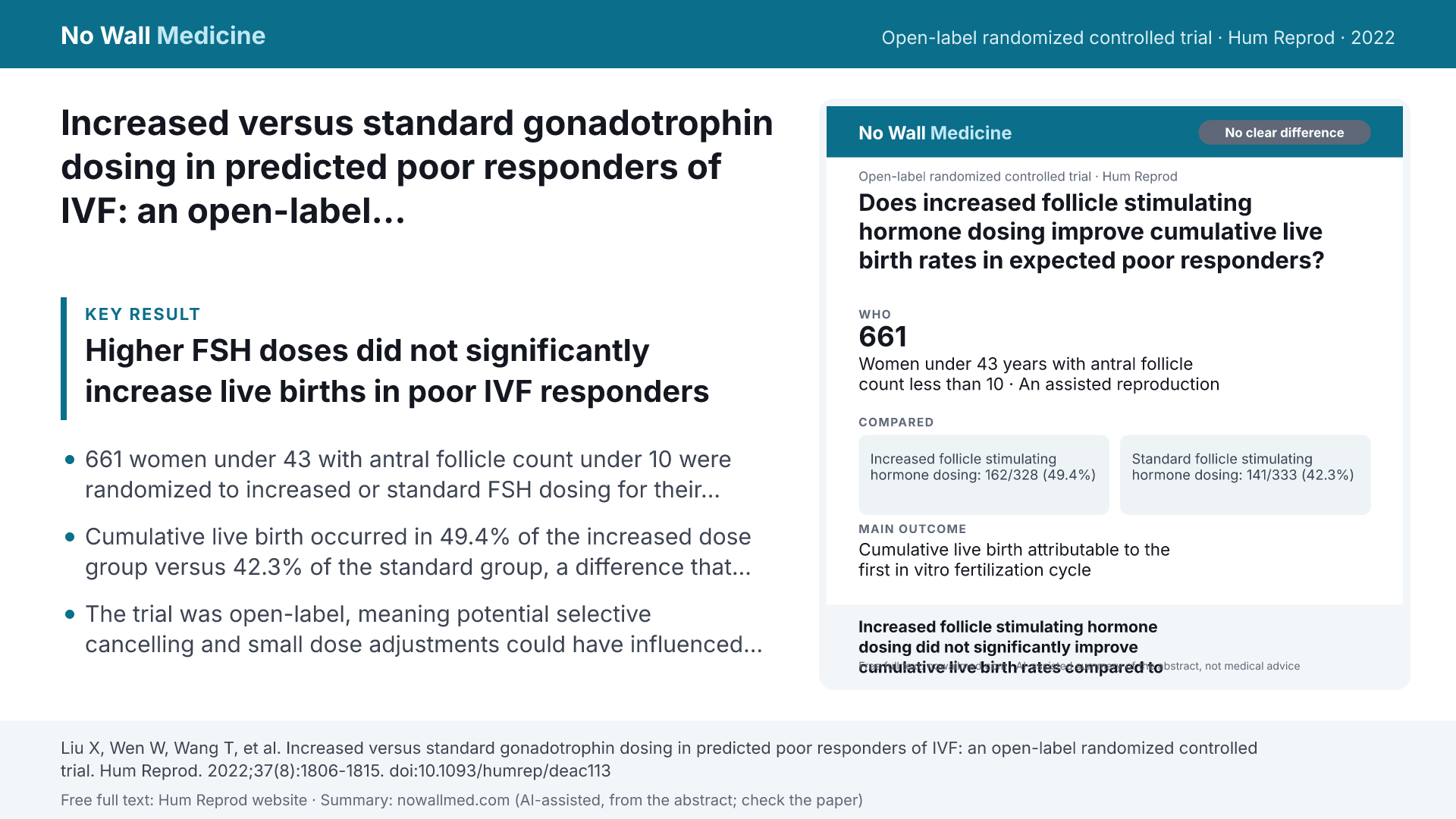
Increased follicle stimulating hormone dosing did not significantly increase live birth rates in predicted poor responders
Increased versus standard gonadotrophin dosing in predicted poor responders of IVF: an open-label randomized controlled trial
Obstetrics & GynecologyAdult and pediatric
Open-label randomized controlled trialNo clear difference
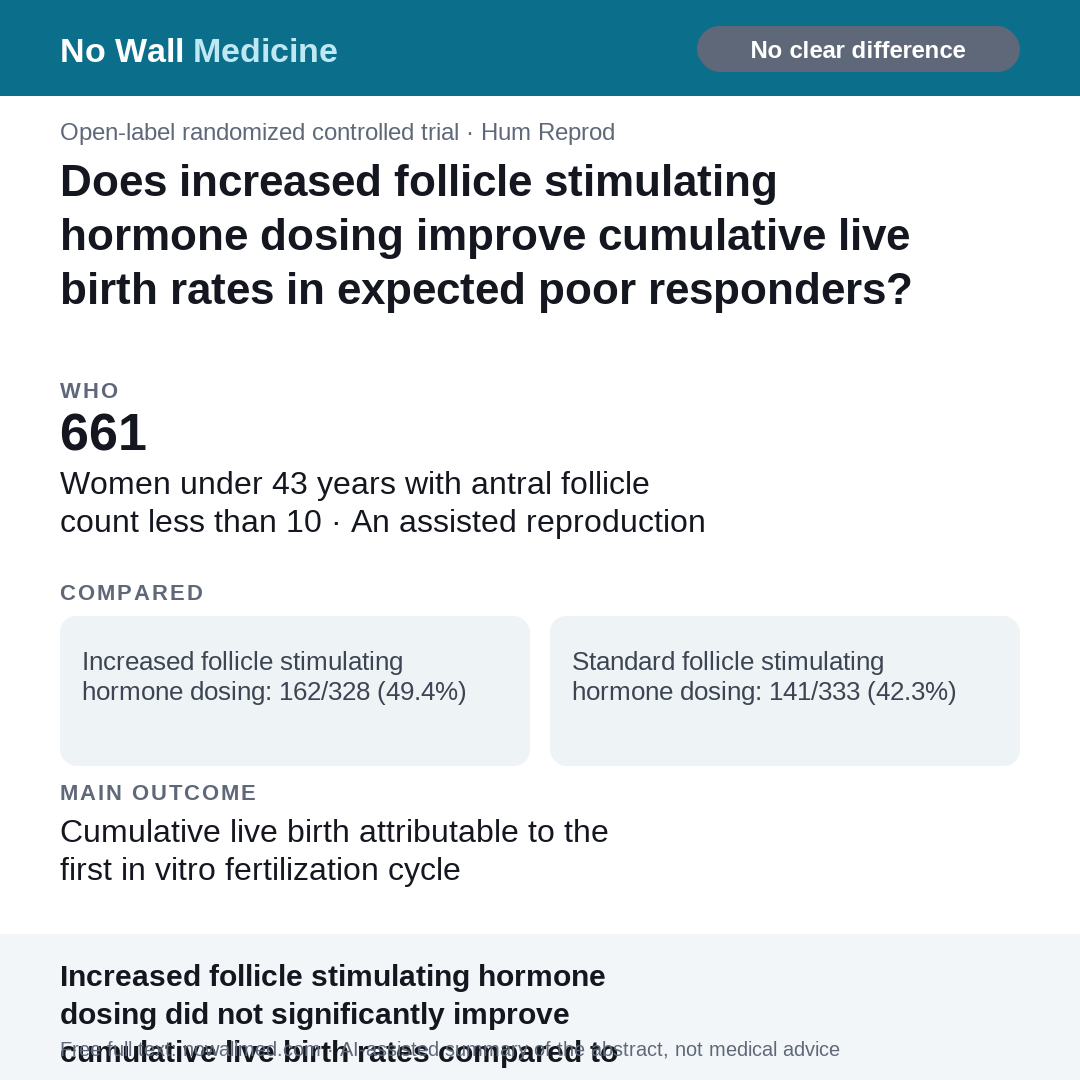
Does increased follicle stimulating hormone dosing improve cumulative live birth rates in expected poor responders?
Who
661
Women under 43 years with antral follicle count less than 10 · An assisted reproduction centre
Compared
Increased follicle stimulating hormone dosing: 162/328 (49.4%)
Standard follicle stimulating hormone dosing: 141/333 (42.3%)
Main outcome
Cumulative live birth attributable to the first in vitro fertilization cycle
Result: risk ratio 1.17 (95% CI, 0.99-1.38)
Bottom line: Increased follicle stimulating hormone dosing did not significantly improve cumulative live birth rates compared to standard dosing in predicted poor responders.
Limitation: The open-label design could have led to potential selective cancelling and small dose adjustments.
Funded by: General Projects of Social Development in Shaanxi Province
Hum Reprod · 2022-05-21Download image
Clinical question: Does increased follicle stimulating hormone dosing improve cumulative live birth rates in expected poor responders?
Why it matters: It is unknown whether increasing the dose of follicle stimulating hormone improves fertility outcomes for women expected to have a poor response to treatment.
Key points
- Researchers randomized 661 women under 43 years of age with an antral follicle count under 10 to receive either increased or standard doses of follicle stimulating hormone.
- Cumulative live births occurred in 49.4% of the increased dosing group compared to 42.3% in the standard group, which was not a statistically significant difference.
- The live birth rate after the first embryo transfer was 38.1% in the increased group versus 35.1% in the standard group.
Limitation the authors note: Because this was an open-label trial, potential selective cancelling and small dose adjustments could have influenced the results.
Headline and key points written with AI from the paper’s abstract, with every number checked against it. Read the paper before relying on them.
Was this summary helpful?
Subject terms
Cite this article
Liu X, Wen W, Wang T, Tian L, Li N, Sun T. Increased versus standard gonadotrophin dosing in predicted poor responders of IVF: an open-label randomized controlled trial. Hum Reprod. 2022. doi:10.1093/humrep/deac113
Spotted a mistake? Suggest a correction