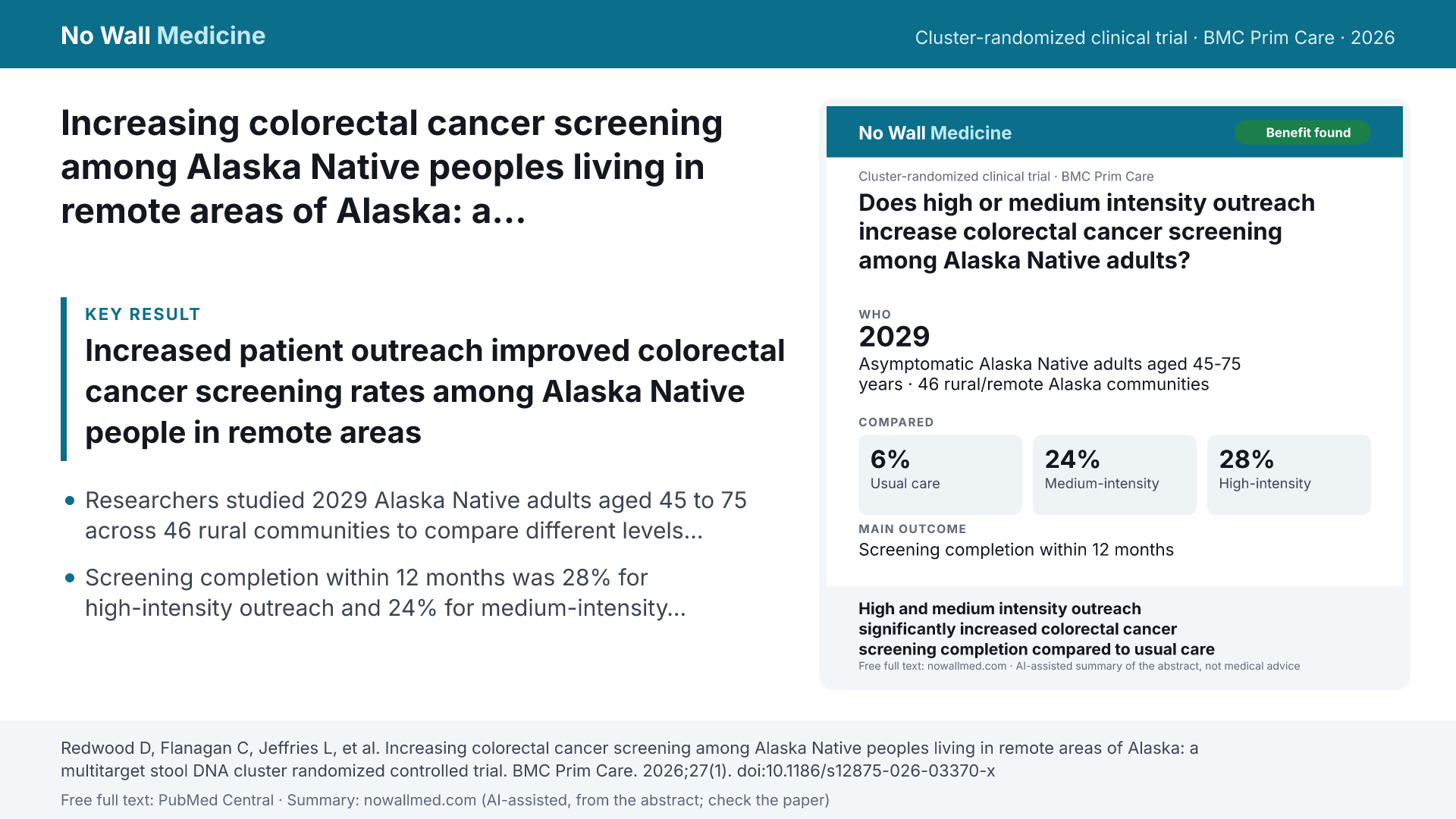
Increased patient outreach improved colorectal cancer screening rates among Alaska Native people in remote areas
Increasing colorectal cancer screening among Alaska Native peoples living in remote areas of Alaska: a multitarget stool DNA cluster randomized controlled trial
Cluster-randomized clinical trialBenefit found
Does high or medium intensity outreach increase colorectal cancer screening among Alaska Native adults?
Who
2029
Asymptomatic Alaska Native adults aged 45-75 years · 46 rural/remote Alaska communities
Compared
6%Usual care
24%Medium-intensity
28%High-intensity
Main outcome
Screening completion within 12 months
Result: odds ratio 5.90 (95% CI, 3.86-9.04) for high-intensity
Bottom line: High and medium intensity outreach significantly increased colorectal cancer screening completion compared to usual care in remote Alaska Native communities.
BMC Prim Care · 2026-05-26 · Save PNG
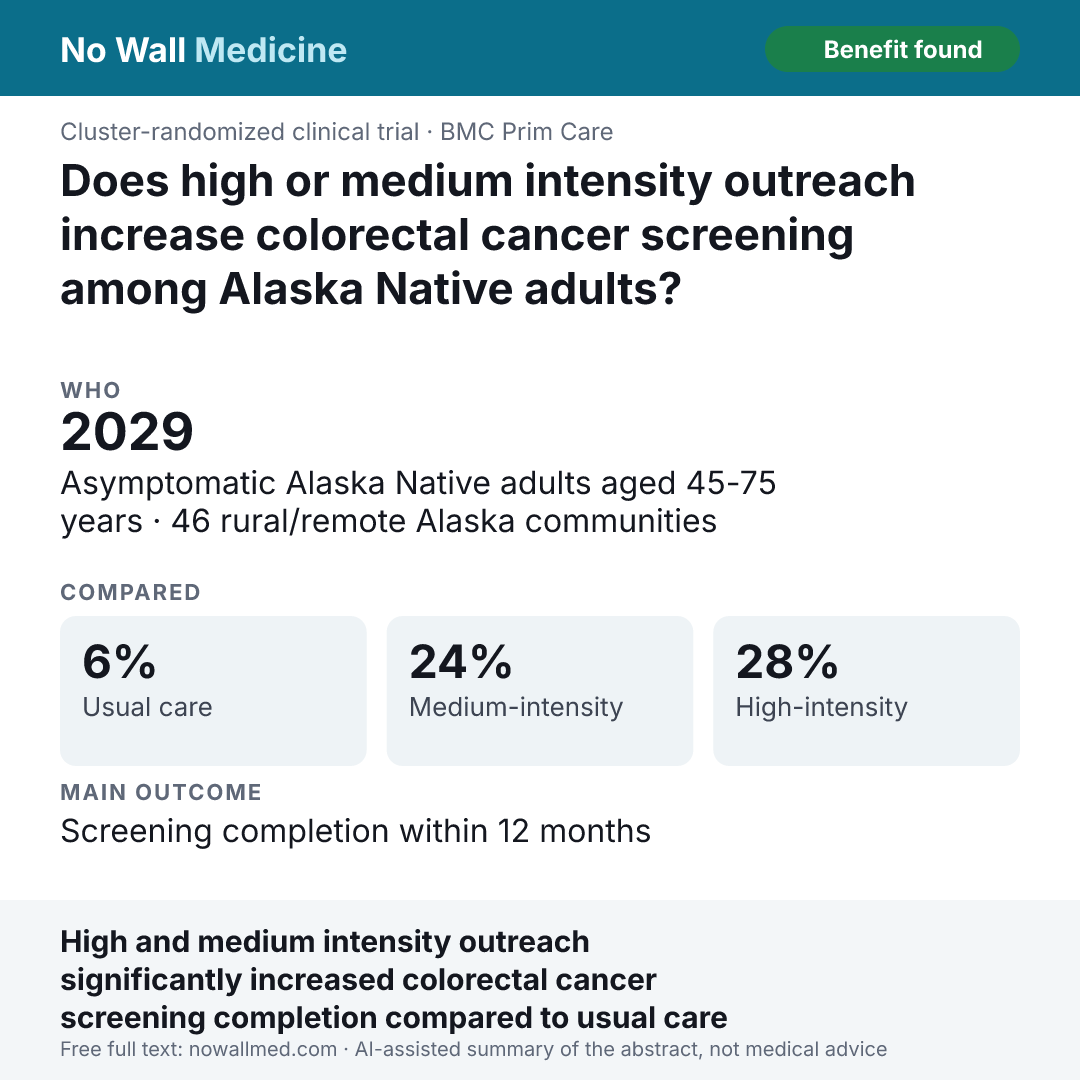
Clinical question: Does high or medium intensity outreach increase colorectal cancer screening among Alaska Native adults?
Why it matters: Increased colorectal cancer screening is needed to address high rates of the disease among Alaska Native populations.
Key points
- Researchers studied 2029 Alaska Native adults aged 45 to 75 across 46 rural communities to compare different levels of patient outreach.
- Screening completion within 12 months was 28% for high-intensity outreach and 24% for medium-intensity outreach compared to 6% for usual care.
- Participants significantly preferred multi-target stool DNA tests, which look for DNA changes in stool, over colonoscopies at a rate of 70% to 30%.
Headline and key points written with AI from the paper’s abstract, with every number checked against it. Read the paper before relying on them.
Was this summary helpful?
Subject terms
Headline, design, result, key points, caveat and citation as plain text.
Cite this article
Redwood D, Flanagan C, Jeffries L, et al. Increasing colorectal cancer screening among Alaska Native peoples living in remote areas of Alaska: a multitarget stool DNA cluster randomized controlled trial. BMC Prim Care. 2026;27(1). doi:10.1186/s12875-026-03370-x
Spotted a mistake? Suggest a correction