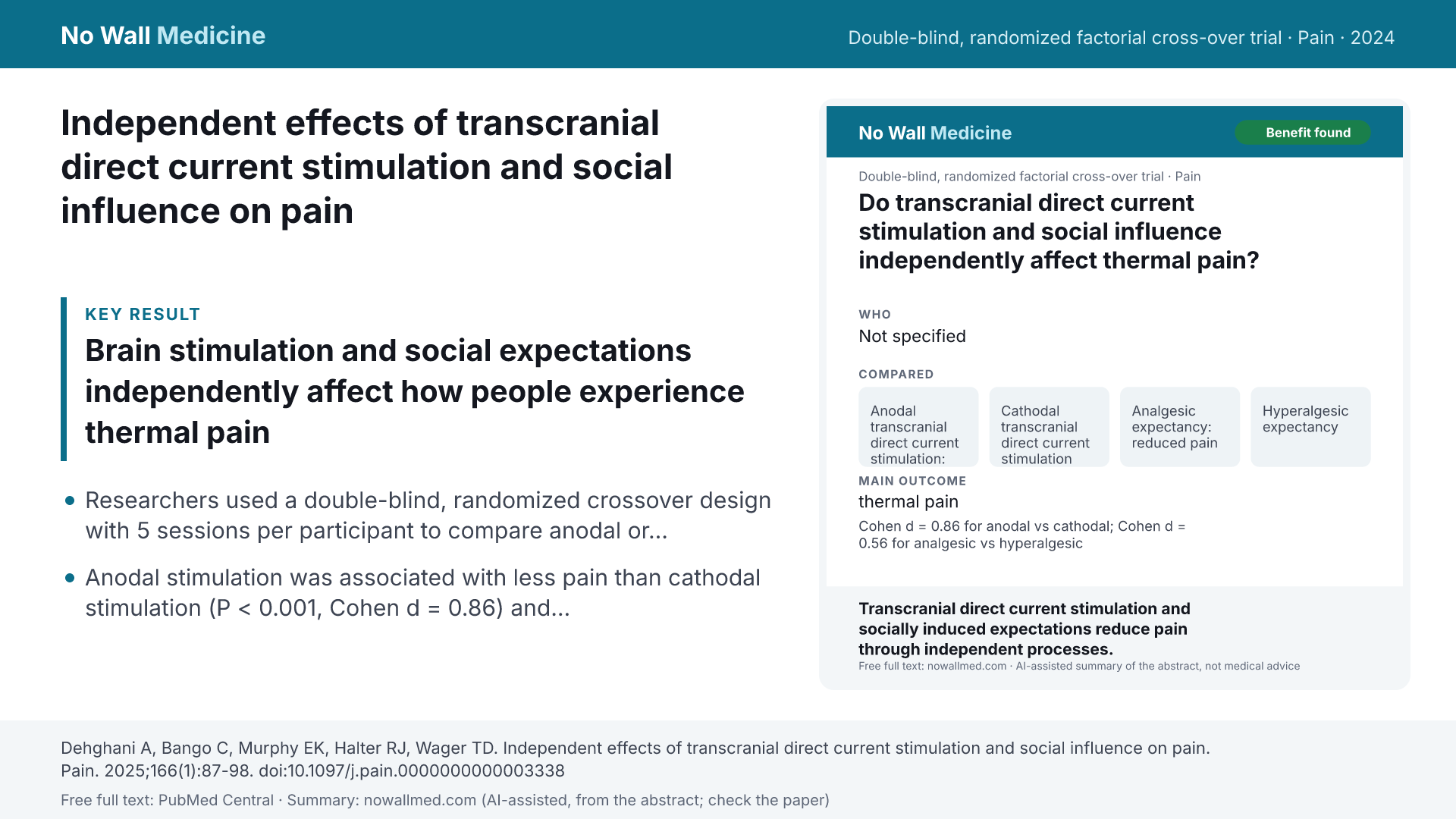
Brain stimulation and social expectations independently affect how people experience thermal pain
Independent effects of transcranial direct current stimulation and social influence on pain
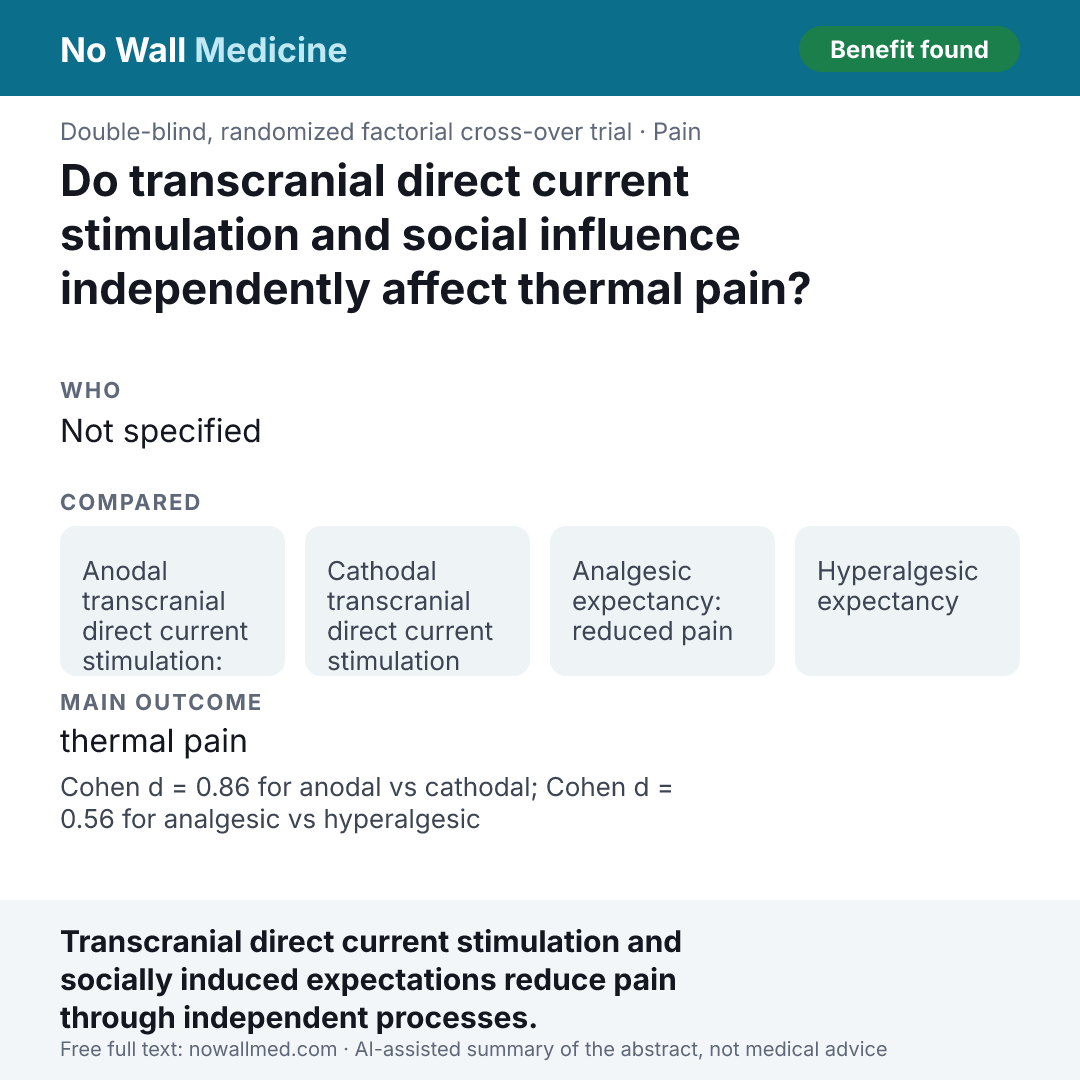
Double-blind, randomized factorial cross-over trialBenefit found
Do transcranial direct current stimulation and social influence independently affect thermal pain?
Who
Not specified
Compared
Anodal transcranial direct current stimulation: reduced pain
Cathodal transcranial direct current stimulation
Analgesic expectancy: reduced pain
Hyperalgesic expectancy
Main outcome
thermal pain
Result: Cohen d = 0.86 for anodal vs cathodal; Cohen d = 0.56 for analgesic vs hyperalgesic
Bottom line: Transcranial direct current stimulation and socially induced expectations reduce pain through independent processes.
Pain · 2024-07-12 · Save PNG
Clinical question: Do transcranial direct current stimulation and social influence independently affect thermal pain?
Key points
- Researchers used a double-blind, randomized crossover design with 5 sessions per participant to compare anodal or cathodal transcranial direct current stimulation (a noninvasive brain stimulation technique) and social expectations.
- Anodal stimulation was associated with less pain than cathodal stimulation (P < 0.001, Cohen d = 0.86) and analgesic expectations were associated with less pain than hyperalgesic expectations (P = 0.027, Cohen d = 0.56).
- There was no significant interaction found between the brain stimulation and the social expectations.
Headline and key points written with AI from the paper’s abstract, with every number checked against it. Read the paper before relying on them.
Was this summary helpful?
Subject terms
Headline, design, result, key points, caveat and citation as plain text.
Cite this article
Dehghani A, Bango C, Murphy EK, Halter RJ, Wager TD. Independent effects of transcranial direct current stimulation and social influence on pain. Pain. 2025;166(1):87-98. doi:10.1097/j.pain.0000000000003338
Spotted a mistake? Suggest a correction