Probability of continued steroid use after bridging therapy for rheumatoid arthritis is low
Individual patient data meta-analysis on continued use of glucocorticoids after their initiation as bridging therapy in patients with rheumatoid arthritis
Individual patient data meta-analysisBenefit found
Can patients with rheumatoid arthritis discontinue glucocorticoids after bridging therapy?
Who
1653
Patients with rheumatoid arthritis receiving glucocorticoid bridging therapy
Compared
Oral glucocorticoid bridging: higher probabilities of later and continuous use
Combined oral and parenteral bridging: lower probabilities of later and continuous use
Main outcome
Glucocorticoid use and cumulative dose after bridging ended
Bottom line: The probability of ongoing glucocorticoid use following bridging therapy in rheumatoid arthritis is low.
Ann Rheum Dis · 2022-12-16Download image
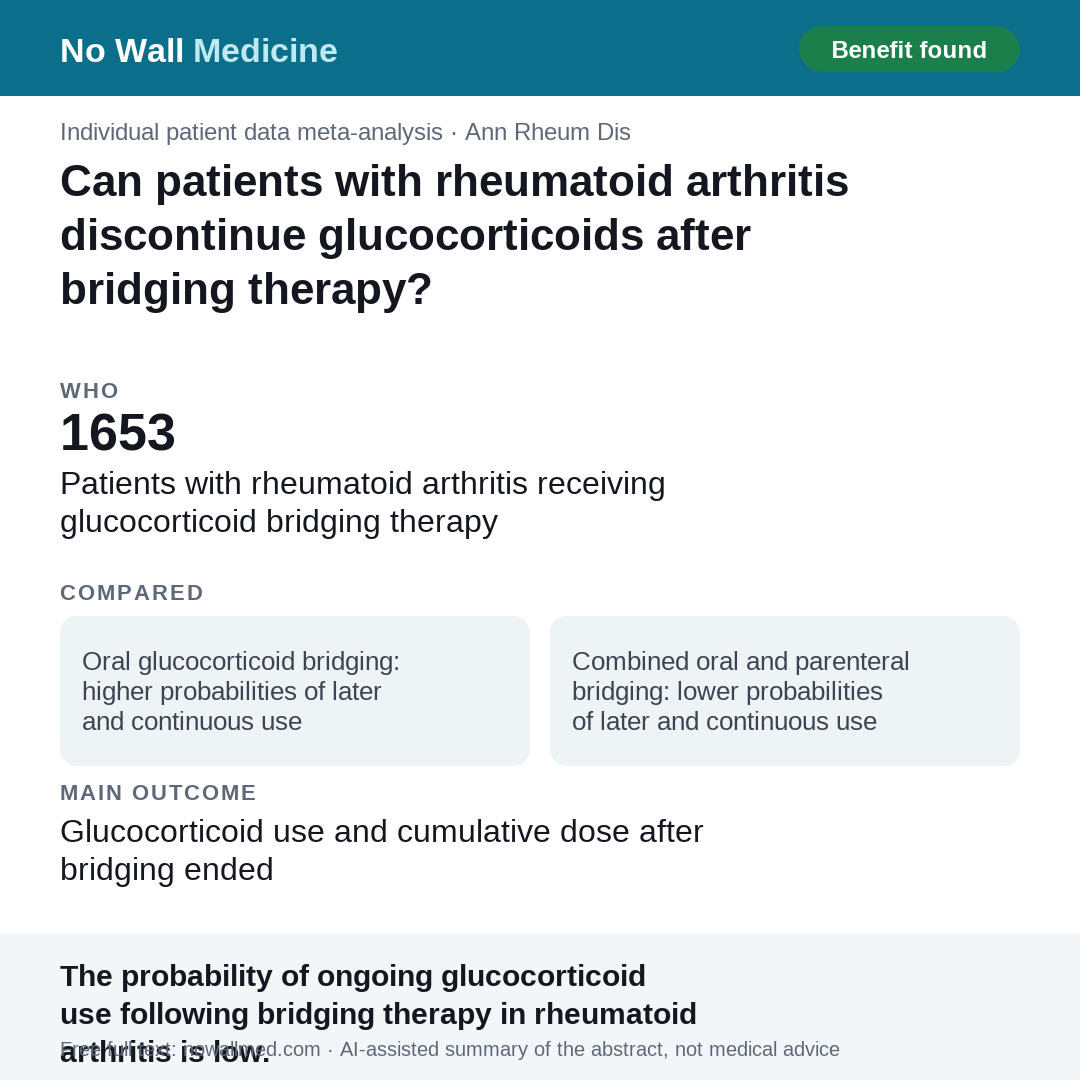
Clinical question: Can patients with rheumatoid arthritis discontinue glucocorticoids after bridging therapy?
Why it matters: It was unknown if patients with rheumatoid arthritis could successfully stop taking glucocorticoids after using them as a temporary bridging therapy.
Key points
- Researchers analyzed data from 1653 patients across 7 clinical trial arms to track glucocorticoid use after bridging therapy ended.
- The probability of using glucocorticoids 1 month after bridging ended was 0.18, which decreased to 0.07 from 6 to 18 months.
- Higher initial doses and longer bridging schedules were associated with higher cumulative doses and more patients using steroids at 18 months.
Headline and key points written with AI from the paper’s abstract, with every number checked against it. Read the paper before relying on them.
Was this summary helpful?
Abstract
Objectives
To investigate whether patients with rheumatoid arthritis (RA) can discontinue glucocorticoids (GC) after GC 'bridging' in the initial treatment step and to identify factors that may affect this. Methods
Data from 7 clinical trial arms (with 1653 patients) that included a GC bridging schedule, previously identified in a systematic literature search, were combined in an individual patient data meta-analysis. Outcomes were GC use (yes/no) at predefined time points (1/3/6/12/18 months after bridging had ended), cumulative GC dose and continuous (≥3 months) GC use after bridging had ended. Age, sex, ACPA status, initial GC dose, duration of bridging schedule, oral versus parenteral GC administration and initial co-treatment were univariably tested with each outcome. Results
The probability of using GC 1 month after bridging therapy had ended was 0.18, decreasing to 0.07 from 6 until 18 months after bridging had ended. The probability of continuous GC use after bridging had ended was 0.18 at 1 year and 0.30 at 2 years of follow-up. In oral GC bridging studies only, the probabilities of later and continuous GC use and the cumulative GC doses were higher compared to the combined analyses with also parenteral GC bridging studies included. A higher initial dose and a longer GC bridging schedule were associated with higher cumulative GC doses and more patients on GC at 18 months after bridging had ended. Conclusions
Based on these RA clinical trial arms with an initial GC bridging schedule, the probability of subsequent ongoing GC use following bridging is low.
Abstract reproduced under the article’s CC BY NC licence.
Subject terms
Cite this article
van Ouwerkerk L, Boers M, Emery P, de Jong PH, Landewé RB, Lems W. Individual patient data meta-analysis on continued use of glucocorticoids after their initiation as bridging therapy in patients with rheumatoid arthritis. Ann Rheum Dis. 2022. doi:10.1136/ard-2022-223443
Spotted a mistake? Suggest a correction
Top studies every Monday
The week’s key trials and guidelines in your specialties, plus any topics you follow. By email, free.
Get the weekly digest