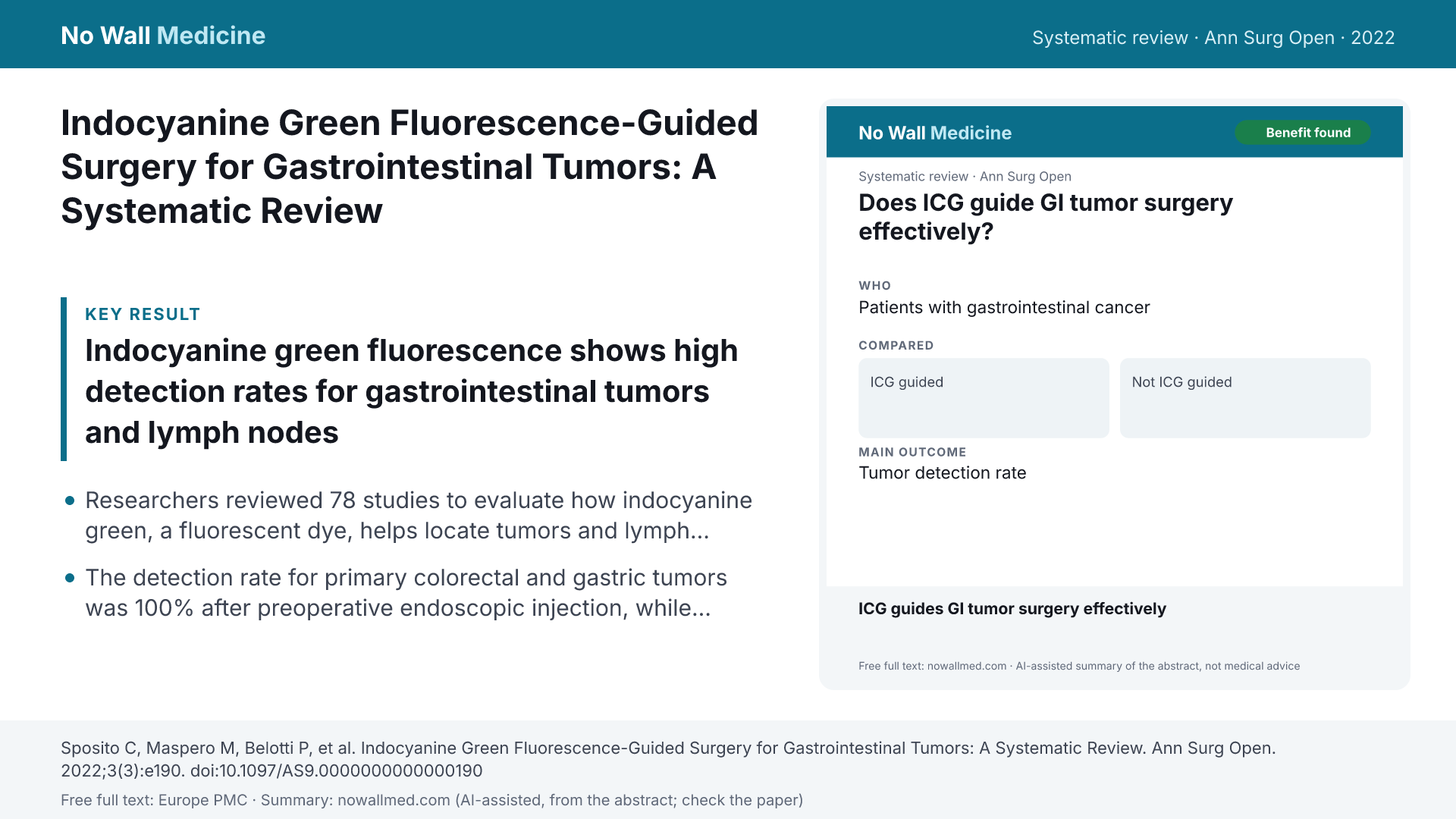
Indocyanine green fluorescence shows high detection rates for gastrointestinal tumors and lymph nodes
Indocyanine Green Fluorescence-Guided Surgery for Gastrointestinal Tumors: A Systematic Review
Systematic reviewBenefit found
Does ICG guide GI tumor surgery effectively?
Who
Patients with gastrointestinal cancer
Compared
ICG guided
Not ICG guided
Main outcome
Tumor detection rate
Bottom line: ICG guides GI tumor surgery effectively
Ann Surg Open · 2022-09-02Download image
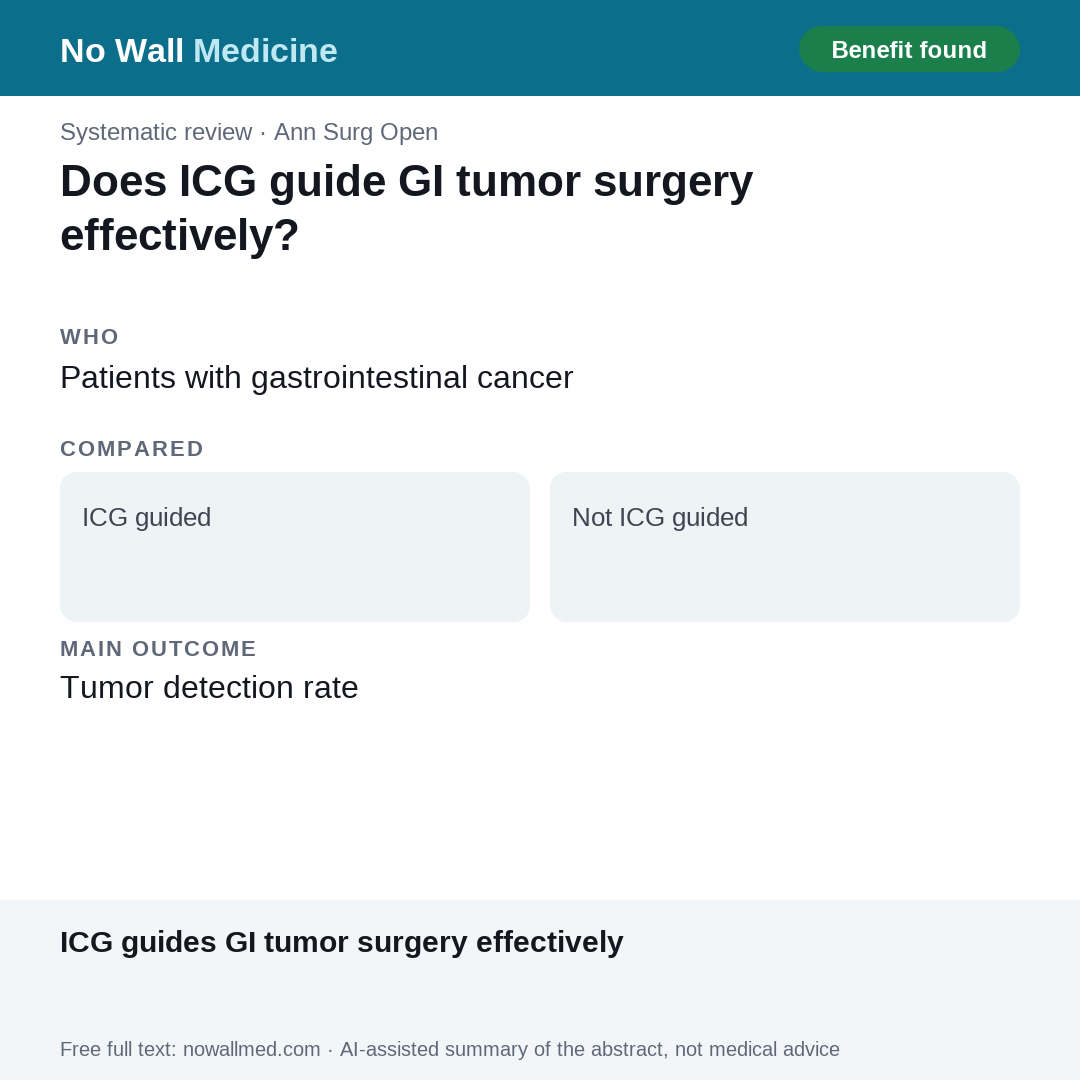
Clinical question: Does ICG guide GI tumor surgery effectively?
Key points
- Researchers reviewed 78 studies to evaluate how indocyanine green, a fluorescent dye, helps locate tumors and lymph nodes during gastrointestinal cancer surgery.
- The detection rate for primary colorectal and gastric tumors was 100% after preoperative endoscopic injection, while liver lesion detection reached 80% to 100%.
- Sentinel lymph node detection rates were 89.8% for esophageal, 98.6% for gastric, 87.4% for colorectal, and 83.3% for anal tumors.
Headline and key points written with AI from the paper’s abstract, with every number checked against it. Read the paper before relying on them.
Was this summary helpful?
Abstract
Objective
To conduct a systematic review of the currently available literature on the use of ICG to guide surgical dissection in gastrointestinal (GI) cancer surgery.Background
Real-time indocyanine green (ICG) fluorescence-guided surgery has the potential to enhance surgical outcomes by increasing patient-tailored oncological precision.Methods
MEDLINE, PubMed, EMBASE, and Google Scholar were searched for publications on the use of ICG as a contrast agent in GI cancer surgery until December 2020. Perfusion studies were excluded. Quality of the studies was assessed with the Methodological Index for nonrandomized Studies or Jadad scale for randomized controlled trials. A narrative synthesis of the results was provided, with descriptive statistics when appropriate.Results
Seventy-eight studies were included. ICG was used for primary tumor and metastases localization, for sentinel lymph node detection, and for lymph flow mapping. The detection rate for primary colorectal and gastric tumors was 100% after preoperative ICG endoscopic injection. For liver lesions, the detection rate after intravenous ICG infusion was 80% and up to 100% for lesions less than 8 mm from the liver surface. The detection rate for sentinel lymph nodes was 89.8% for esophageal, 98.6% for gastric, 87.4% for colorectal, and 83.3% for anal tumors, respectively. In comparative studies, ICG significantly increases the quality of D2 lymphadenectomy in oncological gastrectomy.Conclusion
The use of ICG as a guiding tool for dissection in GI surgery is promising. Further evidence from high-quality studies on larger sample sizes is needed to assess whether ICG-guided surgery may become standard of care.
Abstract reproduced under the article’s CC BY-NC-ND licence.
Cite this article
Sposito C, Maspero M, Belotti P, et al. Indocyanine Green Fluorescence-Guided Surgery for Gastrointestinal Tumors: A Systematic Review. Ann Surg Open. 2022. doi:10.1097/AS9.0000000000000190
Spotted a mistake? Suggest a correction