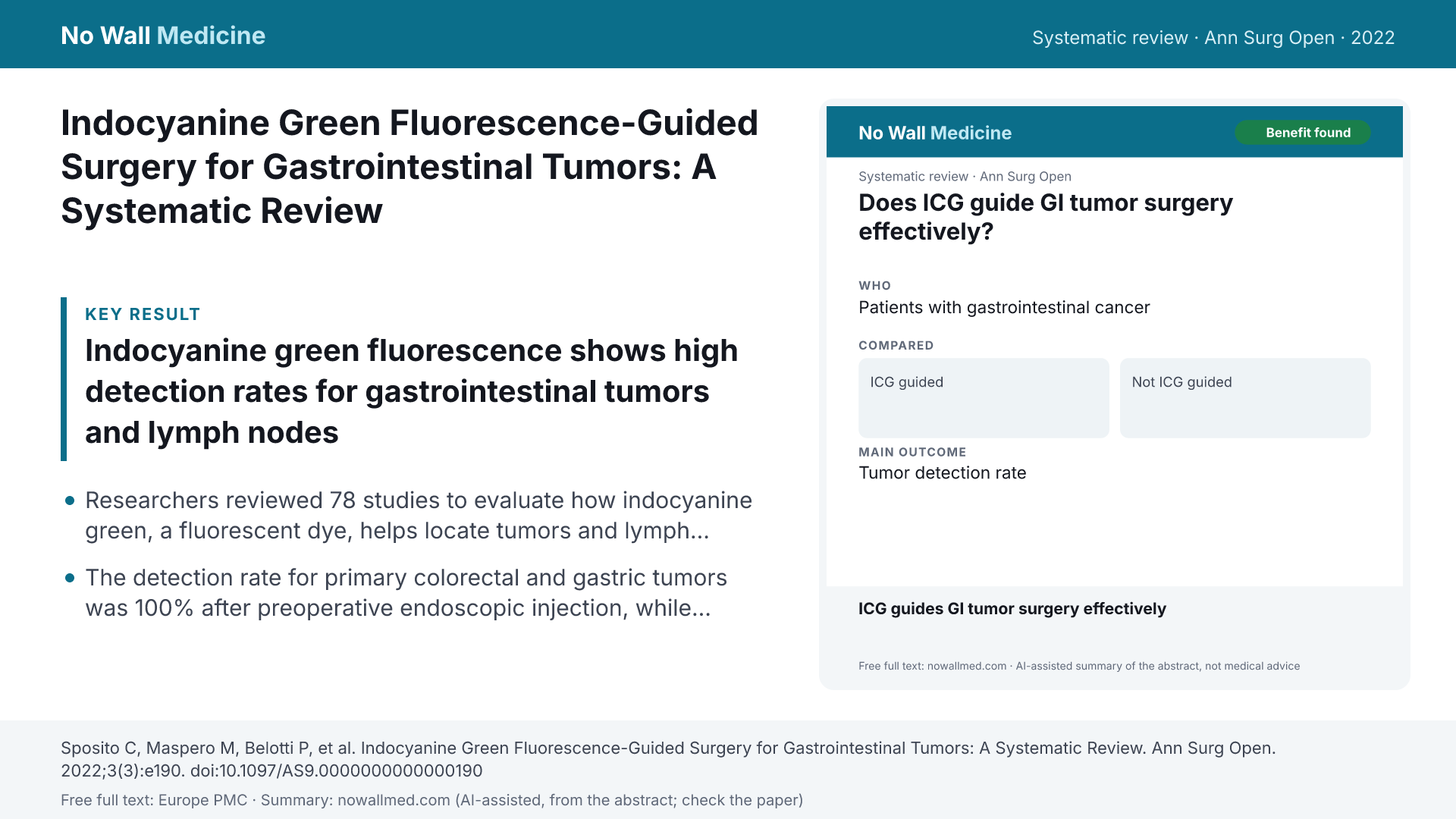
Indocyanine Green Fluorescence-Guided Surgery for Gastrointestinal Tumors: A Systematic Review
Key result: Indocyanine green fluorescence shows high detection rates for gastrointestinal tumors and lymph nodes
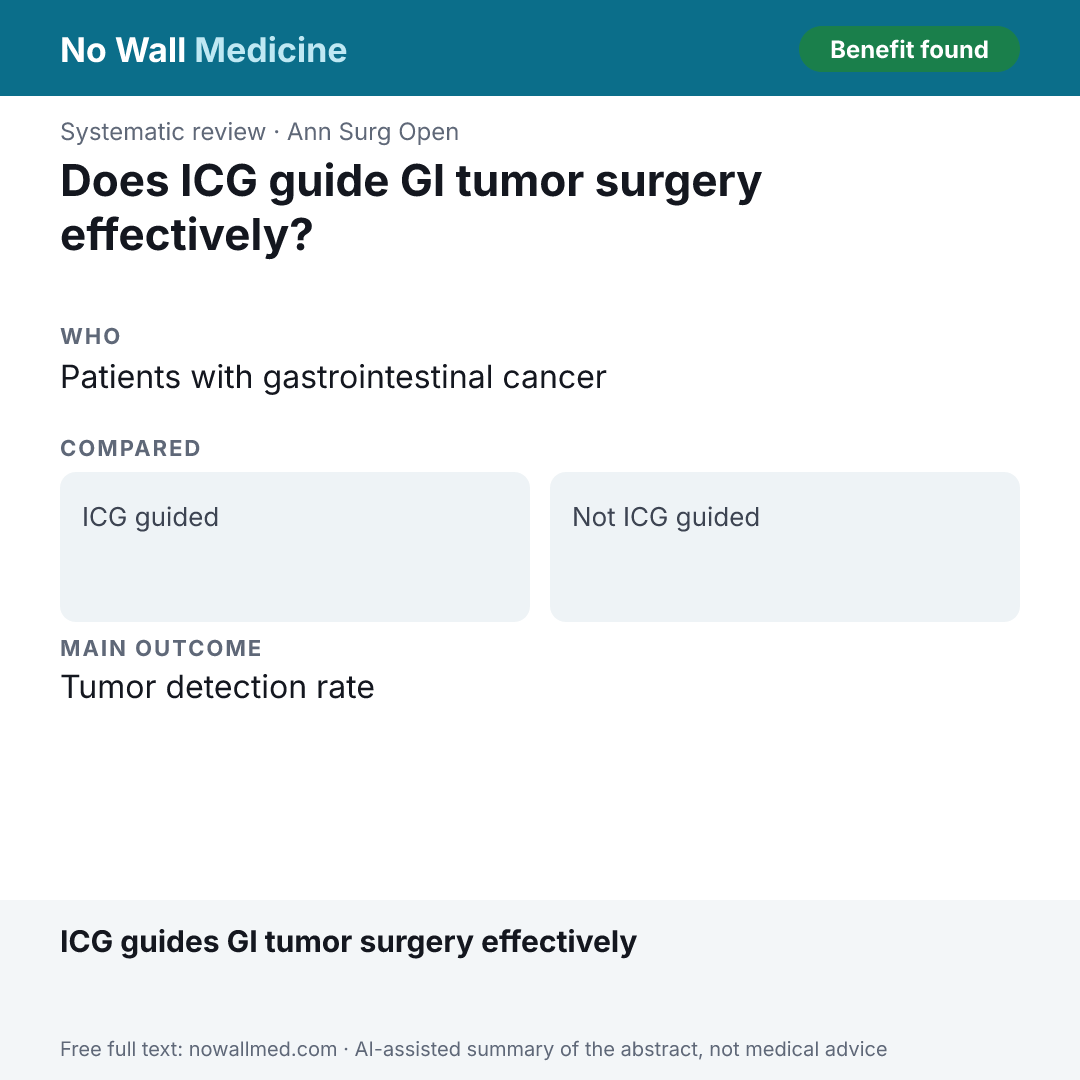
Systematic reviewBenefit found
Does ICG guide GI tumor surgery effectively?
Who
Patients with gastrointestinal cancer
Compared
ICG guided
Not ICG guided
Main outcome
Tumor detection rate
Bottom line: ICG guides GI tumor surgery effectively
Ann Surg Open · 2022-09-02 · Save PNG
Key points
- Researchers reviewed 78 studies to evaluate how indocyanine green, a fluorescent dye, helps locate tumors and lymph nodes during gastrointestinal cancer surgery.
- The detection rate for primary colorectal and gastric tumors was 100% after preoperative endoscopic injection, while liver lesion detection reached 80% to 100%.
- Sentinel lymph node detection rates were 89.8% for esophageal, 98.6% for gastric, 87.4% for colorectal, and 83.3% for anal tumors.
Discussion prompts
- Would these patients look like yours? Who was left out?
- Is the main outcome one that matters to patients?
- Is the difference large enough to change what you do?
Cite: Sposito C, Maspero M, Belotti P, et al. Indocyanine Green Fluorescence-Guided Surgery for Gastrointestinal Tumors: A Systematic Review. Ann Surg Open. 2022;3(3):e190. doi:10.1097/AS9.0000000000000190
Free full text: Europe PMC · Summary and visual abstract: nowallmed.com/a/indocyanine-green-fluorescence-guided-surgery-for-gastrointestinal-ygxcf1/ (AI-assisted from the abstract; check the paper before relying on it).