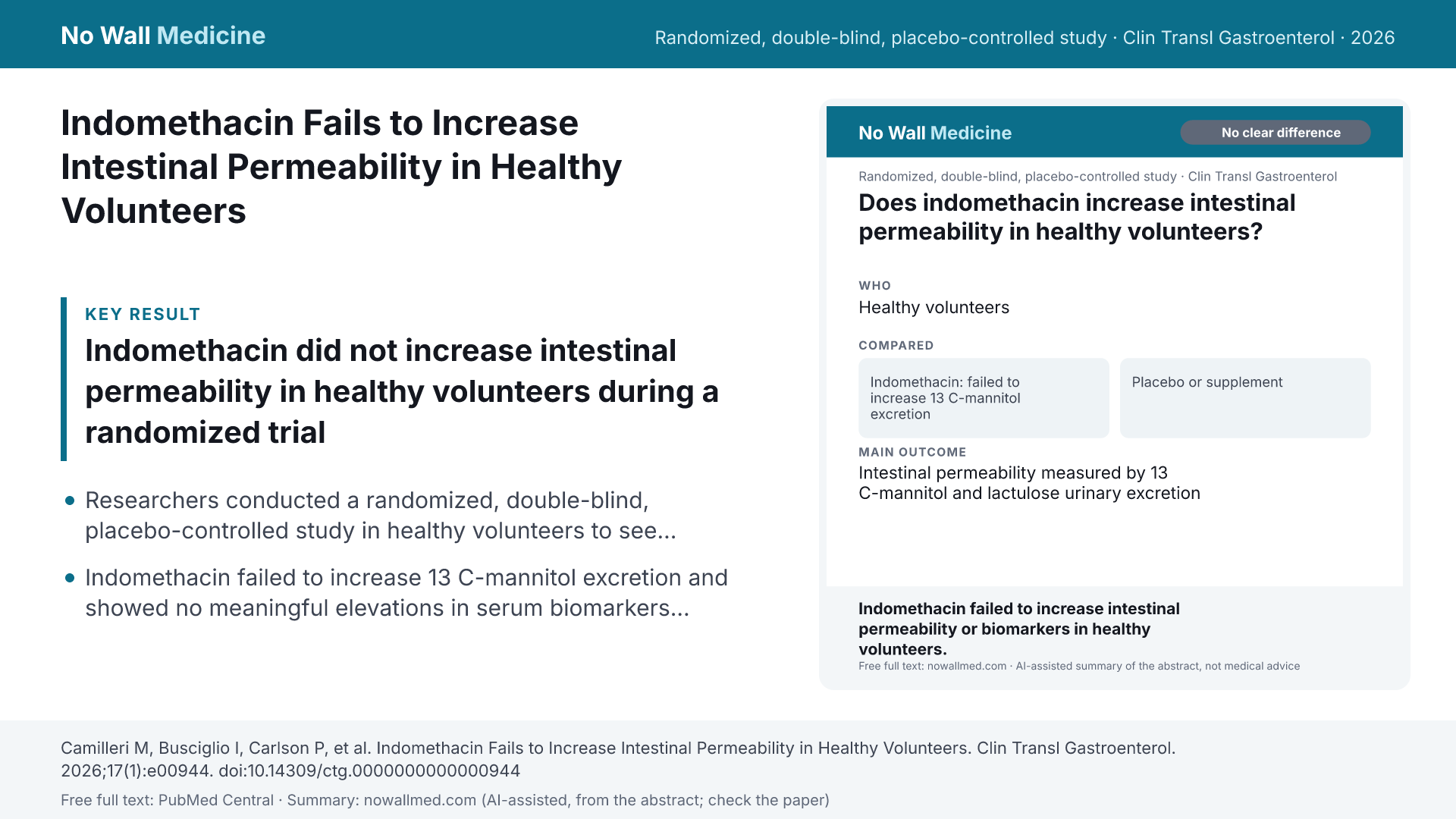
Indomethacin did not increase intestinal permeability in healthy volunteers during a randomized trial
Indomethacin Fails to Increase Intestinal Permeability in Healthy Volunteers
Randomized, double-blind, placebo-controlled studyNo clear difference
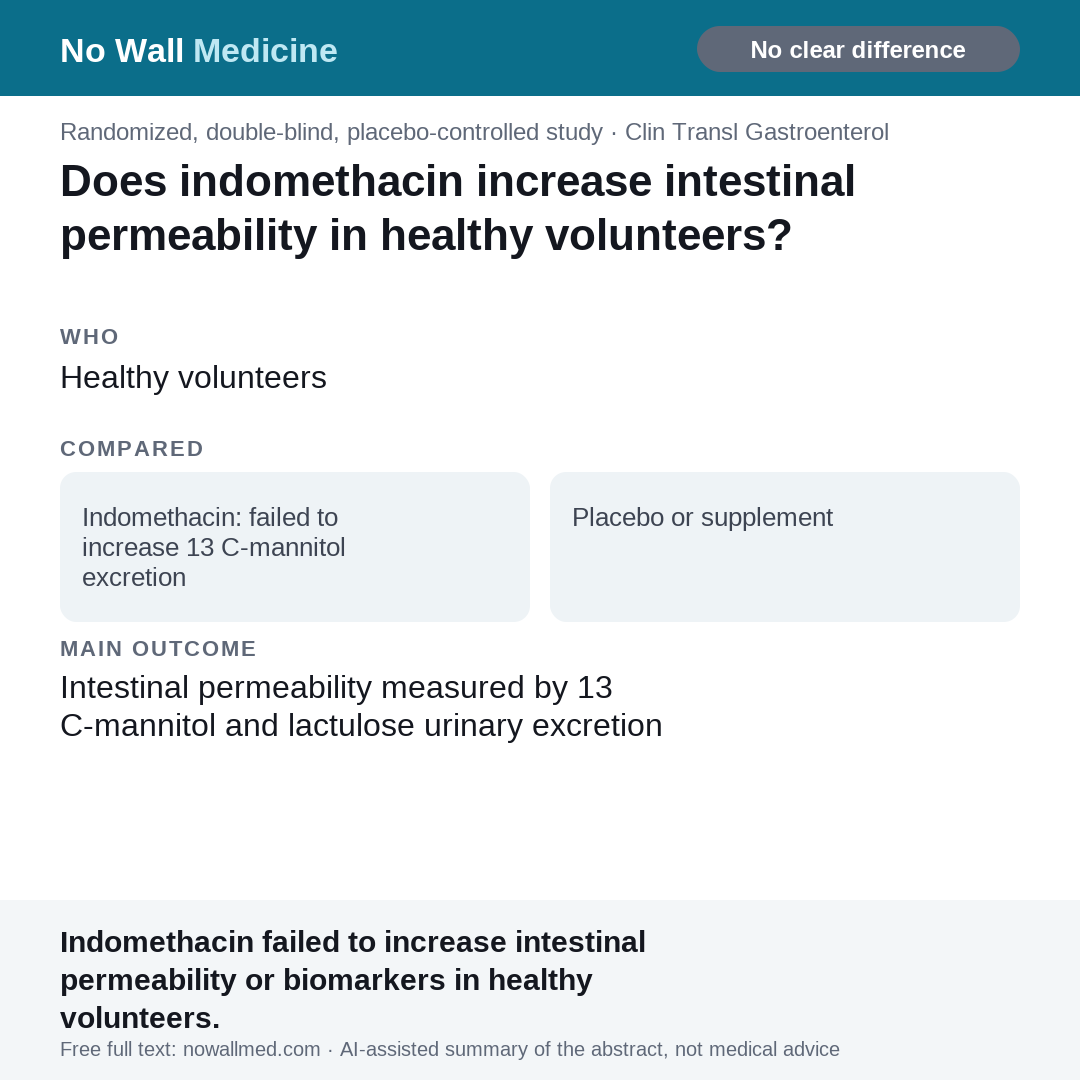
Does indomethacin increase intestinal permeability in healthy volunteers?
Who
Healthy volunteers
Compared
Indomethacin: failed to increase 13 C-mannitol excretion
Placebo or supplement
Main outcome
Intestinal permeability measured by 13 C-mannitol and lactulose urinary excretion
Bottom line: Indomethacin failed to increase intestinal permeability or biomarkers in healthy volunteers.
Clin Transl Gastroenterol · 2026-01-01Download image
Clinical question: Does indomethacin increase intestinal permeability in healthy volunteers?
Why it matters: Indomethacin is often used experimentally to induce intestinal hyperpermeability to evaluate interventions targeting gut barrier function.
Key points
- Researchers conducted a randomized, double-blind, placebo-controlled study in healthy volunteers to see if indomethacin could induce intestinal hyperpermeability.
- Indomethacin failed to increase 13 C-mannitol excretion and showed no meaningful elevations in serum biomarkers like zonulin or claudins, or fecal calprotectin.
Headline and key points written with AI from the paper’s abstract, with every number checked against it. Read the paper before relying on them.
Was this summary helpful?
Subject terms
Cite this article
Camilleri M, Busciglio I, Carlson P, et al. Indomethacin Fails to Increase Intestinal Permeability in Healthy Volunteers. Clin Transl Gastroenterol. 2026. doi:10.14309/ctg.0000000000000944
Spotted a mistake? Suggest a correction