Indomethacin Fails to Increase Intestinal Permeability in Healthy Volunteers
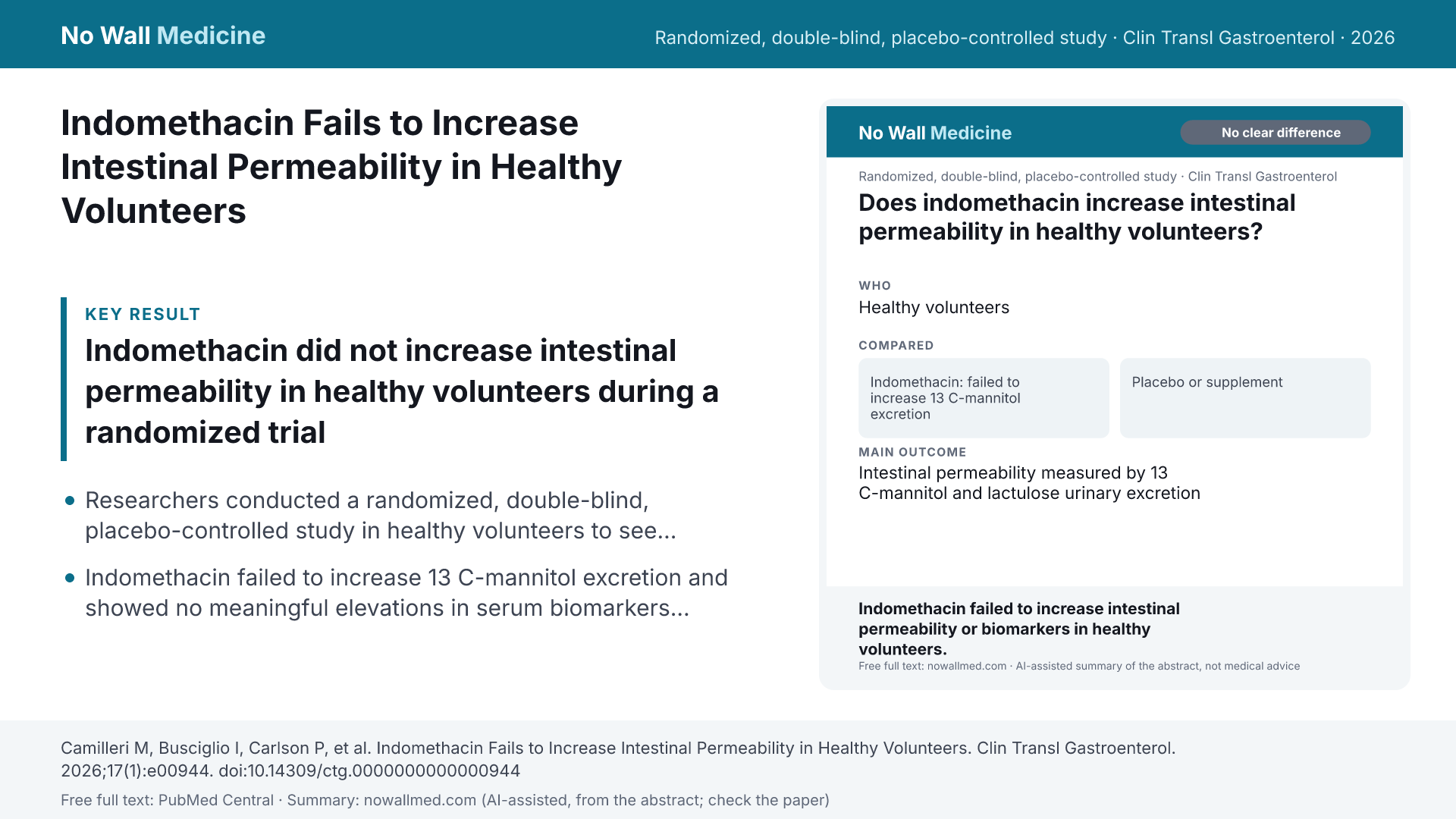
Key result: Indomethacin did not increase intestinal permeability in healthy volunteers during a randomized trial
Randomized, double-blind, placebo-controlled studyNo clear difference
Does indomethacin increase intestinal permeability in healthy volunteers?
Who
Healthy volunteers
Compared
Indomethacin: failed to increase 13 C-mannitol excretion
Placebo or supplement
Main outcome
Intestinal permeability measured by 13 C-mannitol and lactulose urinary excretion
Bottom line: Indomethacin failed to increase intestinal permeability or biomarkers in healthy volunteers.
Clin Transl Gastroenterol · 2026-01-01
Key points
- Researchers conducted a randomized, double-blind, placebo-controlled study in healthy volunteers to see if indomethacin could induce intestinal hyperpermeability.
- Indomethacin failed to increase 13 C-mannitol excretion and showed no meaningful elevations in serum biomarkers like zonulin or claudins, or fecal calprotectin.
Why it matters: Indomethacin is often used experimentally to induce intestinal hyperpermeability to evaluate interventions targeting gut barrier function.
Discussion prompts
- Would these patients look like yours? Who was left out?
- Is the main outcome one that matters to patients?
- Is the difference large enough to change what you do?
Cite: Camilleri M, Busciglio I, Carlson P, et al. Indomethacin Fails to Increase Intestinal Permeability in Healthy Volunteers. Clin Transl Gastroenterol. 2026;17(1):e00944. doi:10.14309/ctg.0000000000000944
Free full text: PubMed Central · Summary and visual abstract: nowallmed.com/a/indomethacin-fails-to-increase-intestinal-permeability-in-healthy-msa8v5/ (AI-assisted from the abstract; check the paper before relying on it).