Infliximab induction therapy showed no benefit for kidney function in deceased donor transplant recipients
Infliximab Induction Lacks Efficacy and Increases BK Virus Infection in Deceased Donor Kidney Transplant Recipients: Results of the CTOT-19 Trial
Randomized, double-blind, placebo-controlled, phase 2 trialHarm found
Does infliximab induction improve outcomes in deceased donor kidney transplant recipients?
Who
225
Primary deceased-donor kidney transplant recipients · 15-center
Compared
Infliximab: 52.45 ml/min per 1.73 m 2
Saline placebo: 57.35 ml/min per 1.73 m 2
Main outcome
mean 24-month estimated glomerular filtration rate
Bottom line: Infliximab induction lacks efficacy for kidney function and increases BK virus infection rates in deceased donor transplant recipients.
JASN · 2022-10-04Download image
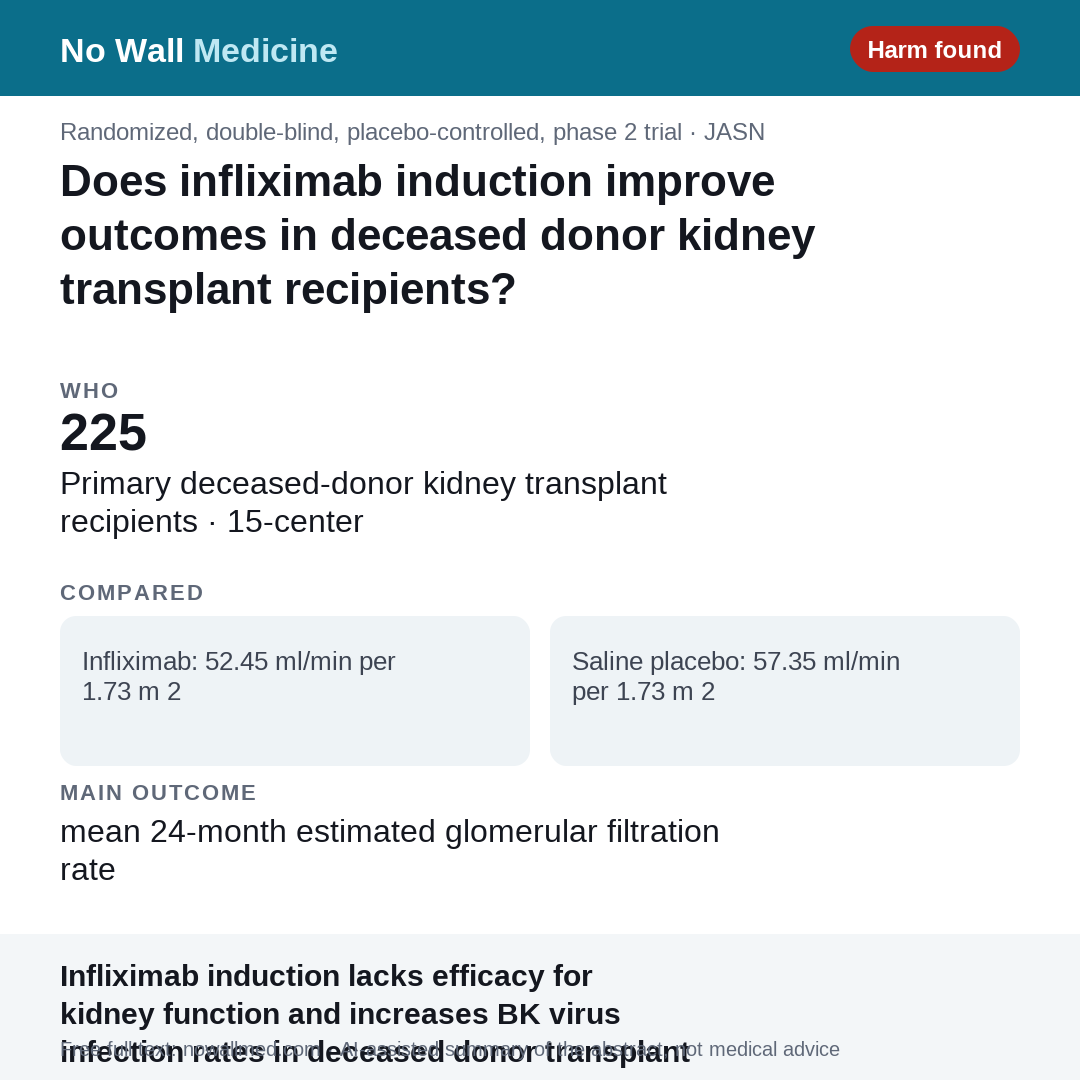
Clinical question: Does infliximab induction improve outcomes in deceased donor kidney transplant recipients?
Why it matters: It was unknown if blocking tumor necrosis factor alpha during kidney transplantation could improve transplant outcomes by reducing inflammation.
Key points
- Researchers studied 225 deceased-donor kidney transplant recipients randomized to receive either infliximab or a saline placebo.
- The 24-month estimated glomerular filtration rate, a measure of kidney function, was 52.45 ml/min per 1.73 m2 for infliximab and 57.35 ml/min per 1.73 m2 for placebo.
- BK virus infection requiring changes to immunosuppression was more frequent in the infliximab group at 28.9% compared to 13.4% in the placebo group.
Headline and key points written with AI from the paper’s abstract, with every number checked against it. Read the paper before relying on them.
Was this summary helpful?
Subject terms
Cite this article
Hricik DE, Armstrong B, Alhamad T, Brennan DC, Bromberg JS, Bunnapradist S. Infliximab Induction Lacks Efficacy and Increases BK Virus Infection in Deceased Donor Kidney Transplant Recipients: Results of the CTOT-19 Trial. JASN. 2022. doi:10.1681/ASN.2022040454
Spotted a mistake? Suggest a correction
Top studies every Monday
The week’s key trials and guidelines in your specialties, plus any topics you follow. By email, free.
Get the weekly digest