Expert consensus guidelines updated for managing BK polyomavirus after kidney transplantation
The Second International Consensus Guidelines on the Management of BK Polyomavirus in Kidney Transplantation
Status not yet checked. We have not confirmed that this is still the issuing body's current recommendation. Check the issuing body before using it in practice.
Why it matters: Management strategies for BK polyomavirus in kidney transplant recipients require updated, evidence-based recommendations to address risks like older age, male sex, and specific drug exposures.
Key points
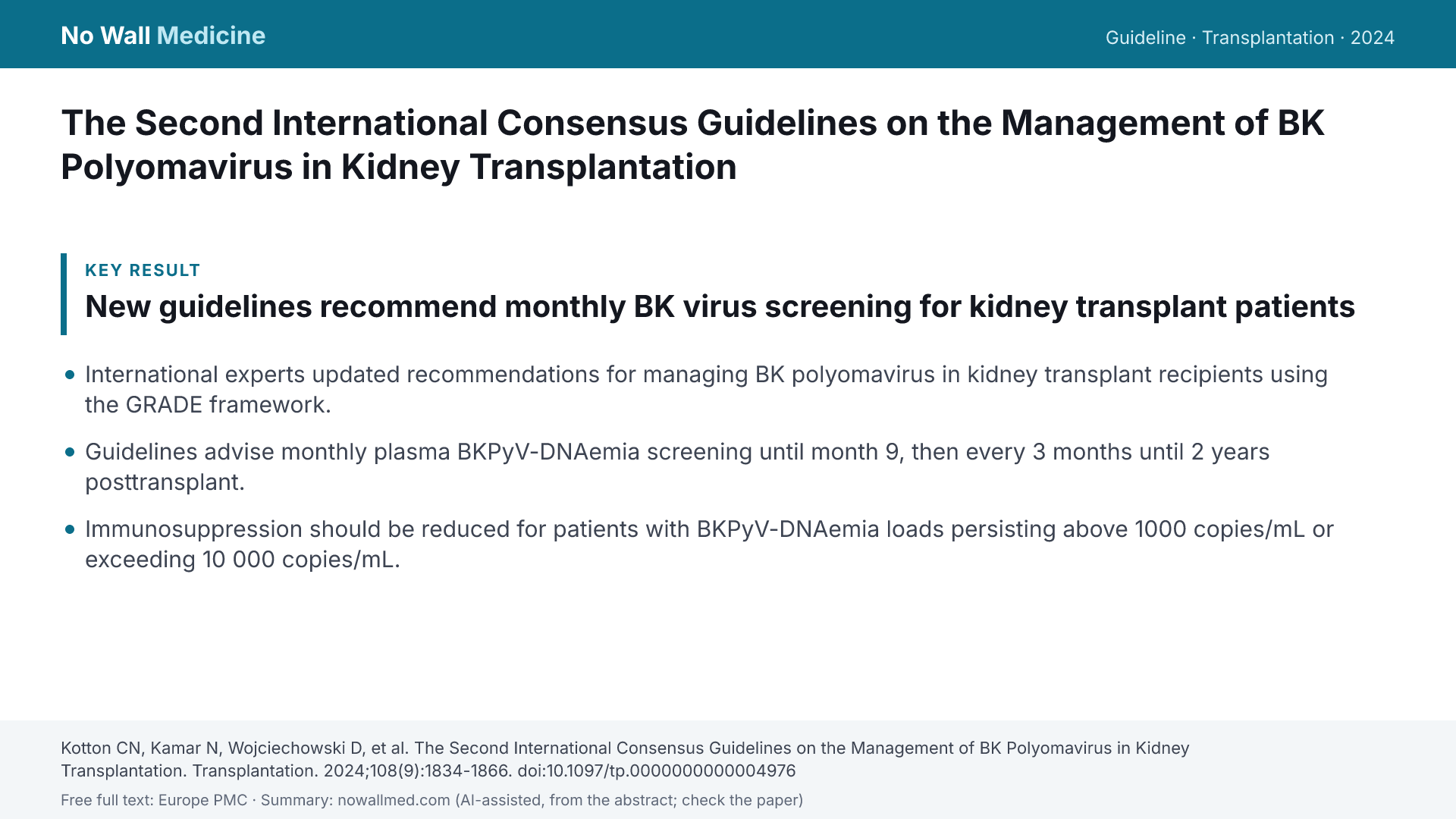
- International experts reviewed evidence to provide updated recommendations for managing BK polyomavirus, a virus that can cause kidney disease after transplant.
- The guidelines suggest monthly blood testing for virus levels until month 9, then every 3 months until 2 years post-transplant, or 3 years for children.
- Reducing immunosuppression is recommended for patients with virus loads exceeding 10,000 copies/mL or those with biopsy-proven kidney disease.
Headline and key points written with AI from the paper’s abstract, with every number checked against it. Read the paper before relying on them.
Was this summary helpful?
Abstract
BK polyomavirus (BKPyV) remains a significant challenge after kidney transplantation. International experts reviewed current evidence and updated recommendations according to Grading of Recommendations, Assessment, Development, and Evaluations (GRADE). Risk factors for BKPyV-DNAemia and biopsy-proven BKPyV-nephropathy include recipient older age, male sex, donor BKPyV-viruria, BKPyV-seropositive donor/-seronegative recipient, tacrolimus, acute rejection, and higher steroid exposure. To facilitate early intervention with limited allograft damage, all kidney transplant recipients should be screened monthly for plasma BKPyV-DNAemia loads until month 9, then every 3 mo until 2 y posttransplant (3 y for children). In resource-limited settings, urine cytology screening at similar time points can exclude BKPyV-nephropathy, and testing for plasma BKPyV-DNAemia when decoy cells are detectable. For patients with BKPyV-DNAemia loads persisting >1000 copies/mL, or exceeding 10 000 copies/mL (or equivalent), or with biopsy-proven BKPyV-nephropathy, immunosuppression should be reduced according to predefined steps targeting antiproliferative drugs, calcineurin inhibitors, or both. In adults without graft dysfunction, kidney allograft biopsy is not required unless the immunological risk is high. For children with persisting BKPyV-DNAemia, allograft biopsy may be considered even without graft dysfunction. Allograft biopsies should be interpreted in the context of all clinical and laboratory findings, including plasma BKPyV-DNAemia. Immunohistochemistry is preferred for diagnosing biopsy-proven BKPyV-nephropathy. Routine screening using the proposed strategies is cost-effective, improves clinical outcomes and quality of life. Kidney retransplantation subsequent to BKPyV-nephropathy is feasible in otherwise eligible recipients if BKPyV-DNAemia is undetectable; routine graft nephrectomy is not recommended. Current studies do not support the usage of leflunomide, cidofovir, quinolones, or IVIGs. Patients considered for experimental treatments (antivirals, vaccines, neutralizing antibodies, and adoptive T cells) should be enrolled in clinical trials.
Abstract reproduced under the article’s CC BY-NC-ND licence.
Subject terms
Cite this article
Kotton CN, Kamar N, Wojciechowski D, Eder M, Hopfer H, Randhawa P. The Second International Consensus Guidelines on the Management of BK Polyomavirus in Kidney Transplantation. Transplantation. 2024. doi:10.1097/tp.0000000000004976
Spotted a mistake? Suggest a correction