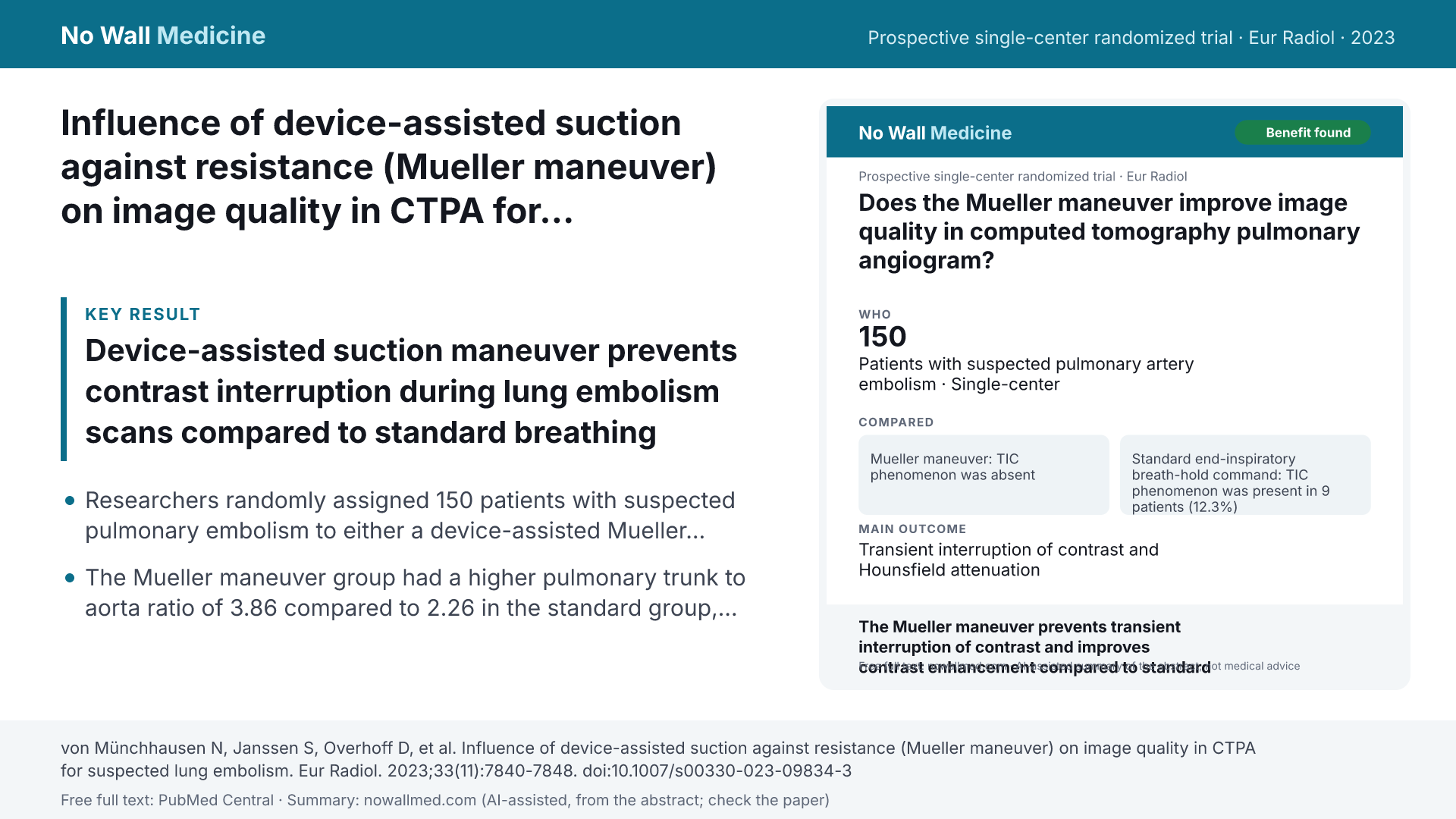
Device-assisted suction maneuver prevents contrast interruption during lung embolism scans compared to standard breathing
Influence of device-assisted suction against resistance (Mueller maneuver) on image quality in CTPA for suspected lung embolism
Prospective single-center randomized trialBenefit found
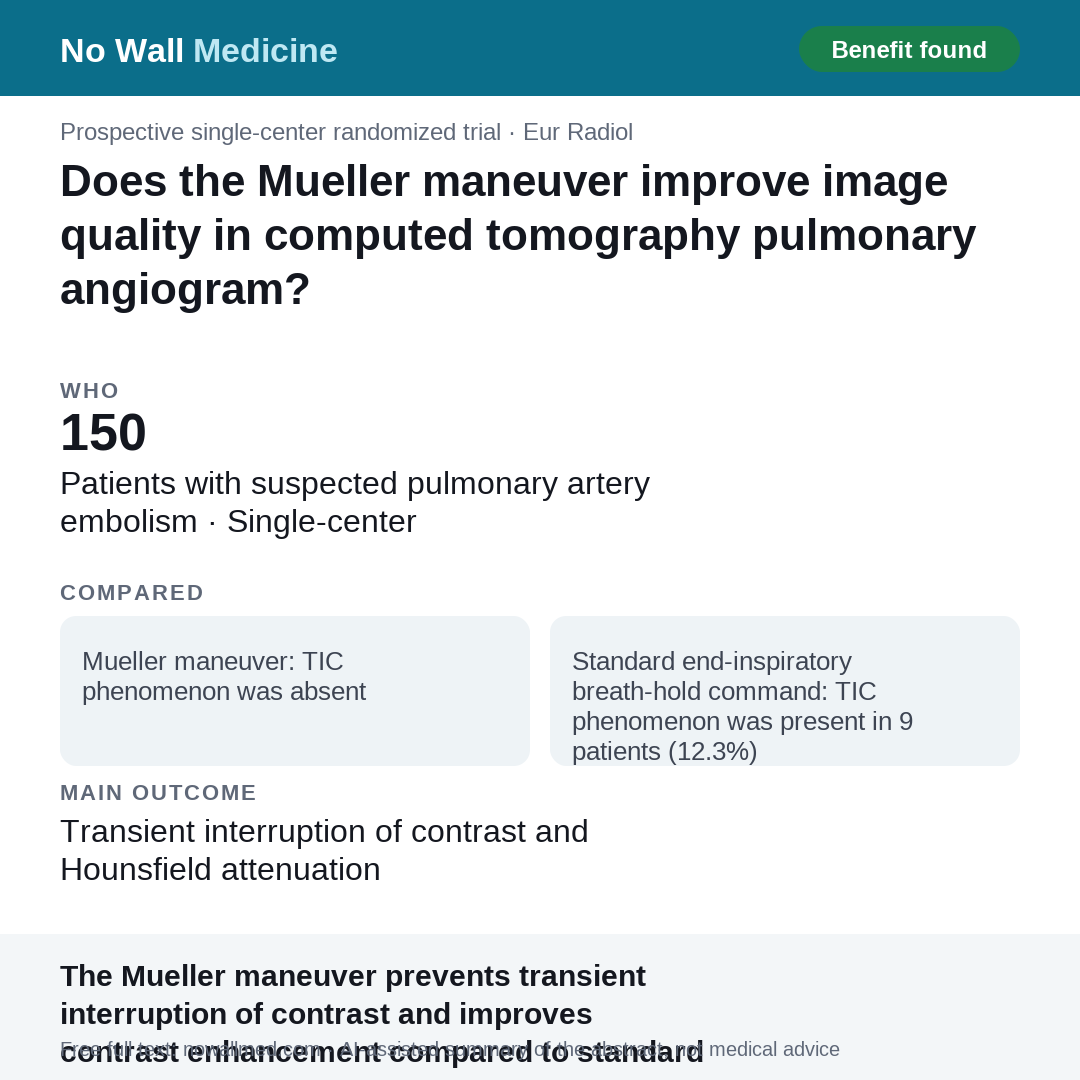
Does the Mueller maneuver improve image quality in computed tomography pulmonary angiogram?
Who
150
Patients with suspected pulmonary artery embolism · Single-center
Compared
Mueller maneuver: TIC phenomenon was absent
Standard end-inspiratory breath-hold command: TIC phenomenon was present in 9 patients (12.3%)
Main outcome
Transient interruption of contrast and Hounsfield attenuation
Bottom line: The Mueller maneuver prevents transient interruption of contrast and improves contrast enhancement compared to standard breathing commands.
Eur Radiol · 2023-06-20Download image
Clinical question: Does the Mueller maneuver improve image quality in computed tomography pulmonary angiogram?
Why it matters: The transient interruption of contrast phenomenon can impair image quality during computed tomography pulmonary angiogram scans for suspected pulmonary embolism.
Key points
- Researchers randomly assigned 150 patients with suspected pulmonary embolism to either a device-assisted Mueller maneuver or a standard end-inspiratory breath-hold command during CT pulmonary angiogram scans.
- The Mueller maneuver group had a higher pulmonary trunk to aorta ratio of 3.86 compared to 2.26 in the standard group, and the transient interruption of contrast was absent in the Mueller group versus 12.3% in the standard group.
- Breathing artifacts were more common in the Mueller maneuver group at 48.1% compared to 30.1% in the standard group, though authors noted no clinical consequence.
Headline and key points written with AI from the paper’s abstract, with every number checked against it. Read the paper before relying on them.
Was this summary helpful?
Subject terms
Cite this article
von Münchhausen N, Janssen S, Overhoff D, et al. Influence of device-assisted suction against resistance (Mueller maneuver) on image quality in CTPA for suspected lung embolism. Eur Radiol. 2023. doi:10.1007/s00330-023-09834-3
Spotted a mistake? Suggest a correction