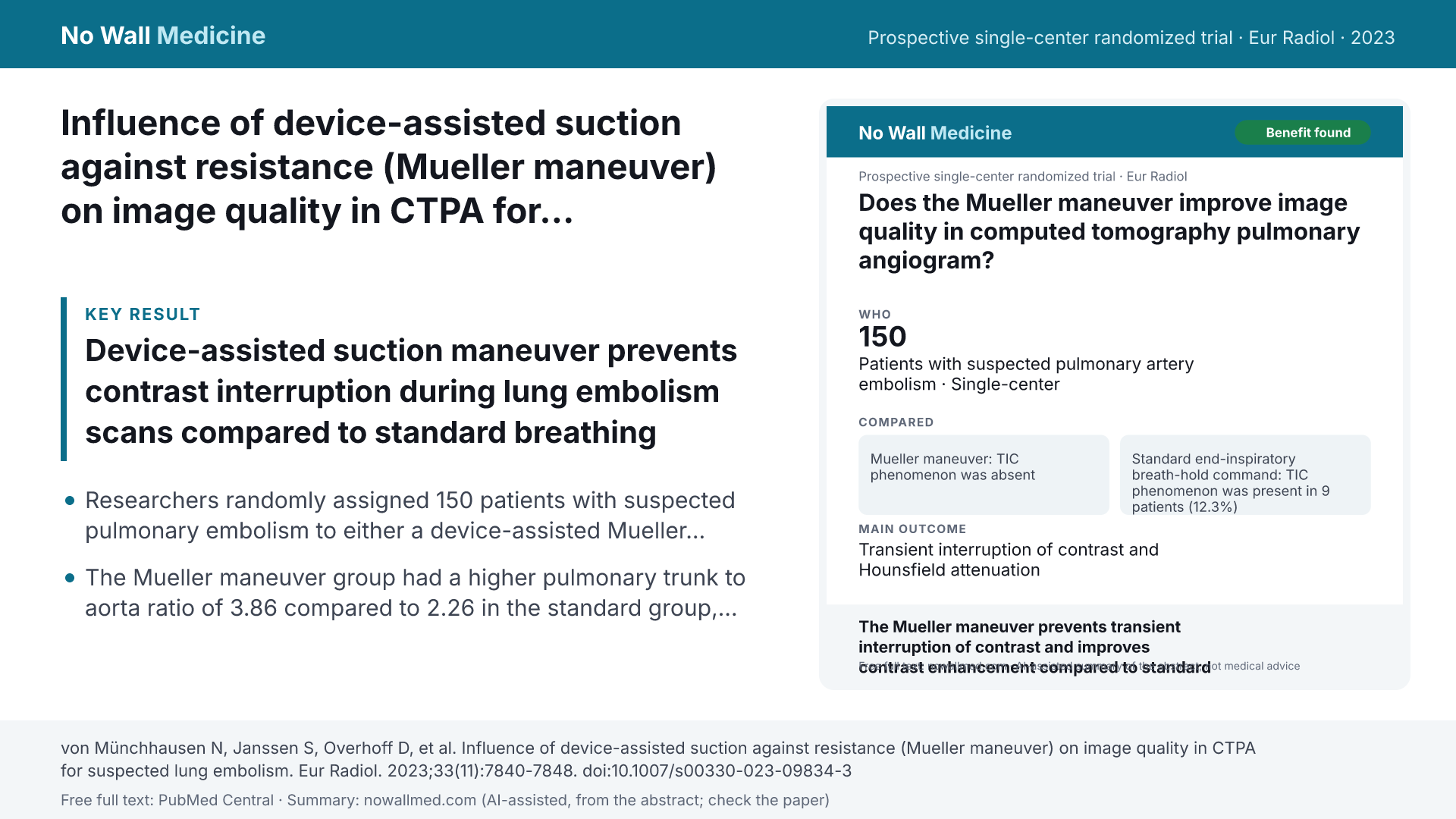
Influence of device-assisted suction against resistance (Mueller maneuver) on image quality in CTPA for suspected lung embolism
Key result: Device-assisted suction maneuver prevents contrast interruption during lung embolism scans compared to standard breathing
Key points
- Researchers randomly assigned 150 patients with suspected pulmonary embolism to either a device-assisted Mueller maneuver or a standard end-inspiratory breath-hold command during CT pulmonary angiogram scans.
- The Mueller maneuver group had a higher pulmonary trunk to aorta ratio of 3.86 compared to 2.26 in the standard group, and the transient interruption of contrast was absent in the Mueller group versus 12.3% in the standard group.
- Breathing artifacts were more common in the Mueller maneuver group at 48.1% compared to 30.1% in the standard group, though authors noted no clinical consequence.
Why it matters: The transient interruption of contrast phenomenon can impair image quality during computed tomography pulmonary angiogram scans for suspected pulmonary embolism.
Discussion prompts
- Would these patients look like yours? Who was left out?
- Is the main outcome one that matters to patients?
- Is the difference large enough to change what you do?
Cite: von Münchhausen N, Janssen S, Overhoff D, et al. Influence of device-assisted suction against resistance (Mueller maneuver) on image quality in CTPA for suspected lung embolism. Eur Radiol. 2023;33(11):7840-7848. doi:10.1007/s00330-023-09834-3
Free full text: PubMed Central · Summary and visual abstract: nowallmed.com/a/influence-of-device-assisted-suction-against-resistance-mueller-1sdhpmv/ (AI-assisted from the abstract; check the paper before relying on it).