Influence of esophageal temperature probe tip placement on core temperature measurement accuracy in cold environments: a randomized crossover trial with implications for cardiac arrest management
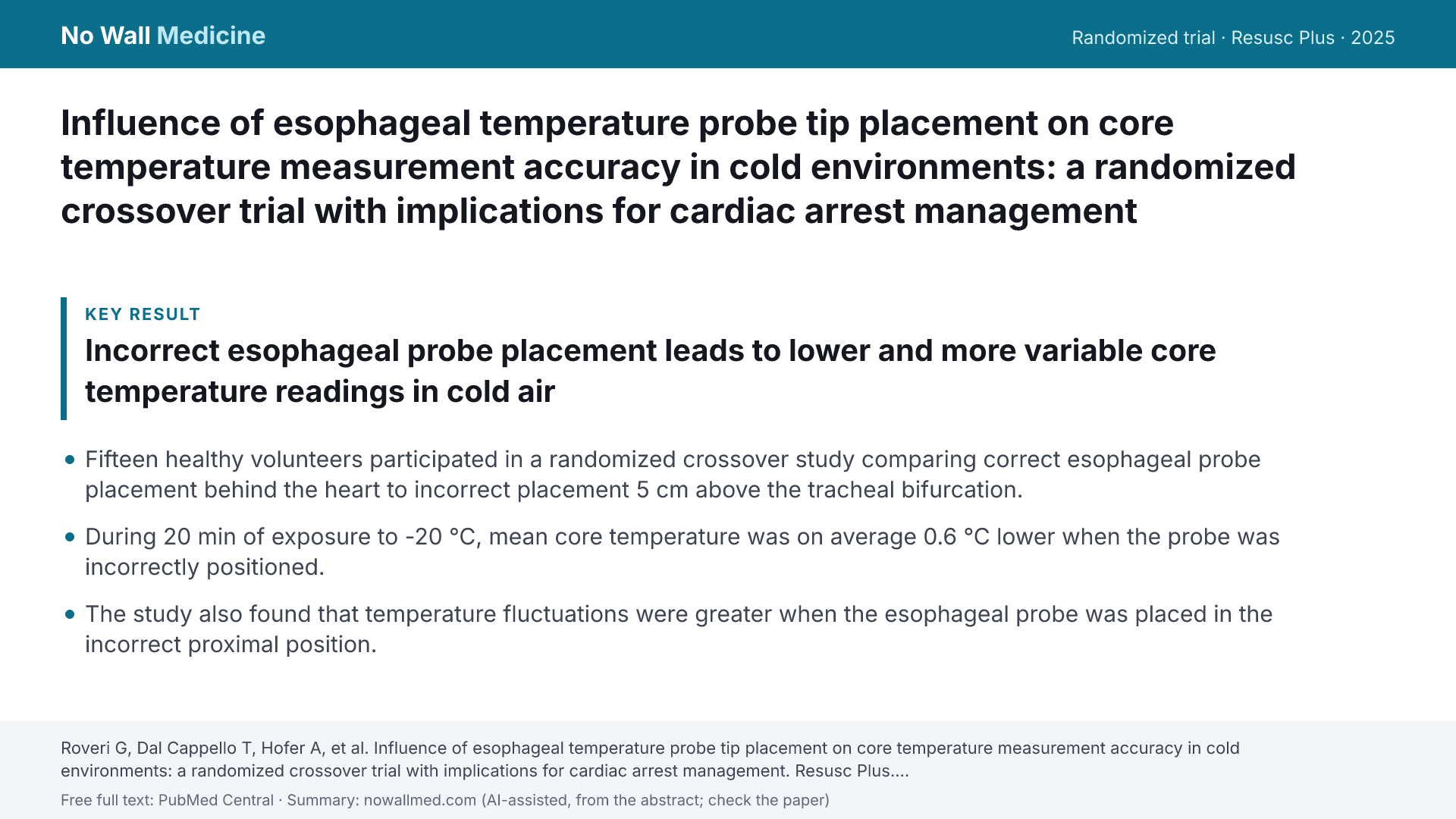
Key result: Incorrect esophageal probe placement leads to lower and more variable core temperature readings in cold air
Key points
- Fifteen healthy volunteers participated in a randomized crossover study comparing correct esophageal probe placement behind the heart to incorrect placement 5 cm above the tracheal bifurcation.
- During 20 min of exposure to -20 °C, mean core temperature was on average 0.6 °C lower when the probe was incorrectly positioned.
- The study also found that temperature fluctuations were greater when the esophageal probe was placed in the incorrect proximal position.
Discussion prompts
- Would these patients look like yours? Who was left out?
- Is the main outcome one that matters to patients?
- Is the difference large enough to change what you do?
Cite: Roveri G, Dal Cappello T, Hofer A, et al. Influence of esophageal temperature probe tip placement on core temperature measurement accuracy in cold environments: a randomized crossover trial with implications for cardiac arrest management. Resusc Plus. 2025;26:101087. doi:10.1016/j.resplu.2025.101087
Free full text: PubMed Central · Summary and visual abstract: nowallmed.com/a/influence-of-esophageal-temperature-probe-tip-placement-on-core-gqydk0/ (AI-assisted from the abstract; check the paper before relying on it).