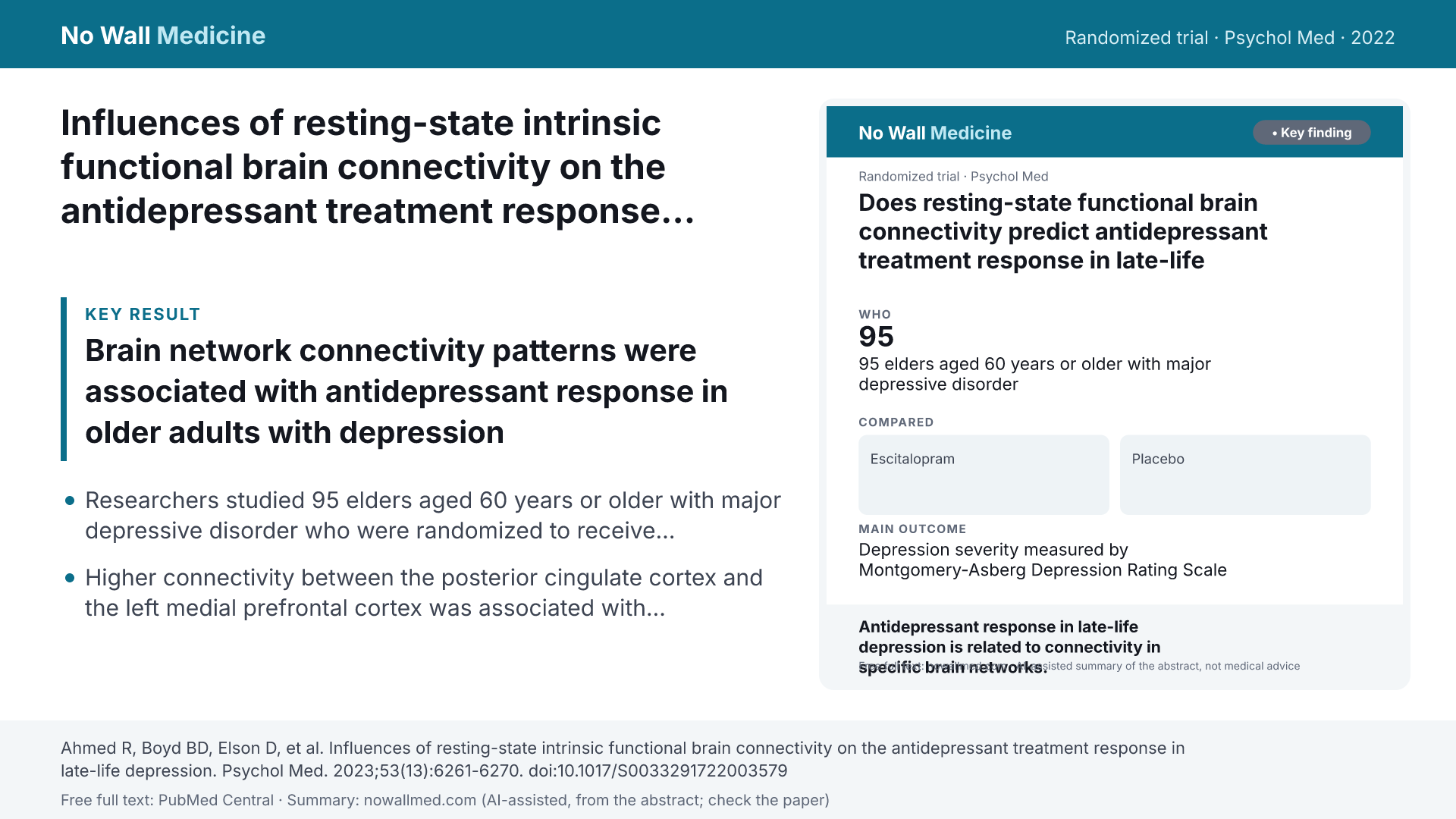
Brain network connectivity patterns were associated with antidepressant response in older adults with depression
Influences of resting-state intrinsic functional brain connectivity on the antidepressant treatment response in late-life depression
Randomized trialBenefit found
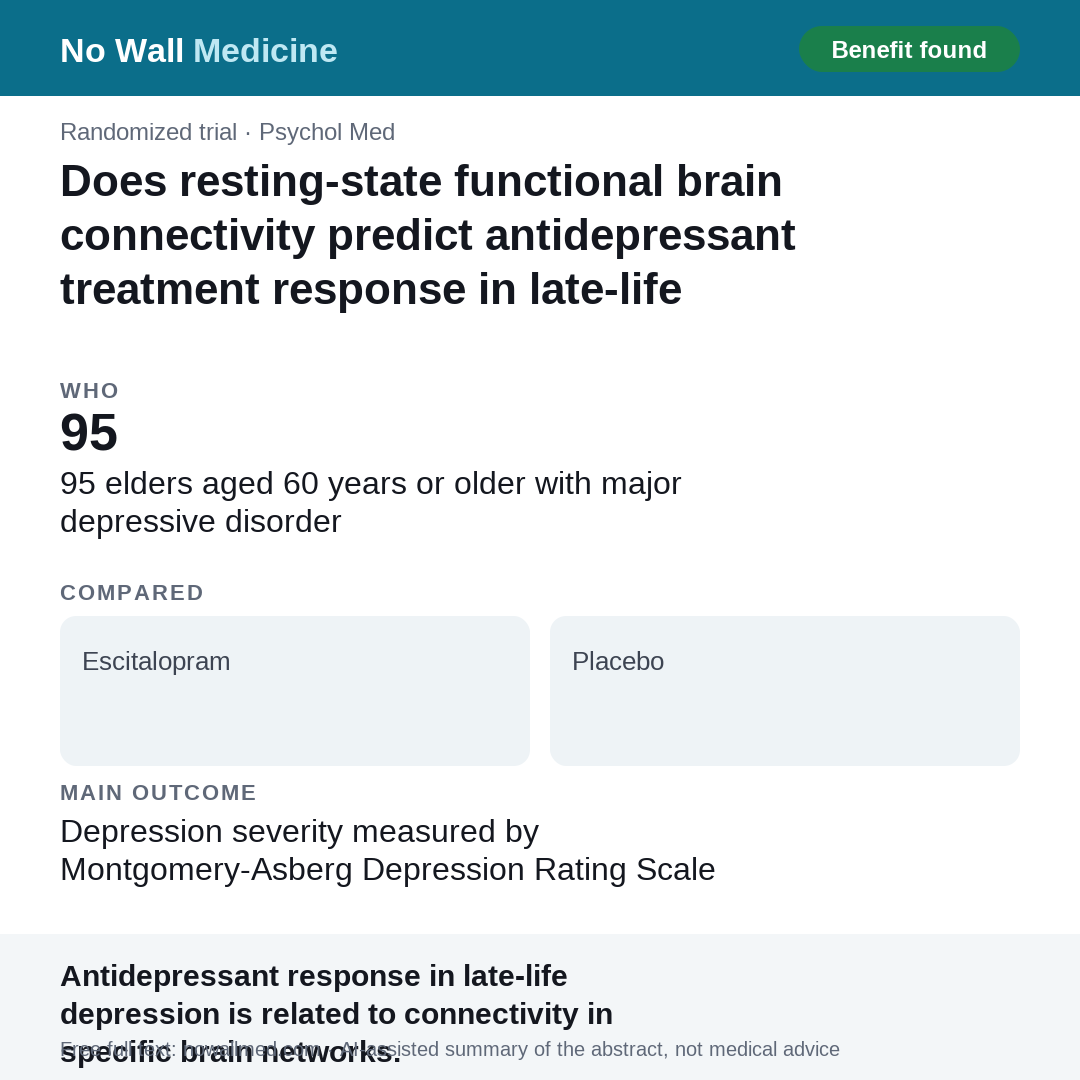
Does resting-state functional brain connectivity predict antidepressant treatment response in late-life depression?
Who
95
95 elders aged 60 years or older with major depressive disorder
Compared
Escitalopram
Placebo
Main outcome
Depression severity measured by Montgomery-Asberg Depression Rating Scale
Bottom line: Antidepressant response in late-life depression is related to connectivity in specific brain networks.
Psychol Med · 2022-12-09Download image
Clinical question: Does resting-state functional brain connectivity predict antidepressant treatment response in late-life depression?
Why it matters: It was unknown whether pre-treatment connectivity within intrinsic brain networks could predict how well older adults respond to antidepressant medications.
Key points
- Researchers studied 95 elders aged 60 years or older with major depressive disorder who were randomized to receive either escitalopram or a placebo.
- Higher connectivity between the posterior cingulate cortex and the left medial prefrontal cortex was associated with lower post-treatment depression severity scores.
- Lower connectivity between the right orbitofrontal cortex and the left amygdala was also associated with lower post-treatment depression severity scores.
Headline and key points written with AI from the paper’s abstract, with every number checked against it. Read the paper before relying on them.
Was this summary helpful?
Subject terms
Cite this article
Ahmed R, Boyd BD, Elson D, Albert K, Begnoche P, Kang H. Influences of resting-state intrinsic functional brain connectivity on the antidepressant treatment response in late-life depression. Psychol Med. 2022. doi:10.1017/S0033291722003579
Spotted a mistake? Suggest a correction