Influences of resting-state intrinsic functional brain connectivity on the antidepressant treatment response in late-life depression
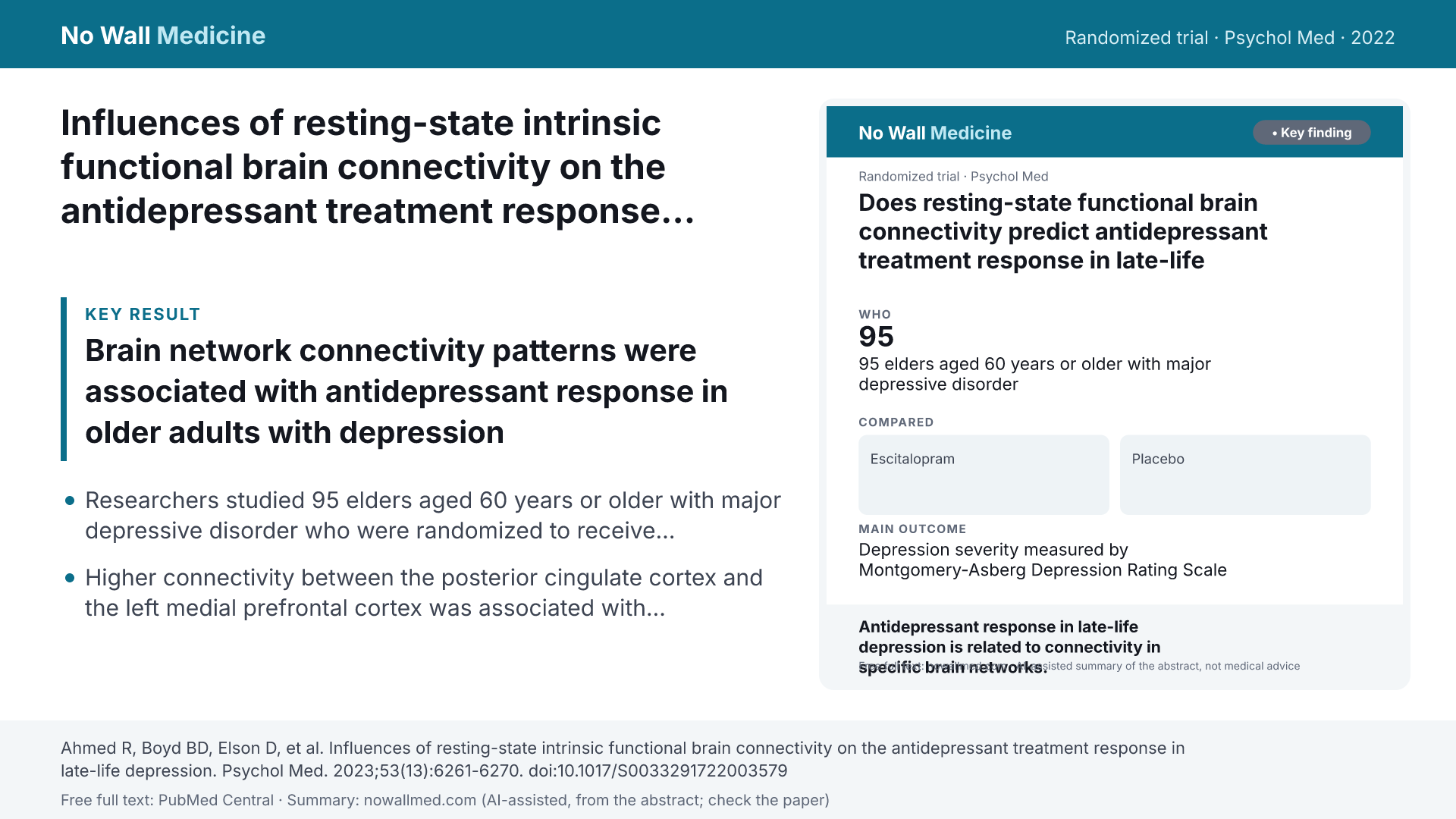
Key result: Brain network connectivity patterns were associated with antidepressant response in older adults with depression
Randomized trialKey finding
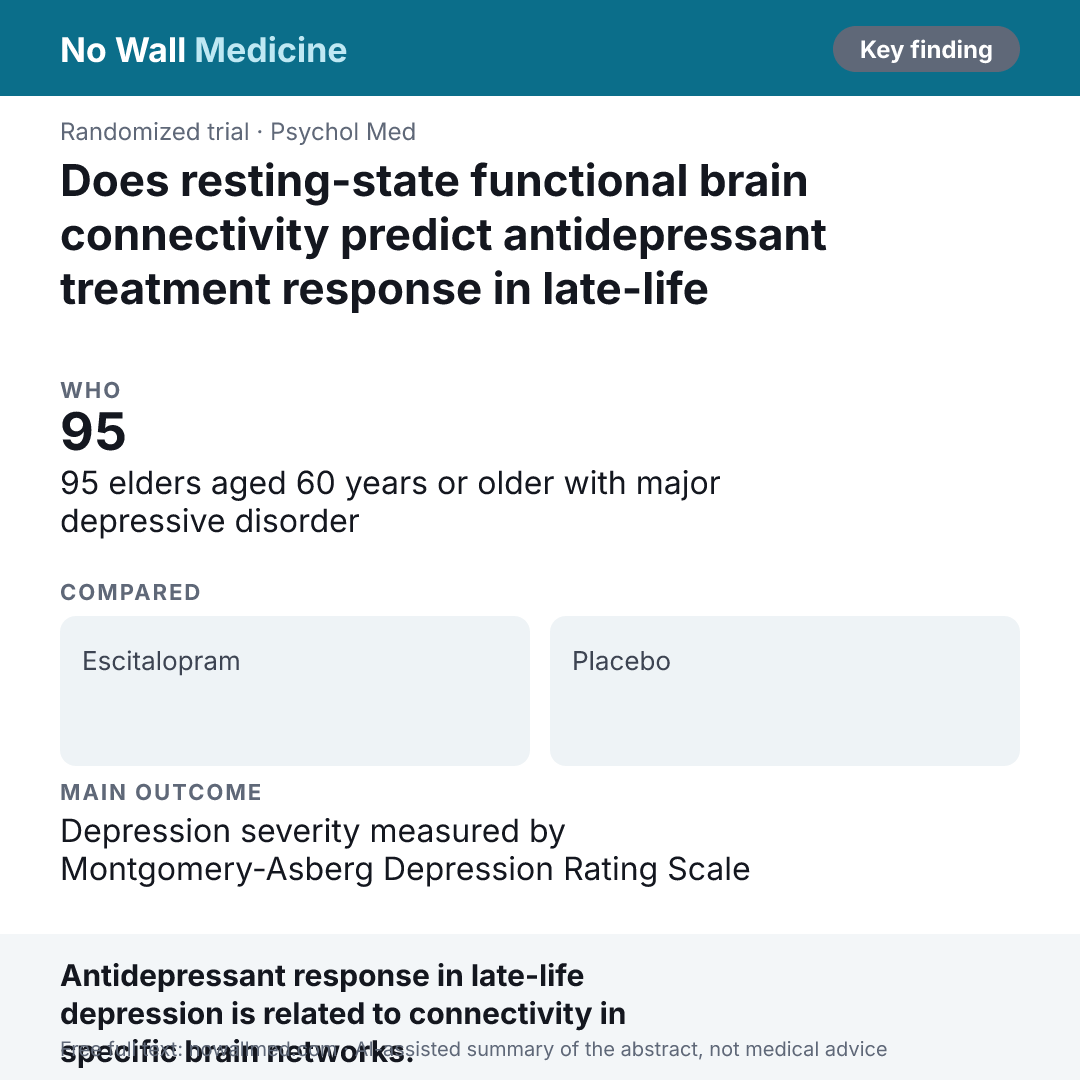
Does resting-state functional brain connectivity predict antidepressant treatment response in late-life depression?
Who
95
95 elders aged 60 years or older with major depressive disorder
Compared
Escitalopram
Placebo
Main outcome
Depression severity measured by Montgomery-Asberg Depression Rating Scale
Bottom line: Antidepressant response in late-life depression is related to connectivity in specific brain networks.
Psychol Med · 2022-12-09 · Save PNG
Key points
- Researchers studied 95 elders aged 60 years or older with major depressive disorder who were randomized to receive either escitalopram or a placebo.
- Higher connectivity between the posterior cingulate cortex and the left medial prefrontal cortex was associated with lower post-treatment depression severity scores.
- Lower connectivity between the right orbitofrontal cortex and the left amygdala was also associated with lower post-treatment depression severity scores.
Discussion prompts
- Would these patients look like yours? Who was left out?
- Is the main outcome one that matters to patients?
- Is the difference large enough to change what you do?
Cite: Ahmed R, Boyd BD, Elson D, et al. Influences of resting-state intrinsic functional brain connectivity on the antidepressant treatment response in late-life depression. Psychol Med. 2023;53(13):6261-6270. doi:10.1017/S0033291722003579
Free full text: PubMed Central · Summary and visual abstract: nowallmed.com/a/influences-of-resting-state-intrinsic-functional-brain-connectivity-ur9riu/ (AI-assisted from the abstract; check the paper before relying on it).