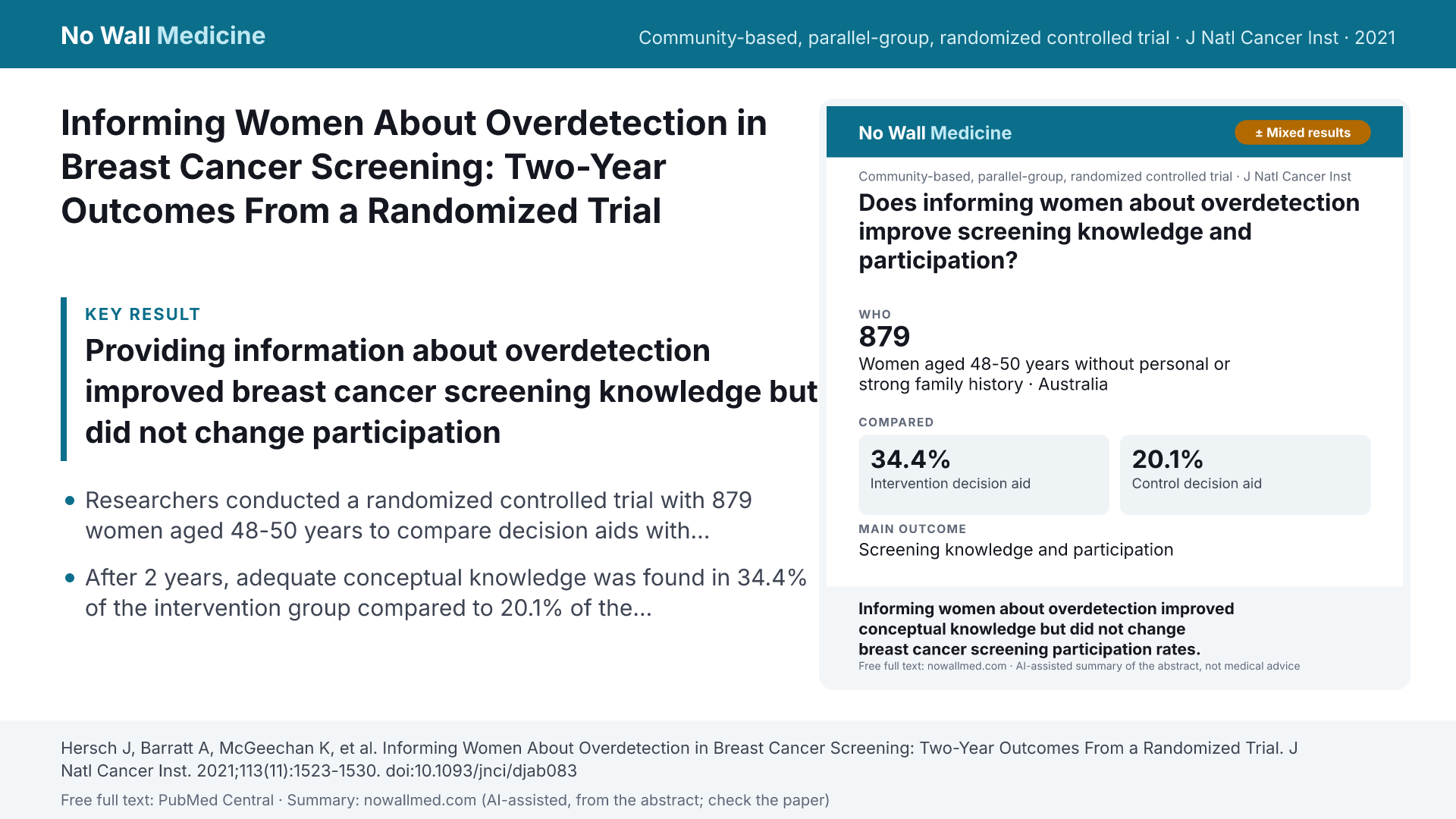
Providing information about overdetection improved breast cancer screening knowledge but did not change participation
Informing Women About Overdetection in Breast Cancer Screening: Two-Year Outcomes From a Randomized Trial
Community-based, parallel-group, randomized controlled trialMixed results
Does informing women about overdetection improve screening knowledge and participation?
Who
879
Women aged 48-50 years without personal or strong family history · Australia
Compared
34.4%Intervention decision aid
20.1%Control decision aid
Main outcome
Screening knowledge and participation
Result: odds ratio = 2.04, 95% confidence interval = 1.46 to 2.85
Bottom line: Informing women about overdetection improved conceptual knowledge but did not change breast cancer screening participation rates.
J Natl Cancer Inst · 2021-04-20 · Save PNG
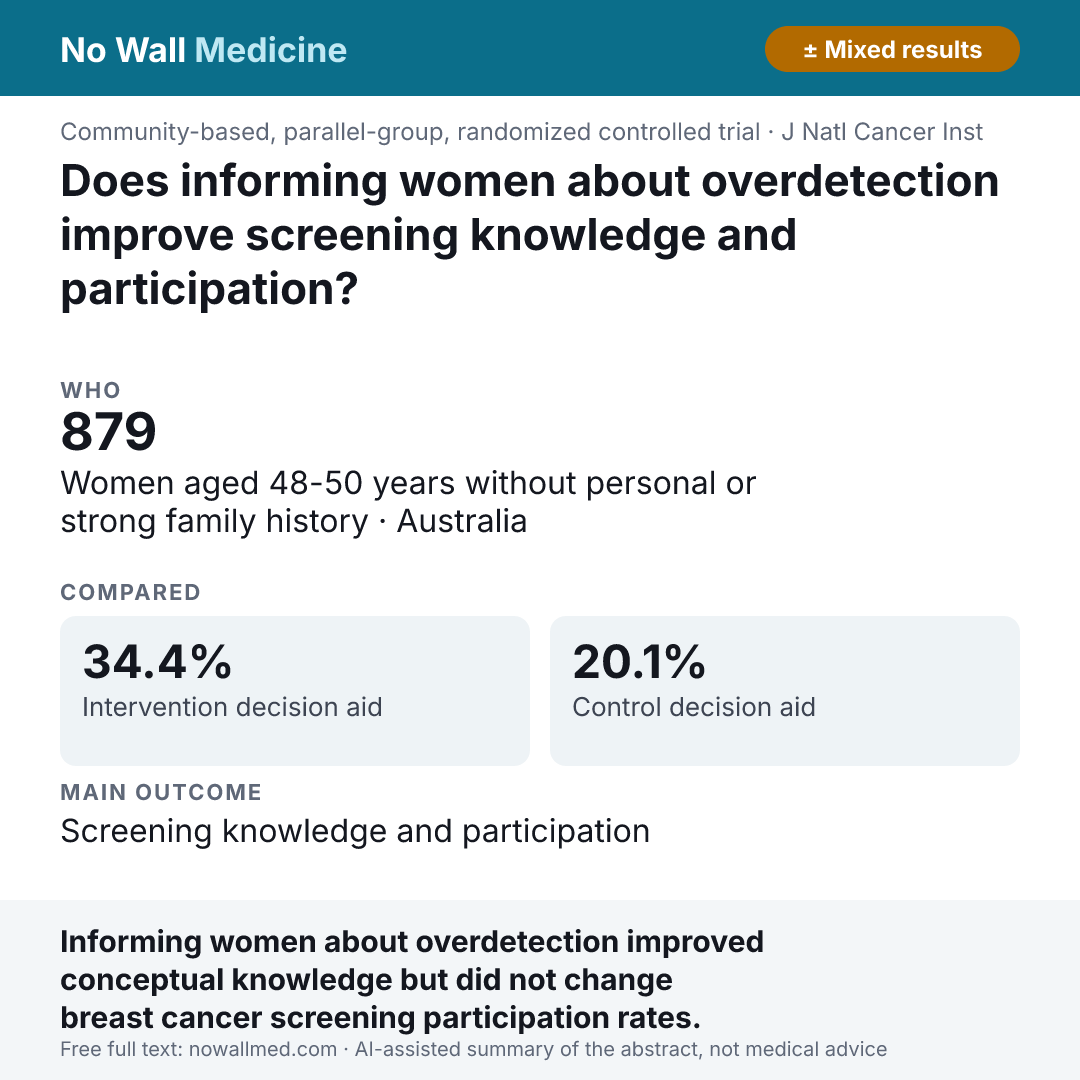
Clinical question: Does informing women about overdetection improve screening knowledge and participation?
Key points
- Researchers conducted a randomized controlled trial with 879 women aged 48-50 years to compare decision aids with and without information on overdetection.
- After 2 years, adequate conceptual knowledge was found in 34.4% of the intervention group compared to 20.1% of the control group.
- Total screening participation rates were similar between the groups at 55.1% for the intervention group and 56.0% for the control group.
Headline and key points written with AI from the paper’s abstract, with every number checked against it. Read the paper before relying on them.
Was this summary helpful?
Subject terms
Headline, design, result, key points, caveat and citation as plain text.
Cite this article
Hersch J, Barratt A, McGeechan K, et al. Informing Women About Overdetection in Breast Cancer Screening: Two-Year Outcomes From a Randomized Trial. J Natl Cancer Inst. 2021;113(11):1523-1530. doi:10.1093/jnci/djab083
Spotted a mistake? Suggest a correction