Inhalational exposures associated with risk of interstitial lung disease: a systematic review and meta-analysis
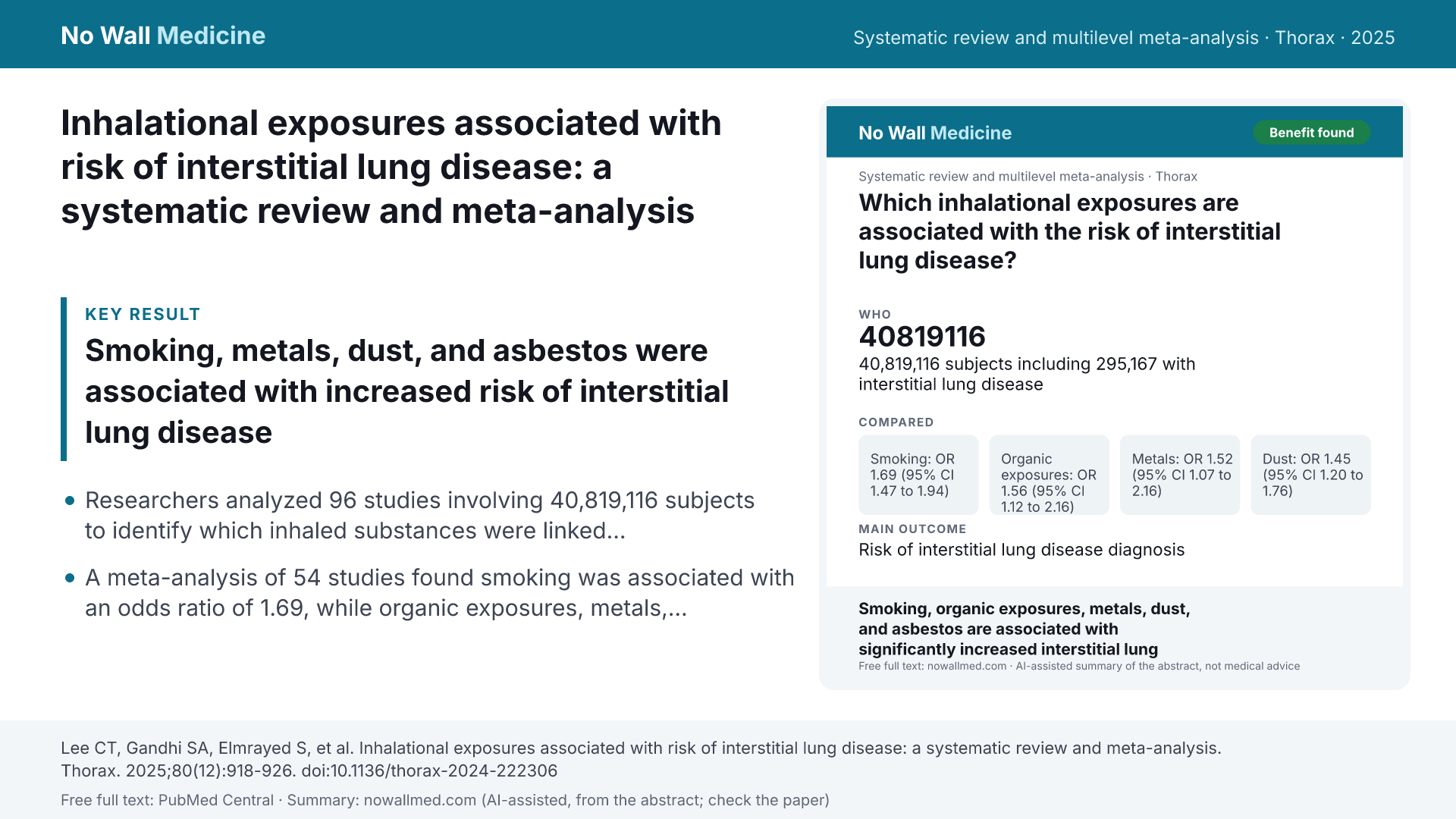
Key result: Smoking, metals, dust, and asbestos were associated with increased risk of interstitial lung disease
Systematic review and multilevel meta-analysisBenefit found
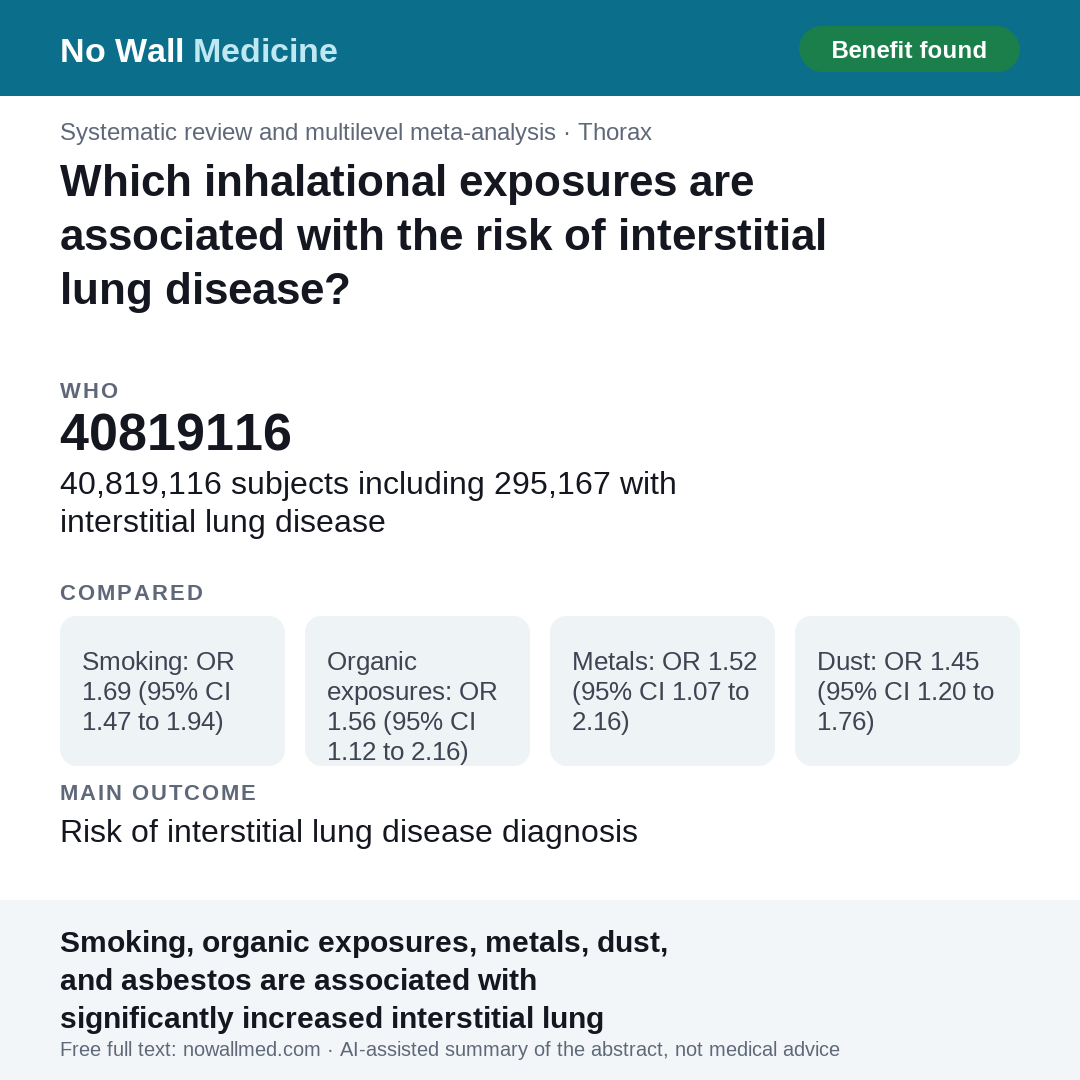
Which inhalational exposures are associated with the risk of interstitial lung disease?
Who
40819116
40,819,116 subjects including 295,167 with interstitial lung disease
Compared
Smoking: OR 1.69 (95% CI 1.47 to 1.94)
Organic exposures: OR 1.56 (95% CI 1.12 to 2.16)
Metals: OR 1.52 (95% CI 1.07 to 2.16)
Dust: OR 1.45 (95% CI 1.20 to 1.76)
Main outcome
Risk of interstitial lung disease diagnosis
Bottom line: Smoking, organic exposures, metals, dust, and asbestos are associated with significantly increased interstitial lung disease risk.
Limitation: Silica and fumes had positive associations that trended towards significance but were not significant.
Thorax · 2025-11-14Download image
Key points
- Researchers analyzed 96 studies involving 40,819,116 subjects to identify which inhaled substances were linked to interstitial lung disease, a group of lung disorders.
- A meta-analysis of 54 studies found smoking was associated with an odds ratio of 1.69, while organic exposures, metals, dust, and asbestos also showed increased risks.
- Silica and fumes were associated with interstitial lung disease, though these findings trended towards significance rather than reaching it.
Why it matters: The relationship between specific inhaled substances and the risk of developing interstitial lung disease is poorly characterized.
Discussion prompts
- Would these patients look like yours? Who was left out?
- Is the main outcome one that matters to patients?
- Is the difference large enough to change what you do?
Cite: Lee CT, Gandhi SA, Elmrayed S, et al. Inhalational exposures associated with risk of interstitial lung disease: a systematic review and meta-analysis. Thorax. 2025. doi:10.1136/thorax-2024-222306
Free full text: PubMed Central · Summary and visual abstract: nowallmed.com/a/inhalational-exposures-associated-with-risk-of-interstitial-lung-s4fcsp/ (AI-assisted from the abstract; check the paper before relying on it).