Inhaled colistimethate sodium results varied between two randomized trials for bronchiectasis patients
Inhaled colistimethate sodium in patients with bronchiectasis and Pseudomonas aeruginosa infection: results of PROMIS-I and PROMIS-II, two randomised, double-blind, placebo-controlled phase 3 trials assessing safety and efficacy over 12 months
Randomised, double-blind, placebo-controlled phase 3 trialsMixed results
Does inhaled colistimethate sodium improve exacerbation rates in bronchiectasis patients with Pseudomonas aeruginosa?
Who
Patients with bronchiectasis, Pseudomonas aeruginosa, and recent exacerbations · Multiple countries including Argentina, Australia, Canada, and USA
Compared
0·58Colistimethate sodium (PROMIS-I)
0·95Placebo (PROMIS-I)
0·89Colistimethate sodium (PROMIS-II)
0·89Placebo (PROMIS-II)
Main outcome
mean annual exacerbation rate
Result: rate ratio 0·61 (95% CI 0·46-0·82) in PROMIS-I
Bottom line: PROMIS-I showed benefit in reducing exacerbations, but results were not replicated in the prematurely terminated PROMIS-II trial.
Funded by: Zambon
Lancet Respir Med · 2024-09-10Download image
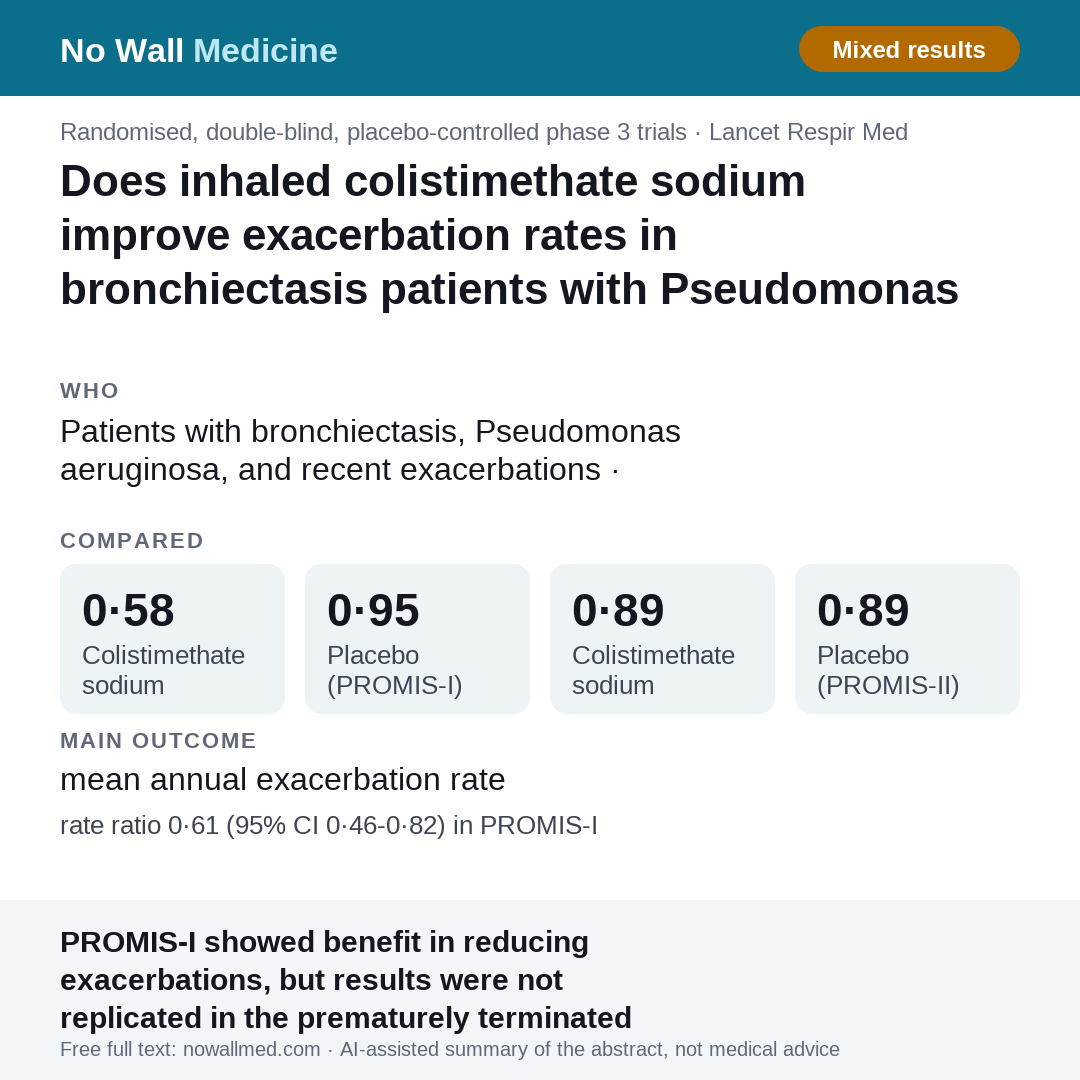
Clinical question: Does inhaled colistimethate sodium improve exacerbation rates in bronchiectasis patients with Pseudomonas aeruginosa?
Why it matters: It is unknown if 12 months of inhaled colistimethate sodium is effective for reducing lung infection flare-ups in people with bronchiectasis and Pseudomonas aeruginosa.
Key points
- In the PROMIS-I trial of 377 patients, the annual exacerbation rate was 0.58 for colistimethate sodium versus 0.95 for placebo.
- In the PROMIS-II trial of 287 patients, the annual exacerbation rate was 0.89 for both the colistimethate sodium and placebo groups.
- Adverse events occurred in 81% of patients in both groups in PROMIS-I, and in 81% of the colistimethate sodium group versus 77% of the placebo group in PROMIS-II.
Headline and key points written with AI from the paper’s abstract, with every number checked against it. Read the paper before relying on them.
Was this summary helpful?
Abstract
Background
Chronic lung infection with Pseudomonas aeruginosa is associated with increased exacerbations and mortality in people with bronchiectasis. The PROMIS-I and PROMIS-II trials investigated the efficacy and safety of 12-months of inhaled colistimethate sodium delivered via the I-neb. Methods
Two randomised, double-blind, placebo-controlled trials of twice per day colistimethate sodium versus placebo were conducted in patients with bronchiectasis with P aeruginosa and a history of at least two exacerbations requiring oral antibiotics or one requiring intravenous antibiotics in the previous year in hospitals in Argentina, Australia, Belgium, Canada, France, Germany, Greece, Israel, Italy, Netherlands, New Zealand, Poland, Portugal, Spain, Switzerland, the UK, and the USA. Randomisation was conducted through an interactive web response system and stratified by site and long term use of macrolides. Masking was achieved by providing colistimethate sodium and placebo in identical vials. After random assignment, study visits were scheduled for 1, 3, 6, 9, and 12 months (the end of the treatment period); and telephone calls were scheduled for 7 days after random assignment and 2 weeks after the end of treatment. The primary endpoint was the mean annual exacerbation rate. These trials are registered with EudraCT: number 2015-002743-33 (for PROMIS-I) and 2016-004558-13 (for PROMIS-II), and are now completed. Findings
377 patients were randomly assigned in PROMIS-I (177 to colistimethate sodium and 200 to placebo; in the modified intention-to-treat population, 176 were in the colistimethate sodium group and 197 were in the placebo group) between June 6, 2017, and April 8, 2020. The annual exacerbation rate was 0·58 in the colistimethate sodium group versus 0·95 in the placebo group (rate ratio 0·61; 95% CI 0·46-0·82; p=0·0010). 287 patients were randomly assigned in PROMIS-II (152 were assigned to colistimethate sodium and 135 were assigned to placebo, in the modified intention-to-treat population), between Feb 12, 2018, and Oct 22, 2021. PROMIS-II was then prematurely terminated due to the effect of the COVID-19 pandemic. No significant difference was observed in the annual exacerbation rate between the colistimethate sodium and placebo groups (0·89 vs 0·89; rate ratio 1·00; 95% CI 0·75-1·35; p=0·98). No major safety issues were identified. The overall frequency of adverse events was 142 (81%) patients in the colistimethate sodium group versus 159 (81%) patients in the placebo group in PROMIS-I, and 123 (81%) patients versus 104 (77%) patients in PROMIS-II. There were no deaths related to study treatment. Interpretation
The data from PROMIS-I suggest a clinically important benefit of colistimethate sodium delivered via the I-neb adaptive aerosol delivery system in patients with bronchiectasis and P aeruginosa infection. These results were not replicated in PROMIS-II, which was affected by the COVID-19 pandemic and prematurely terminated. Funding
Zambon.
Abstract reproduced under the article’s CC BY licence.
Subject terms
Cite this article
Haworth CS, Shteinberg M, Winthrop K, Barker A, Blasi F, Dimakou K. Inhaled colistimethate sodium in patients with bronchiectasis and Pseudomonas aeruginosa infection: results of PROMIS-I and PROMIS-II, two randomised, double-blind, placebo-controlled phase 3 trials assessing safety and efficacy over 12 months. Lancet Respir Med. 2024. doi:10.1016/S2213-2600(24)00225-X
Spotted a mistake? Suggest a correction
Top studies every Monday
The week’s key trials and guidelines in your specialties, plus any topics you follow. By email, free.
Get the weekly digest