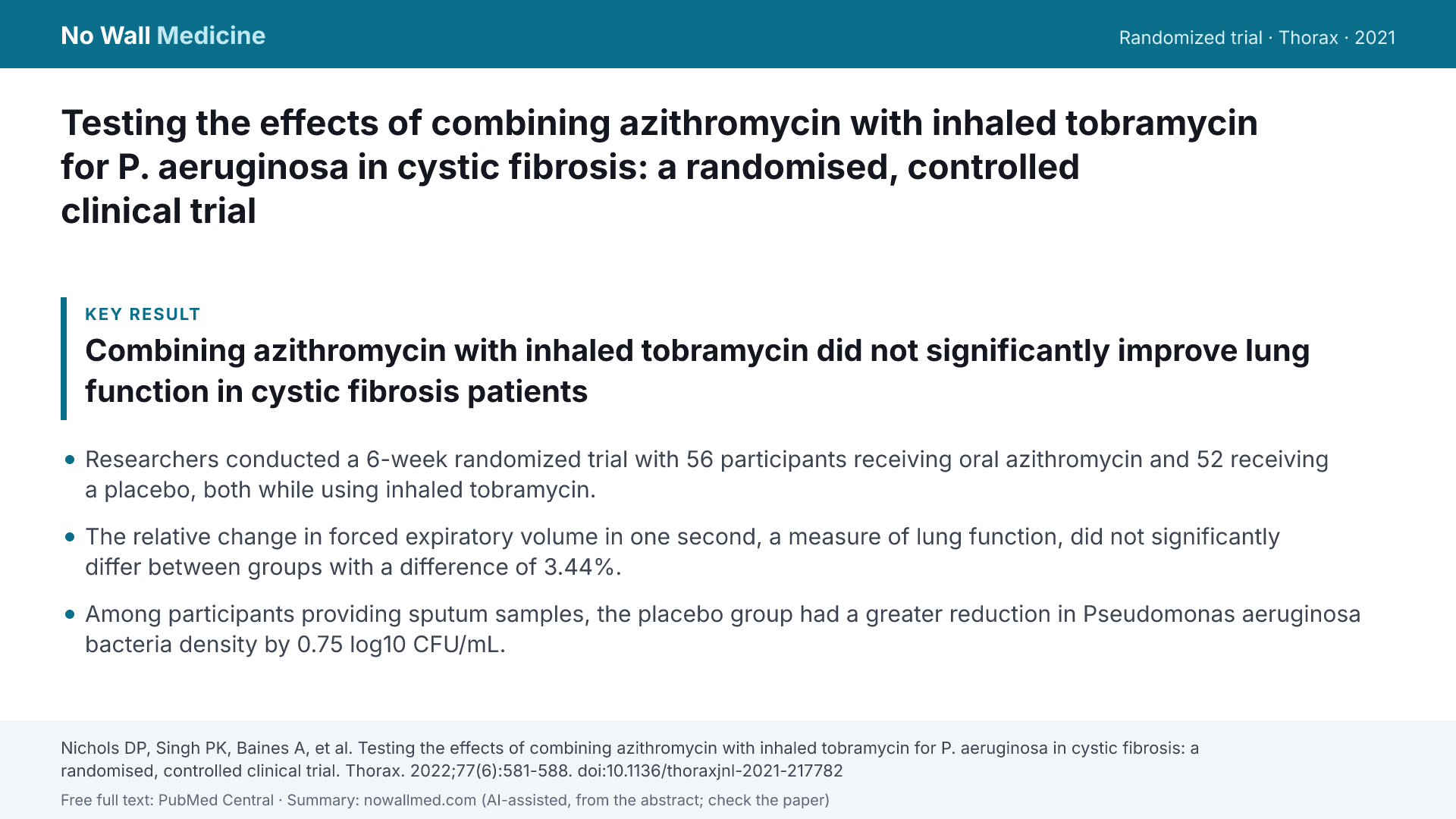
Combining azithromycin with inhaled tobramycin did not significantly improve lung function in cystic fibrosis patients
Testing the effects of combining azithromycin with inhaled tobramycin for P. aeruginosa in cystic fibrosis: a randomised, controlled clinical trial
Why it matters: It was unknown if adding oral azithromycin to inhaled tobramycin would affect clinical outcomes or the ability of tobramycin to kill Pseudomonas aeruginosa bacteria.
Key points
- Researchers conducted a 6-week randomized trial with 56 participants receiving oral azithromycin and 52 receiving a placebo, both while using inhaled tobramycin.
- The relative change in forced expiratory volume in one second, a measure of lung function, did not significantly differ between groups with a difference of 3.44%.
- Among participants providing sputum samples, the placebo group had a greater reduction in Pseudomonas aeruginosa bacteria density by 0.75 log10 CFU/mL.
Headline and key points written with AI from the paper’s abstract, with every number checked against it. Read the paper before relying on them.
Was this summary helpful?
Abstract
Rationale
Inhaled tobramycin and oral azithromycin are common chronic therapies in people with cystic fibrosis and Pseudomonas aeruginosa airway infection. Some studies have shown that azithromycin can reduce the ability of tobramycin to kill P. aeruginosa. This trial was done to test the effects of combining azithromycin with inhaled tobramycin on clinical and microbiological outcomes in people already using inhaled tobramycin. We theorised that those randomised to placebo (no azithromycin) would have greater improvement in forced expiratory volume in one second (FEV1) and greater reduction in P. aeruginosa sputum in response to tobramycin. Methods
A 6-week prospective, randomised, placebo-controlled, double-blind trial testing oral azithromycin versus placebo combined with clinically prescribed inhaled tobramycin in individuals with cystic fibrosis and P. aeruginosa airway infection. Results
Over a 6-week period, including 4 weeks of inhaled tobramycin, the relative change in FEV1 did not statistically significantly differ between groups (azithromycin (n=56) minus placebo (n=52) difference: 3.44%; 95% CI: -0.48 to 7.35; p=0.085). Differences in secondary clinical outcomes, including patient-reported symptom scores, weight and need for additional antibiotics, did not significantly differ. Among the 29 azithromycin and 35 placebo participants providing paired sputum samples, the 6-week change in P. aeruginosa density differed in favour of the placebo group (difference: 0.75 log10 CFU/mL; 95% CI: 0.03 to 1.47; p=0.043). Conclusions
Despite having greater reduction in P. aeruginosa density in participants able to provide sputum samples, participants randomised to placebo with inhaled tobramycin did not experience significantly greater improvements in lung function or other clinical outcomes compared with those randomised to azithromycin with tobramycin.
Abstract reproduced under the article’s CC BY NC licence.
Subject terms
Cite this article
Nichols DP, Singh PK, Baines A, et al. Testing the effects of combining azithromycin with inhaled tobramycin for P. aeruginosa in cystic fibrosis: a randomised, controlled clinical trial. Thorax. 2021. doi:10.1136/thoraxjnl-2021-217782
Spotted a mistake? Suggest a correction