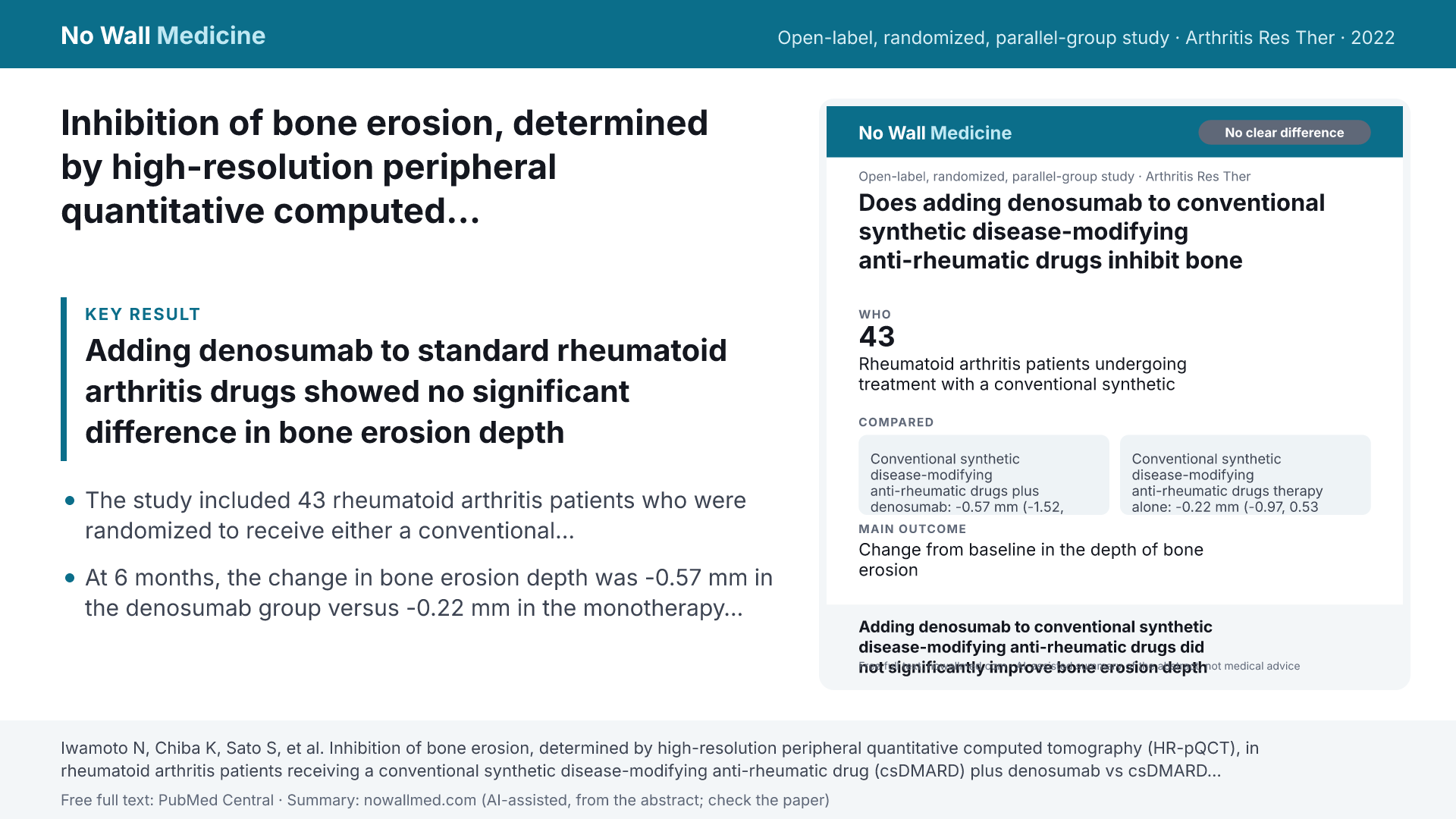
Adding denosumab to standard rheumatoid arthritis drugs showed no significant difference in bone erosion depth
Inhibition of bone erosion, determined by high-resolution peripheral quantitative computed tomography (HR-pQCT), in rheumatoid arthritis patients receiving a conventional synthetic disease-modifying anti-rheumatic drug (csDMARD) plus denosumab vs csDMARD therapy alone: an open-label, randomized, parallel-group study
Open-label, randomized, parallel-group studyNo clear difference
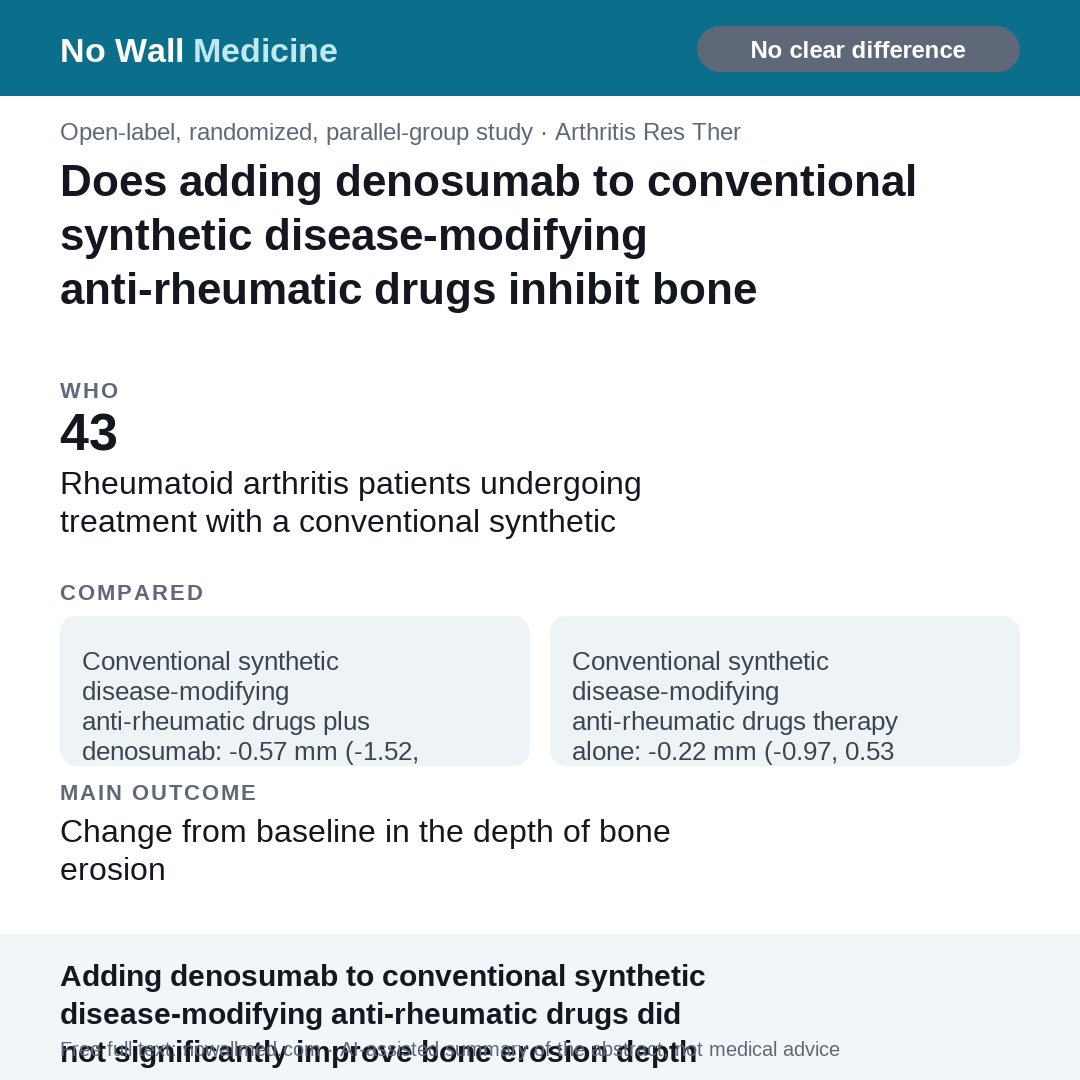
Does adding denosumab to conventional synthetic disease-modifying anti-rheumatic drugs inhibit bone erosion progression?
Who
43
Rheumatoid arthritis patients undergoing treatment with a conventional synthetic disease-modifying anti-rheumatic drug
Compared
Conventional synthetic disease-modifying anti-rheumatic drugs plus denosumab: -0.57 mm (-1.52, 0.39 mm)
Conventional synthetic disease-modifying anti-rheumatic drugs therapy alone: -0.22 mm (-0.97, 0.53 mm)
Main outcome
Change from baseline in the depth of bone erosion
Result: -0.35 mm [-1.00, 0.31]
Bottom line: Adding denosumab to conventional synthetic disease-modifying anti-rheumatic drugs did not significantly improve bone erosion depth after 6 months.
Arthritis Res Ther · 2022-12-07Download image
Clinical question: Does adding denosumab to conventional synthetic disease-modifying anti-rheumatic drugs inhibit bone erosion progression?
Why it matters: It was unknown if adding denosumab to conventional synthetic disease-modifying anti-rheumatic drugs could inhibit bone erosion progression or improve bone micro-architecture in rheumatoid arthritis patients.
Key points
- The study included 43 rheumatoid arthritis patients who were randomized to receive either a conventional synthetic disease-modifying anti-rheumatic drug alone or combined with denosumab for 12 months.
- At 6 months, the change in bone erosion depth was -0.57 mm in the denosumab group versus -0.22 mm in the monotherapy group, which was not statistically significant (P = 0.2716).
- Adverse events occurred in 52.2% of the denosumab group and 56.5% of the monotherapy group, while serious adverse events were 4.3% and 8.7%, respectively.
Headline and key points written with AI from the paper’s abstract, with every number checked against it. Read the paper before relying on them.
Was this summary helpful?
Subject terms
Cite this article
Iwamoto N, Chiba K, Sato S, Shiraishi K, Watanabe K, Oki N. Inhibition of bone erosion, determined by high-resolution peripheral quantitative computed tomography (HR-pQCT), in rheumatoid arthritis patients receiving a conventional synthetic disease-modifying anti-rheumatic drug (csDMARD) plus denosumab vs csDMARD therapy alone: an open-label, randomized, parallel-group study. Arthritis Res Ther. 2022. doi:10.1186/s13075-022-02957-w
Spotted a mistake? Suggest a correction
Top studies every Monday
The week’s key trials and guidelines in your specialties, plus any topics you follow. By email, free.
Get the weekly digest