Five specific tools were found to be valid and reliable for measuring fatigue in rheumatic diseases
Instruments for measuring fatigue in people with rheumatic and musculoskeletal diseases: a systematic review of measurement properties
Systematic reviewUnclear result
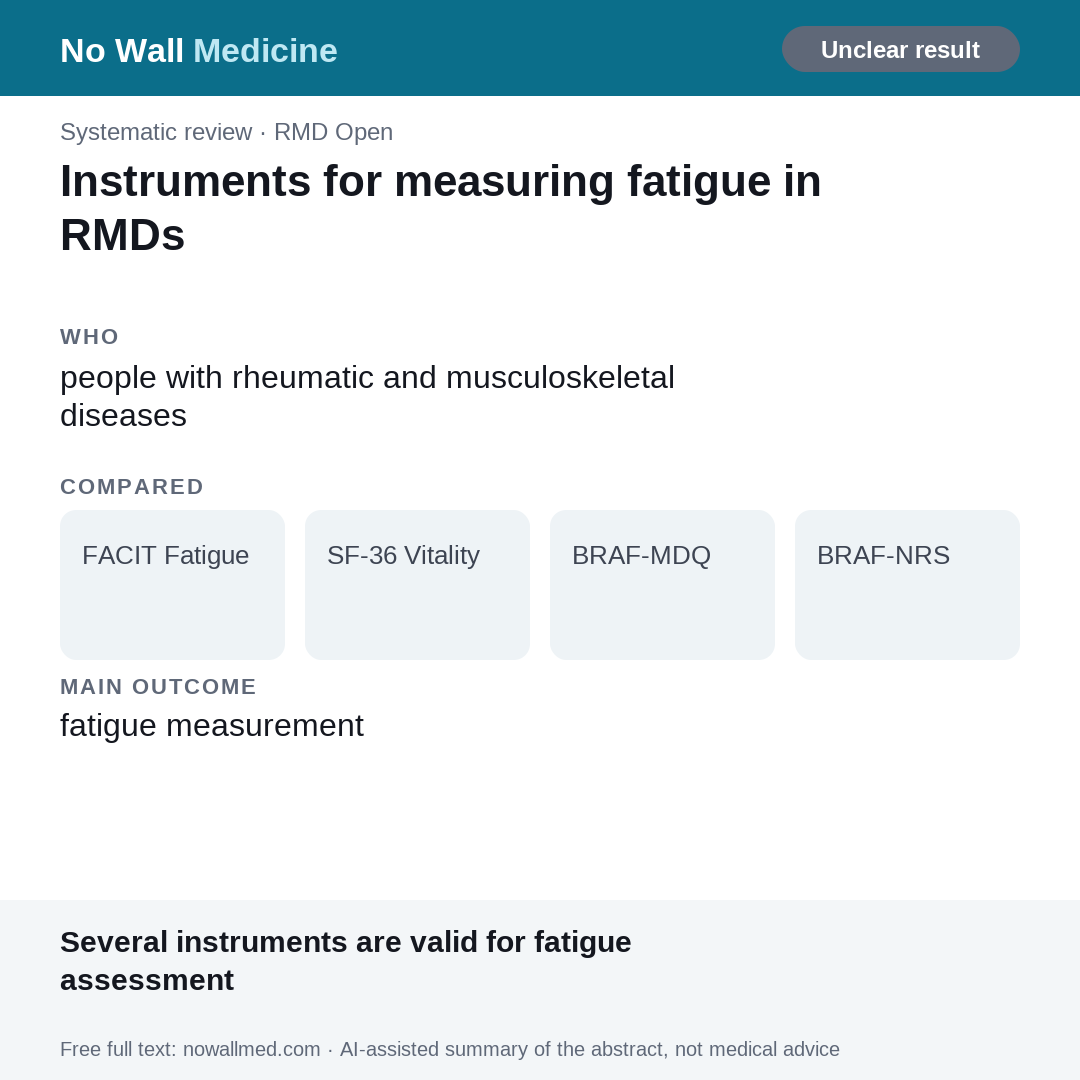
Instruments for measuring fatigue in RMDs
Who
people with rheumatic and musculoskeletal diseases
Compared
FACIT Fatigue
SF-36 Vitality
BRAF-MDQ
BRAF-NRS
Main outcome
fatigue measurement
Bottom line: Several instruments are valid for fatigue assessment
Limitation: limited evidence on clinical trial discrimination
RMD Open · 2025-10-23Download image
Why it matters: Clinicians and researchers need reliable tools to accurately assess fatigue levels in patients living with rheumatic and musculoskeletal diseases.
Key points
- Researchers reviewed 60 studies evaluating 27 different tools used to measure fatigue in children and adults with rheumatic and musculoskeletal diseases.
- Five instruments—FACIT-Fatigue, SF-36 Vitality, BRAF-MDQ, BRAF-NRS, and FSS—were rated as valid, reliable, and having a low risk of bias.
- Most studies focused on construct validity (90%) and intermethod reliability (75%), while responsiveness (23.3%) and test-retest reliability (21.7%) were less frequently assessed.
Limitation the authors note: Evidence regarding clinical trial discrimination and thresholds of meaningful change was limited or absent.
Headline and key points written with AI from the paper’s abstract, with every number checked against it. Read the paper before relying on them.
Abstract
Objective
To summarise the measurement properties of instruments used to assess fatigue in people with rheumatic and musculoskeletal diseases (RMDs). Methods
A systematic review (SR) of measurement properties was conducted in children, adolescents/young adults and adults with RMDs, following Joanna Briggs Institute and COSMIN (COnsensus-based Standards for the selection of health Measurement INstruments) guidelines. Searches were performed in Medline, Embase, CINAHL and Cochrane Library. Risk of bias assessment, data extraction and synthesis were conducted independently by two reviewers. Instruments were assessed according to Outcome Measures in Rheumatology (OMERACT) criteria. Results
Out of 16 657 records, 109 articles underwent full-text review, and 60 met inclusion criteria. These studies evaluated the psychometric properties of 27 instruments. Most studies focused on construct validity (54/60, 90%) and intermethod reliability (45/60, 75%), with an overall low risk of bias. In contrast, test-retest reliability (13/60, 21.7%) and responsiveness (14/60, 23.3%) were less frequently assessed, but also with an overall low risk of bias. Evidence regarding clinical trial discrimination and thresholds of meaningful change was limited or absent, indicating the need for further research in these domains. Only five instruments-the Functional Assessment of Chronic Illness Therapy (FACIT) Fatigue, the 36-Item Short Form Survey Instrument (SF-36) Vitality, the Bristol Rheumatoid Arthritis Fatigue Multi-Dimensional Questionnaire (BRAF-MDQ), the BRAF Numerical Rating Scales (BRAF-NRS) and the Fatigue Severity Scale (FSS)-were rated as valid, reliable and low risk of bias, fulfilling OMERACT endorsement criteria. Conclusions
This SR comprehensively supports the use of several well-validated instruments to assess fatigue, particularly FACIT-Fatigue, SF-36 Vitality, BRAF-MDQ, BRAF-NRS and FSS, in both clinical and research settings. Prospero registration number
CRD42024507112.
Abstract reproduced under the article’s CC BY NC licence.
Topics
Cite this article
Santos EJF, Farisogullari B, Fishpool K, Young G, Ciurtin C, Cramp F. Instruments for measuring fatigue in people with rheumatic and musculoskeletal diseases: a systematic review of measurement properties. RMD Open. 2025. doi:10.1136/rmdopen-2025-006079
Spotted a mistake? Suggest a correction