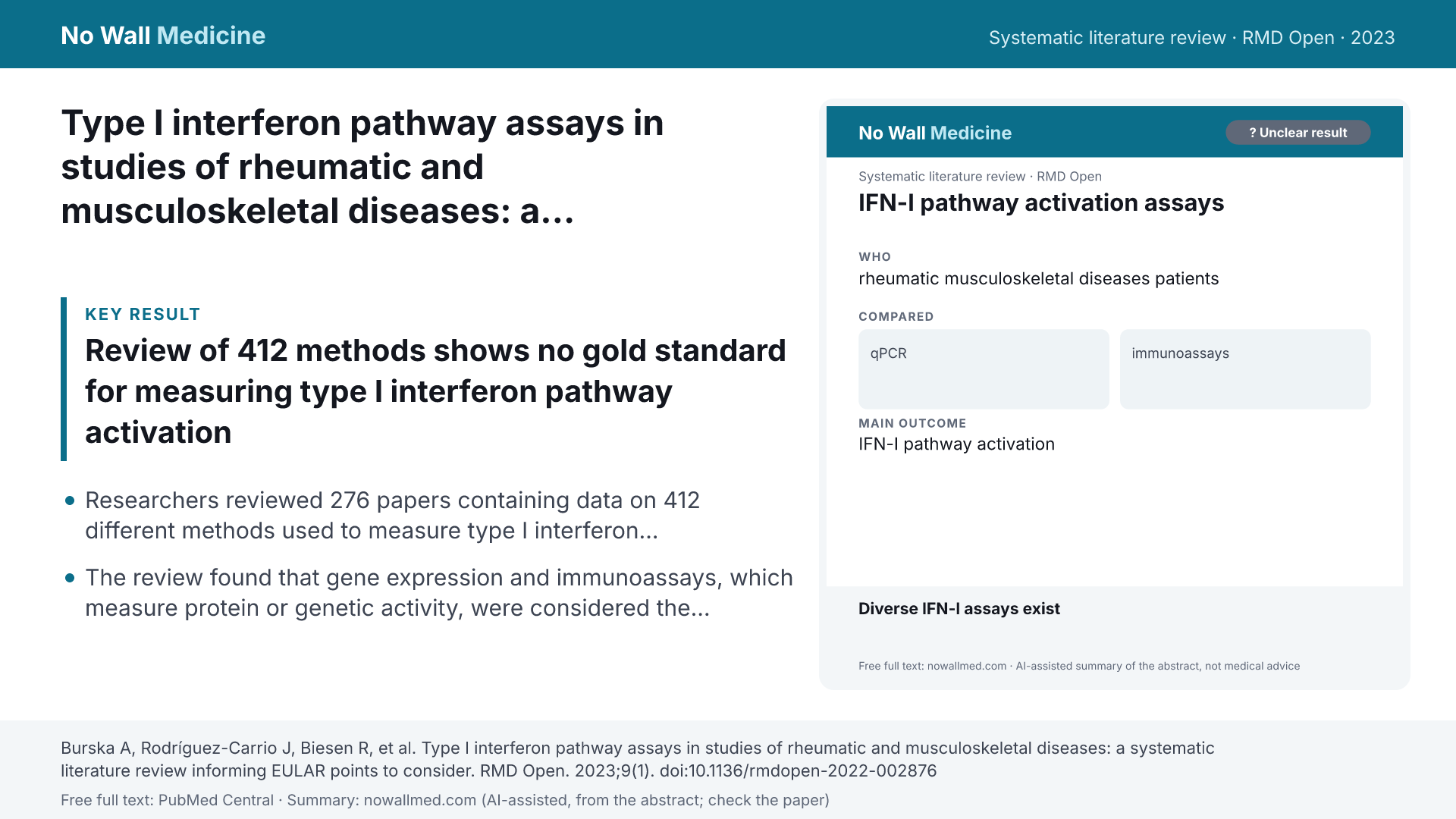
Review of 412 methods shows no gold standard for measuring type I interferon pathway activation
Type I interferon pathway assays in studies of rheumatic and musculoskeletal diseases: a systematic literature review informing EULAR points to consider
Systematic literature reviewUnclear result
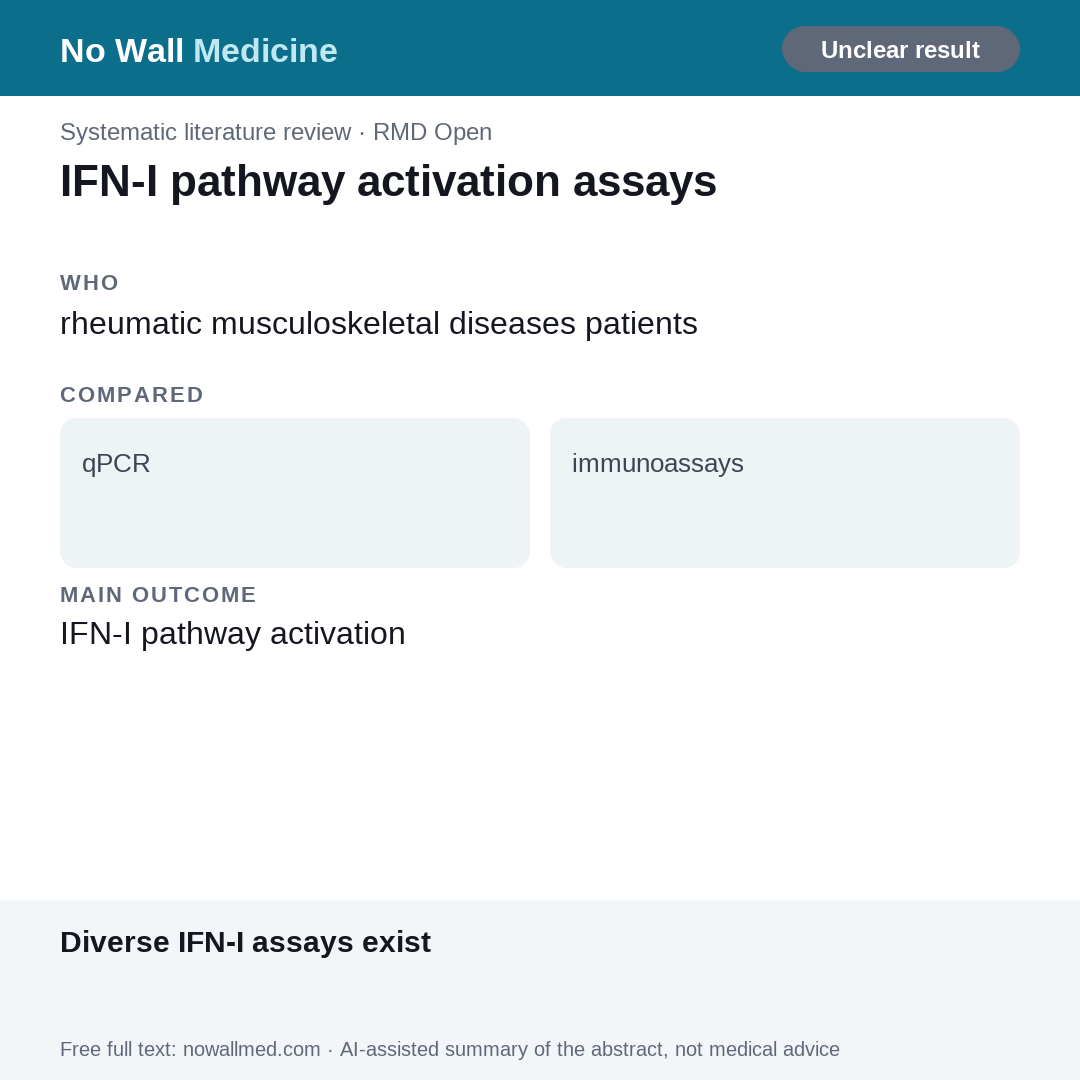
IFN-I pathway activation assays
Who
rheumatic musculoskeletal diseases patients
Compared
qPCR
immunoassays
Main outcome
IFN-I pathway activation
Bottom line: Diverse IFN-I assays exist
Limitation: limited reliability data
RMD Open · 2023-03-02Download image
Why it matters: There is a lack of standardized terminology and a single gold standard method to measure type I interferon pathway activation in rheumatic and musculoskeletal diseases.
Key points
- Researchers reviewed 276 papers containing data on 412 different methods used to measure type I interferon pathway activation in rheumatic and musculoskeletal diseases.
- The review found that gene expression and immunoassays, which measure protein or genetic activity, were considered the most feasible methods.
- Data regarding the reliability of these tests or how they compare to one another were limited, with reliability data provided for only 13 assays.
Limitation the authors note: Data on reliability or comparing different assays were limited.
Headline and key points written with AI from the paper’s abstract, with every number checked against it. Read the paper before relying on them.
Was this summary helpful?
Abstract
Objectives
To systematically review the literature for assay methods that aim to evaluate type I interferon (IFN-I) pathway activation and to harmonise-related terminology. Methods
Three databases were searched for reports of IFN-I and rheumatic musculoskeletal diseases. Information about the performance metrics of assays measuring IFN-I and measures of truth were extracted and summarised. A EULAR task force panel assessed feasibility and developed consensus terminology. Results
Of 10 037 abstracts, 276 fulfilled eligibility criteria for data extraction. Some reported more than one technique to measure IFN-I pathway activation. Hence, 276 papers generated data on 412 methods. IFN-I pathway activation was measured using: qPCR (n=121), immunoassays (n=101), microarray (n=69), reporter cell assay (n=38), DNA methylation (n=14), flow cytometry (n=14), cytopathic effect assay (n=11), RNA sequencing (n=9), plaque reduction assay (n=8), Nanostring (n=5), bisulphite sequencing (n=3). Principles of each assay are summarised for content validity. Concurrent validity (correlation with other IFN assays) was presented for n=150/412 assays. Reliability data were variable and provided for 13 assays. Gene expression and immunoassays were considered most feasible. Consensus terminology to define different aspects of IFN-I research and practice was produced. Conclusions
Diverse methods have been reported as IFN-I assays and these differ in what elements or aspects of IFN-I pathway activation they measure and how. No 'gold standard' represents the entirety of the IFN pathway, some may not be specific for IFN-I. Data on reliability or comparing assays were limited, and feasibility is a challenge for many assays. Consensus terminology should improve consistency of reporting.
Abstract reproduced under the article’s CC BY licence.
Subject terms
Cite this article
Burska A, Rodríguez-Carrio J, Biesen R, et al. Type I interferon pathway assays in studies of rheumatic and musculoskeletal diseases: a systematic literature review informing EULAR points to consider. RMD Open. 2023. doi:10.1136/rmdopen-2022-002876
Spotted a mistake? Suggest a correction