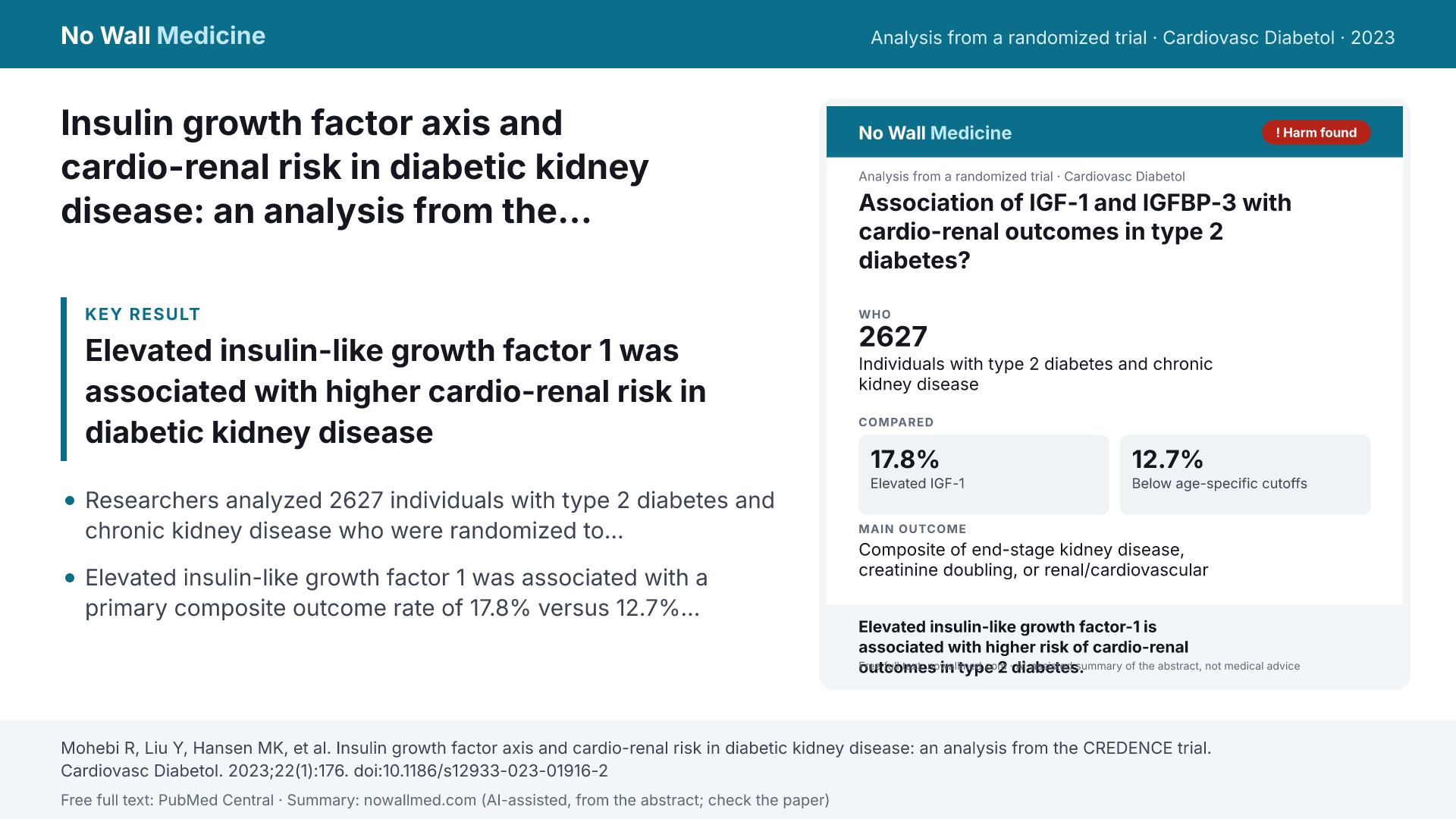
Elevated insulin-like growth factor 1 was associated with higher cardio-renal risk in diabetic kidney disease
Insulin growth factor axis and cardio-renal risk in diabetic kidney disease: an analysis from the CREDENCE trial
Analysis from a randomized trialHarm found
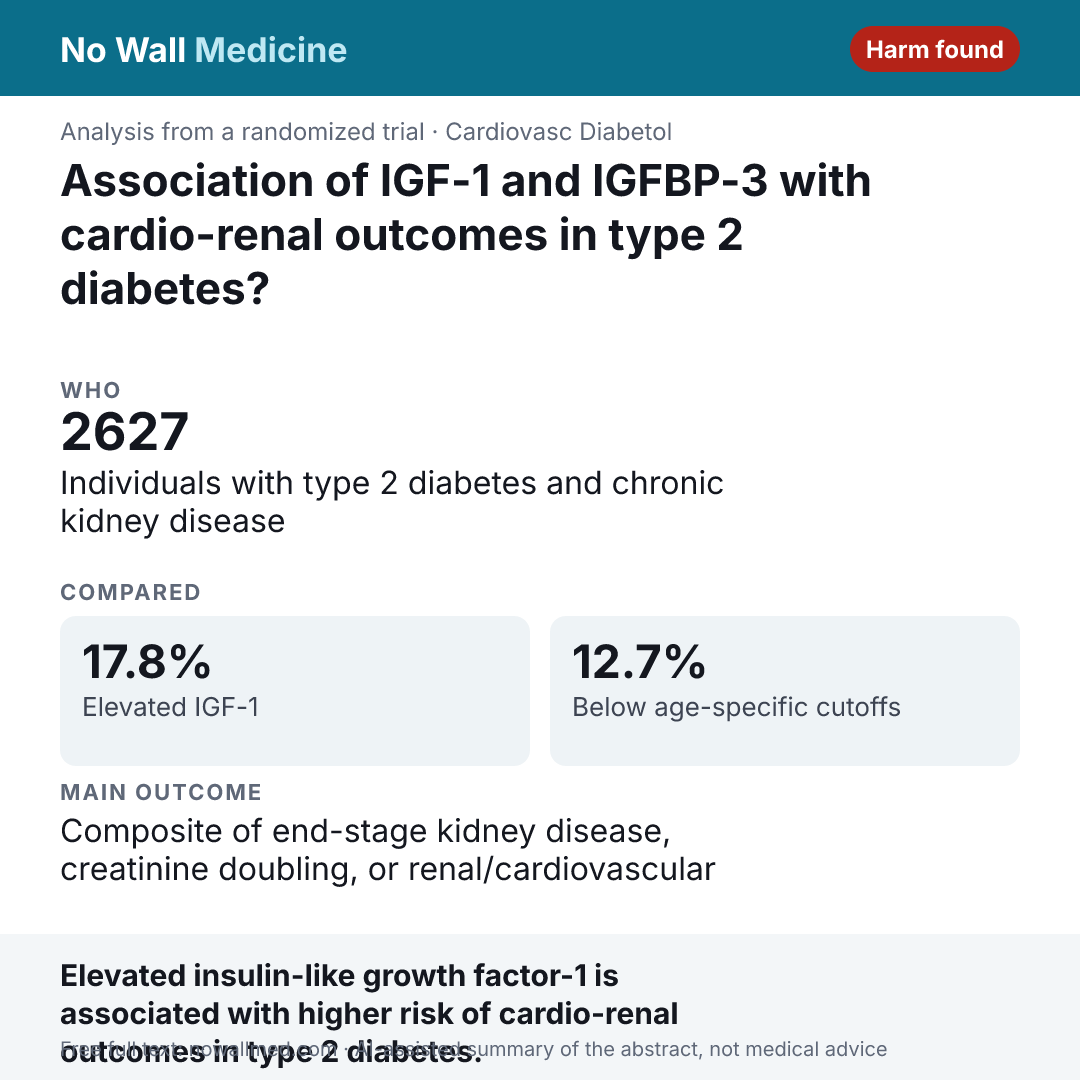
Association of IGF-1 and IGFBP-3 with cardio-renal outcomes in type 2 diabetes?
Who
2627
Individuals with type 2 diabetes and chronic kidney disease
Compared
17.8%Elevated IGF-1
12.7%Below age-specific cutoffs
Main outcome
Composite of end-stage kidney disease, creatinine doubling, or renal/cardiovascular death
Result: hazard ratio 1.52 (95% CI 1.09-2.13)
Bottom line: Elevated insulin-like growth factor-1 is associated with higher risk of cardio-renal outcomes in type 2 diabetes.
Cardiovasc Diabetol · 2023-07-12 · Save PNG
Same trial (NCT02065791)
Papers we list that report this registered trial, oldest first. Read a secondary analysis alongside the main results.
- Main results Benefit found
In type 2 diabetes with albuminuric chronic kidney disease, canagliflozin lowered the kidney or cardiovascular composite by 30% (HR 0.70) and end-stage kidney disease by 32% NEJM 2019-04 - Secondary analysis Benefit found
Canagliflozin effects on kidney and cardiovascular outcomes were consistent across different albuminuria levels CJASN 2021-02 - Related analysis Mixed results
Removing the Black race coefficient from kidney function equations affects participant inclusion and event rates CJASN 2022-01 - Secondary analysis Benefit found
Canagliflozin effects on kidney function decline varied based on baseline blood sugar levels CJASN 2023-03 - Secondary analysis Harm found
This paper Cardiovasc Diabetol 2023-07 - Pooled analysis Benefit found
Canagliflozin reduced heart failure hospitalizations across different levels of kidney function in diabetes patients Eur J Heart Fail 2024-06 - Pooled analysis Benefit found
Canagliflozin treatment was associated with a 41% lower need for increasing oral loop diuretics Eur J Heart Fail 2025-01 - Secondary analysis Benefit found
Canagliflozin benefits both frail and non-frail patients with type 2 diabetes in pooled analysis J Am Geriatr Soc 2025-03 - Secondary analysis Mixed results
Canagliflozin was associated with increased risk of heart attack in males with high red blood cell levels Blood Adv 2025-04 - Related analysis Key finding
Machine learning model predicts heart and kidney risks in patients with diabetic kidney disease Cardiovasc Diabetol 2025-05 - Secondary analysis Benefit found
Canagliflozin reduced kidney and heart risks in patients with elevated heart stress markers Eur J Heart Fail 2025-07
Clinical question: Association of IGF-1 and IGFBP-3 with cardio-renal outcomes in type 2 diabetes?
Key points
- Researchers analyzed 2627 individuals with type 2 diabetes and chronic kidney disease who were randomized to receive canagliflozin or a placebo.
- Elevated insulin-like growth factor 1 was associated with a primary composite outcome rate of 17.8% versus 12.7% (hazard ratio: 1.52; 95% CI 1.09-2.13; P: 0.01).
- An increase in the insulin-like growth factor 1 to insulin-like growth factor binding protein-3 ratio was associated with a higher risk of the primary composite outcome (hazard ratio: 1.57; 95% CI 1.09-2.26; P: 0.01).
Headline and key points written with AI from the paper’s abstract, with every number checked against it. Read the paper before relying on them.
Was this summary helpful?
Subject terms
Headline, design, result, key points, caveat and citation as plain text.
Cite this article
Mohebi R, Liu Y, Hansen MK, et al. Insulin growth factor axis and cardio-renal risk in diabetic kidney disease: an analysis from the CREDENCE trial. Cardiovasc Diabetol. 2023;22(1):176. doi:10.1186/s12933-023-01916-2
Spotted a mistake? Suggest a correction