Integra® versus Novosorb® biodegradable temporizing matrix for burn wounds: a comparative systematic review and meta analysis
Systematic review and meta-analysisMixed results
How do Integra and Novosorb Biodegradable Temporizing Matrix compare for burn wounds?
Who
Patients treated with artificial dermal matrices for burn wounds
Compared
Integra: 18.4 days integration time
Novosorb Biodegradable Temporizing Matrix: 32.11 days integration time
Main outcome
Integration time, skin graft take, infection rate, and wound closure
Bottom line: Novosorb Biodegradable Temporizing Matrix had longer integration time and higher infection rates but improved skin graft take.
Limitation: Very low-quality evidence and majority of studies were non-comparative case series.
Burns · 2025-10-27Download image
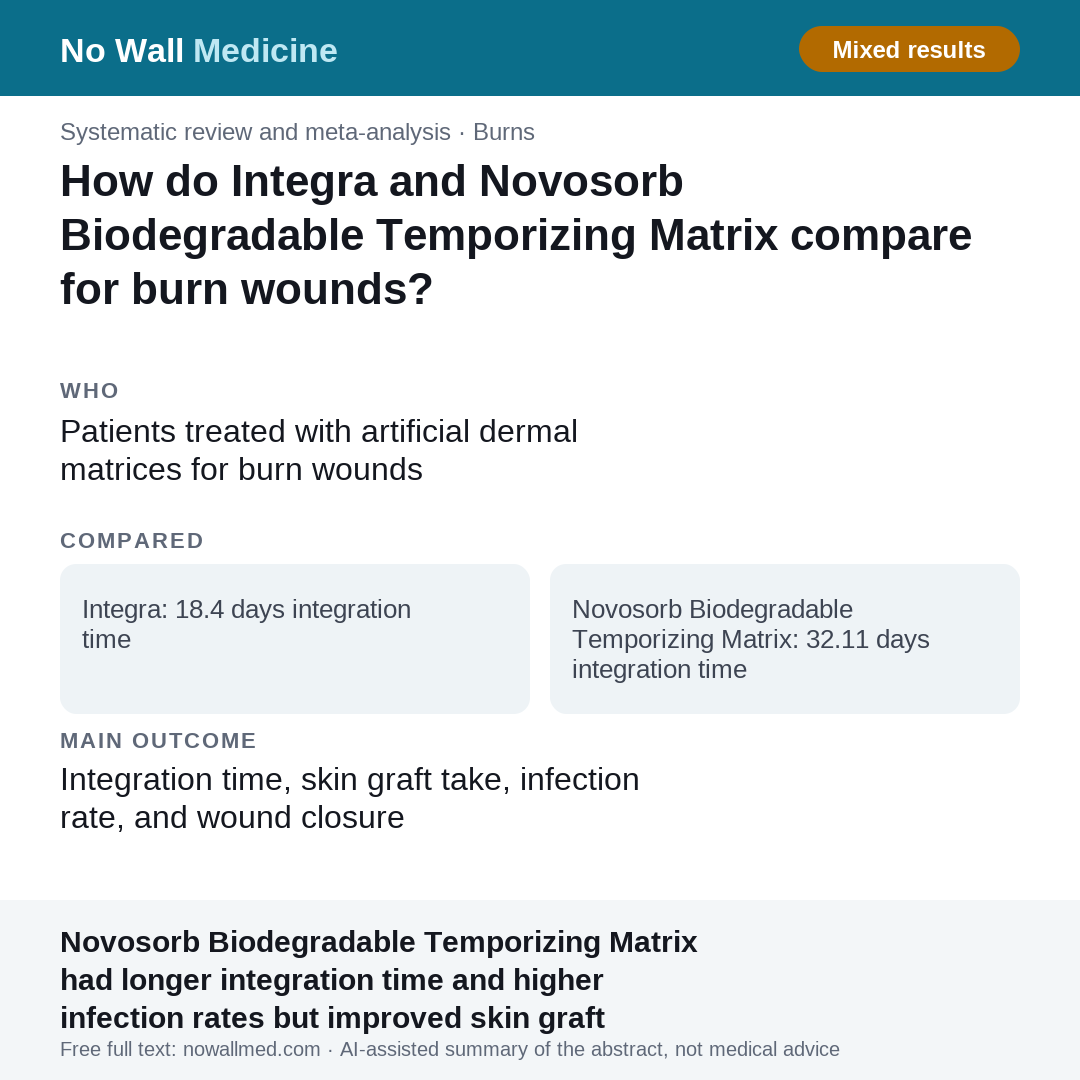
Clinical question: How do Integra and Novosorb Biodegradable Temporizing Matrix compare for burn wounds?
Abstract
Background and objectives
Integra® is a bovine-derived artificial dermal matrix (ADM) widely used in the management of burns. More recently, Novosorb® Biodegradable Temporizing Matrix (BTM) has emerged as a fully synthetic ADM product. While experience with Integra® and BTM has been separately reviewed, burn wound healing outcomes and infectious complications have yet to be pooled and compared. Methods
Following librarian-reviewed systematic search, a mixed-effects meta-regression model was fitted based on all studies with ADM type as a categorical moderator. A two-stage individual patient data (IPD) meta-analysis was also conducted. Results
Thirty-five studies were included, the majority of which were non-comparative case series. Nineteen studies provided IPD. 674 patients were treated with Integra® and 288 with BTM. Integration time prior to second stage skin grafting was significantly longer with BTM than Integra® (32.11 vs 18.4 days, p < 0.01). Skin graft take was higher with BTM than Integra® when effects of NPWT use, template size and patient age were adjusted on meta-regression (90.6 vs 77.2 %, p = 0.016). This remained significant on two-stage IPD meta-analysis and exclusion of studies with high risk of bias. Moderator-adjusted infection rate was higher with BTM than Integra® (22.8 vs 2.96 %, p = 0.0072), but no differences were observed in average template take or infection-related reoperation rate. Wound closure rate, defined as > 95 % wound epithelialization, was comparable with BTM and Integra® (96.0 vs 96.5 %, p = 0.81). Discussion
While acknowledging BTM's prolonged healing timeline with no difference in overall wound closure rate, BTM may offer improved graft take and greater salvageability than Integra® in the event of infection. Summary and conclusion
Very low-quality evidence suggests that BTM is associated with longer integration time and higher graft take when compared to Integra®. Infection rate was higher with BTM than Integra® but there was no difference in template take or need for reoperation. Overall wound closure rates were comparable.
Topics
Cite this article
He M, Choi J, Mir I, Al Wahaiby M, Papp A. Integra® versus Novosorb® biodegradable temporizing matrix for burn wounds: a comparative systematic review and meta analysis. Burns. 2025. doi:10.1016/j.burns.2025.107754
Spotted a mistake? Suggest a correction