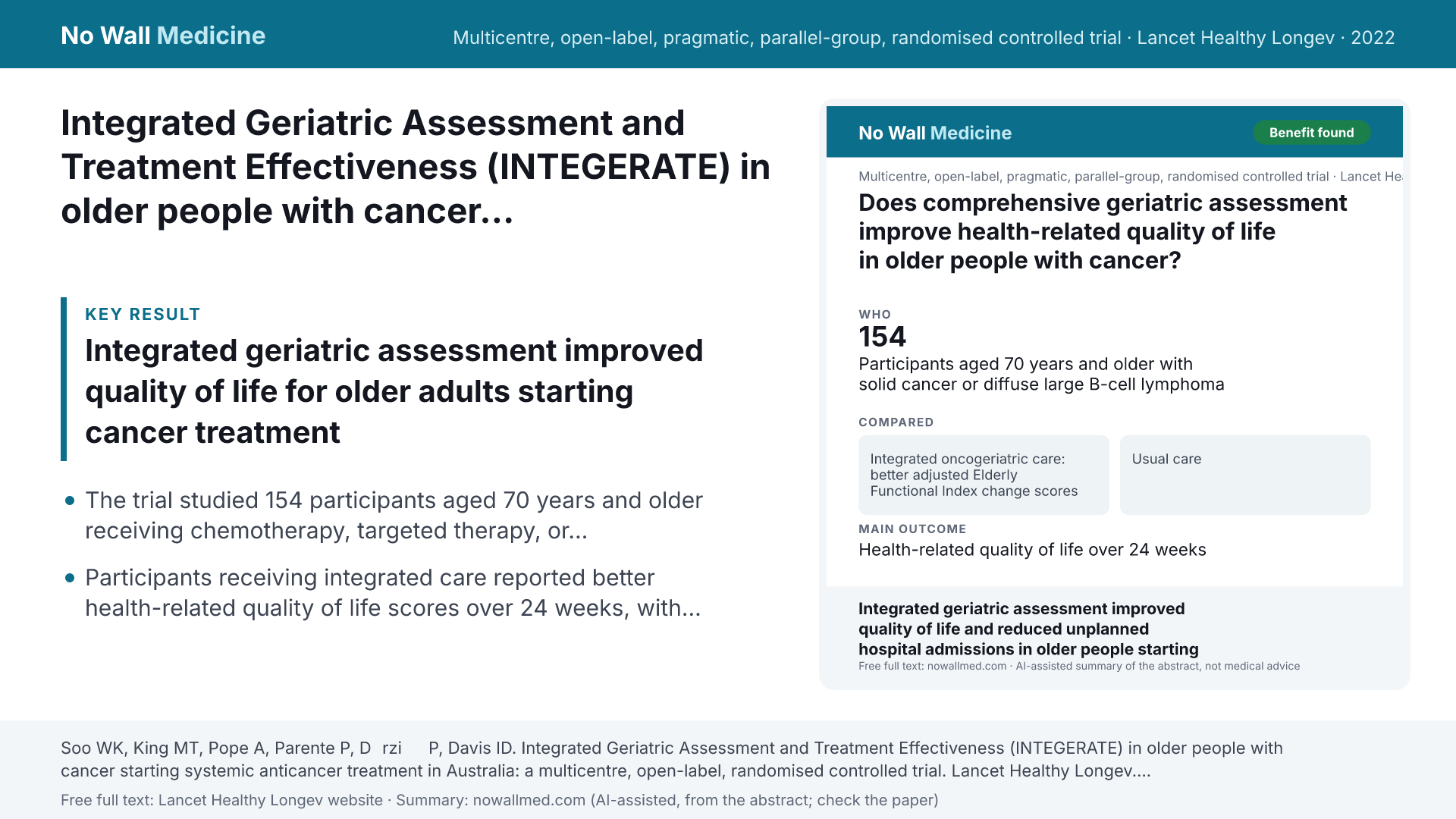
Integrated geriatric assessment improved quality of life for older adults starting cancer treatment
Integrated Geriatric Assessment and Treatment Effectiveness (INTEGERATE) in older people with cancer starting systemic anticancer treatment in Australia: a multicentre, open-label, randomised controlled trial
Multicentre, open-label, pragmatic, parallel-group, randomised controlled trialBenefit found
Does comprehensive geriatric assessment improve health-related quality of life in older people with cancer?
Who
154
Participants aged 70 years and older with solid cancer or diffuse large B-cell lymphoma · Three hospitals in Australia
Compared
Integrated oncogeriatric care: better adjusted Elderly Functional Index change scores
Usual care
Main outcome
Health-related quality of life over 24 weeks
Result: mean difference in change 9·8 (95% CI 2·4-17·2)
Bottom line: Integrated geriatric assessment improved quality of life and reduced unplanned hospital admissions in older people starting systemic anticancer treatment.
Funded by: National Health and Medical Research Council, Monash University, and Eastern Health
Lancet Healthy Longev · 2022-08-22Download image
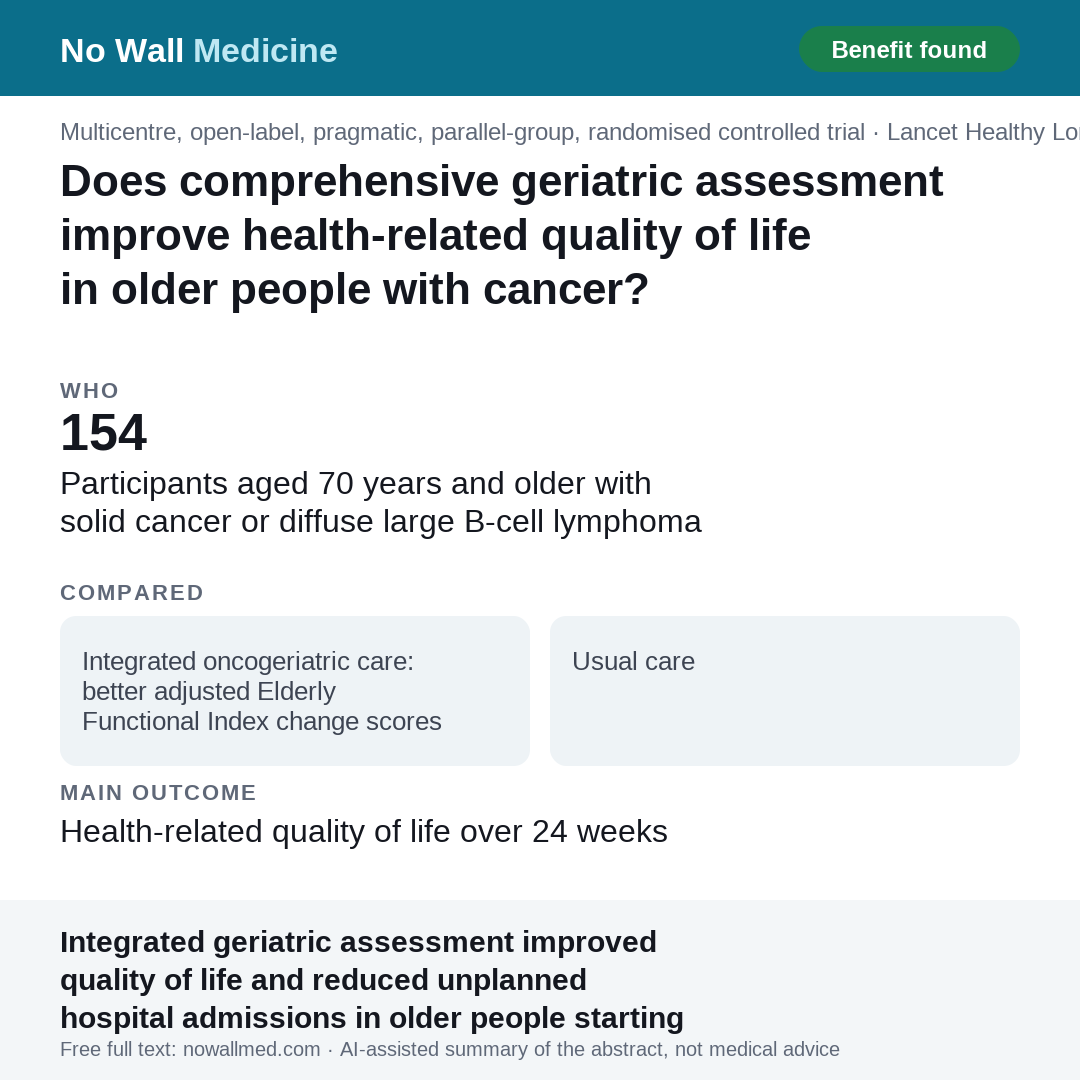
Clinical question: Does comprehensive geriatric assessment improve health-related quality of life in older people with cancer?
Key points
- The trial studied 154 participants aged 70 years and older receiving chemotherapy, targeted therapy, or immunotherapy, comparing integrated oncogeriatric care to usual care.
- Participants receiving integrated care reported better health-related quality of life scores over 24 weeks, with a maximal mean difference in change of 9.8 at week 18.
- The integrated care group also had significantly fewer unplanned hospital admissions at 24 weeks, though no statistically significant difference was observed in overall survival.
Headline and key points written with AI from the paper’s abstract, with every number checked against it. Read the paper before relying on them.
Was this summary helpful?
Abstract
Background
The effectiveness of comprehensive geriatric assessment (CGA) in improving health outcomes in cancer settings is unclear. We evaluated whether CGA can improve health-related quality of life (HRQOL) in older people with cancer who are starting systemic anticancer treatment. Methods
INTEGERATE is a multicentre, open-label, pragmatic, parallel-group, randomised controlled trial that was done at three hospitals in Australia. Participants aged 70 years and older with solid cancer or diffuse large B-cell lymphoma planned for chemotherapy, targeted therapy, or immunotherapy, were randomly assigned (1:1; using a central computer-generated minimisation algorithm with a random element, balancing treatment intent, cancer type, age, sex, and performance status) to receive CGA integrated into oncology care (integrated oncogeriatric care) or usual care only. Group assignment was not concealed from the participants and clinicians. The primary outcome was HRQOL over 24 weeks, assessed at baseline, week 12, week 18, and week 24, using the Elderly Functional Index (ELFI; score range 0-100). Analyses were by intention to treat. The trial is registered with ANZCTR.org.au, ACTRN12614000399695, and is completed. Findings
Between Aug 18, 2014, and Sept 5, 2018, 154 participants were randomly assigned to integrated oncogeriatric care (n=76) or usual care (n=78). 13 participants died by week 12 and 130 (92%) of the remaining 141 participants completed two or more ELFI assessments. Participants assigned to integrated oncogeriatric care reported better adjusted ELFI change scores over 24 weeks compared with those in the usual care group (overall main effect of group: t=2·1, df=213, p=0·039; effect size=0·38), with maximal between-group differences at week 18 (mean difference in change 9·8 [95% CI 2·4-17·2]; p=0·010, corrected p=0·030, effect size=0·48). The integrated oncogeriatric care group also had significantly fewer unplanned hospital admissions at 24 weeks (multivariable-adjusted incidence rate ratio 0·60 [95% CI 0·42-0·87]; p=0·0066). No statistically significant between-group difference was observed in overall survival. Interpretation
CGA led to better quality of life and health-care delivery in older people receiving systemic anticancer treatment. Routine CGA-based interventions should be considered in at-risk older people starting systemic anticancer treatment. Funding
National Health and Medical Research Council (Australia), Monash University, and Eastern Health.
Abstract reproduced under the article’s CC BY NC ND licence.
Subject terms
Cite this article
Soo WK, King MT, Pope A, Parente P, Dārziņš P, Davis ID. Integrated Geriatric Assessment and Treatment Effectiveness (INTEGERATE) in older people with cancer starting systemic anticancer treatment in Australia: a multicentre, open-label, randomised controlled trial. Lancet Healthy Longev. 2022. doi:10.1016/S2666-7568(22)00169-6
Spotted a mistake? Suggest a correction