Intercostal nerve block provided noninferior pain relief compared to thoracic epidural in lung surgery patients
Intercostal or Paravertebral Block vs Thoracic Epidural in Lung Surgery: A Randomized Noninferiority Trial
Randomized noninferiority clinical trialMixed results
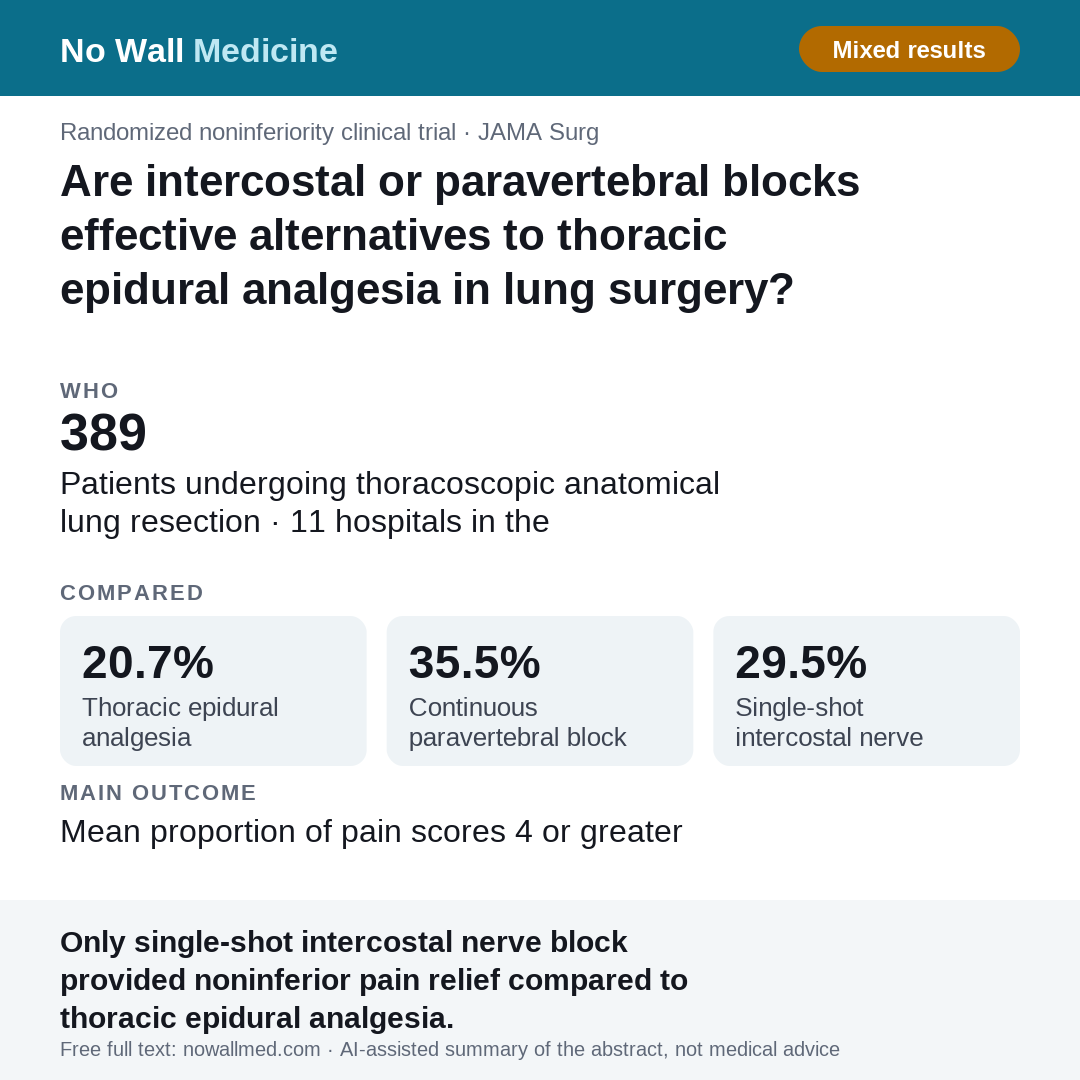
Are intercostal or paravertebral blocks effective alternatives to thoracic epidural analgesia in lung surgery?
Who
389
Patients undergoing thoracoscopic anatomical lung resection · 11 hospitals in the Netherlands and Belgium
Compared
20.7%Thoracic epidural analgesia (95% CI, 16.5%-24.9%)
35.5%Continuous paravertebral block (95% CI, 30.1%-40.8%)
29.5%Single-shot intercostal nerve block (95% CI, 24.6%-34.4%)
Main outcome
Mean proportion of pain scores 4 or greater
Bottom line: Only single-shot intercostal nerve block provided noninferior pain relief compared to thoracic epidural analgesia.
JAMA Surg · 2025-06-25Download image
Clinical question: Are intercostal or paravertebral blocks effective alternatives to thoracic epidural analgesia in lung surgery?
Why it matters: Thoracic epidural analgesia is effective for pain but has adverse effects that conflict with enhanced recovery principles after lung surgery.
Key points
- Researchers studied 389 patients undergoing lung resection and compared continuous paravertebral block, single-shot intercostal nerve block, and thoracic epidural analgesia.
- Intercostal nerve block was noninferior to thoracic epidural for pain, while paravertebral block was found to be inferior regarding pain scores.
- Both nerve block methods were associated with lower opioid consumption and better mobility compared to thoracic epidural analgesia.
Headline and key points written with AI from the paper’s abstract, with every number checked against it. Read the paper before relying on them.
Was this summary helpful?
Subject terms
Cite this article
Spaans LN, Dijkgraaf MGW, Susa D, de Loos ER, Mourisse JMJ, Bouwman RA. Intercostal or Paravertebral Block vs Thoracic Epidural in Lung Surgery: A Randomized Noninferiority Trial. JAMA Surg. 2025. doi:10.1001/jamasurg.2025.1899
Spotted a mistake? Suggest a correction
Top studies every Monday
The week’s key trials and guidelines in your specialties, plus any topics you follow. By email, free.
Get the weekly digest