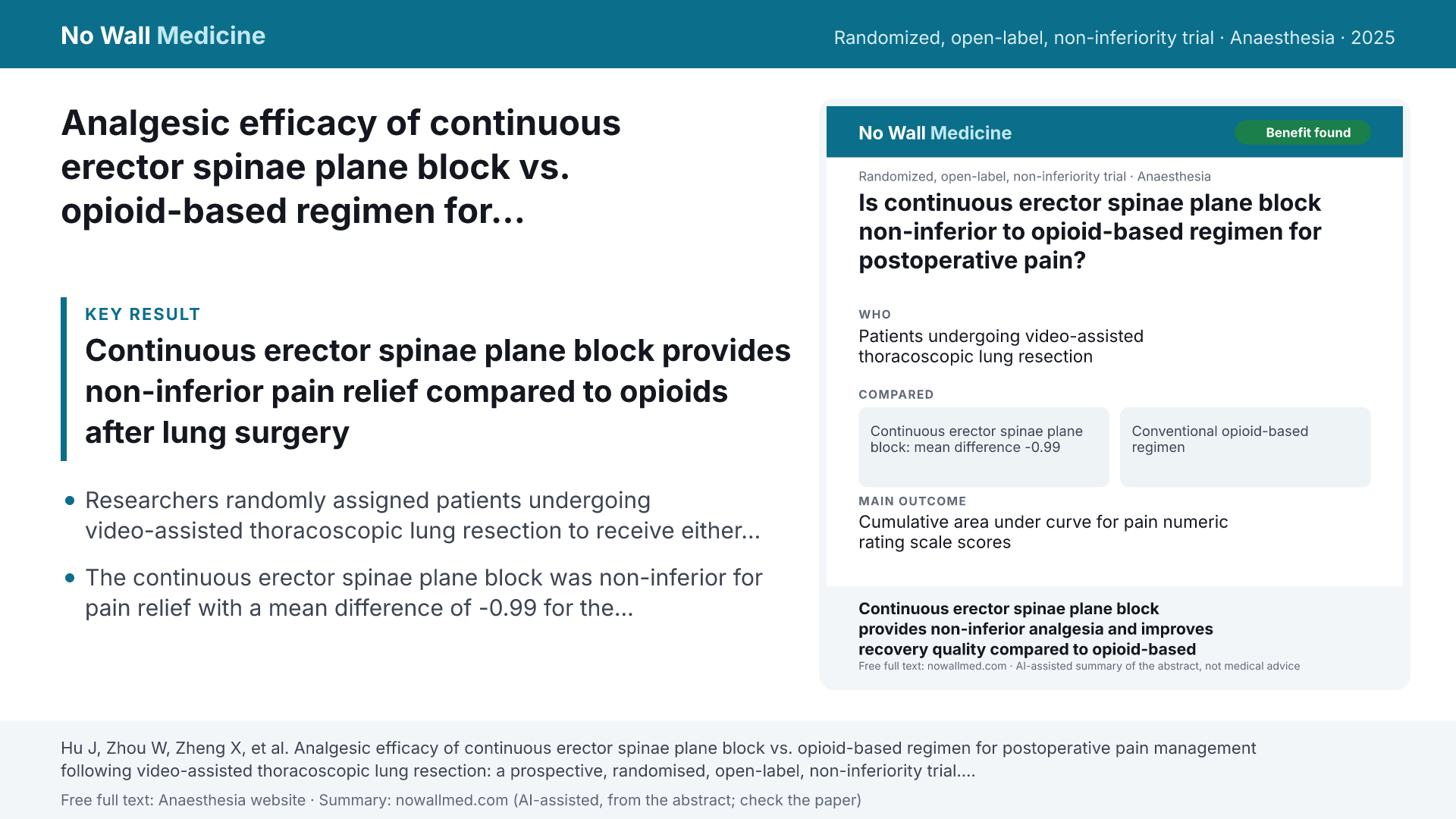
Continuous erector spinae plane block provides non-inferior pain relief compared to opioids after lung surgery
Analgesic efficacy of continuous erector spinae plane block vs. opioid-based regimen for postoperative pain management following video-assisted thoracoscopic lung resection: a prospective, randomised, open-label, non-inferiority trial
Randomized, open-label, non-inferiority trialBenefit found
Is continuous erector spinae plane block non-inferior to opioid-based regimen for postoperative pain?
Who
Patients undergoing video-assisted thoracoscopic lung resection
Compared
Continuous erector spinae plane block: mean difference -0.99
Conventional opioid-based regimen
Main outcome
Cumulative area under curve for pain numeric rating scale scores
Result: mean difference -0.99 (95%CI -11.97 to 9.98)
Bottom line: Continuous erector spinae plane block provides non-inferior analgesia and improves recovery quality compared to opioid-based regimens.
Anaesthesia · 2025-06-23Download image
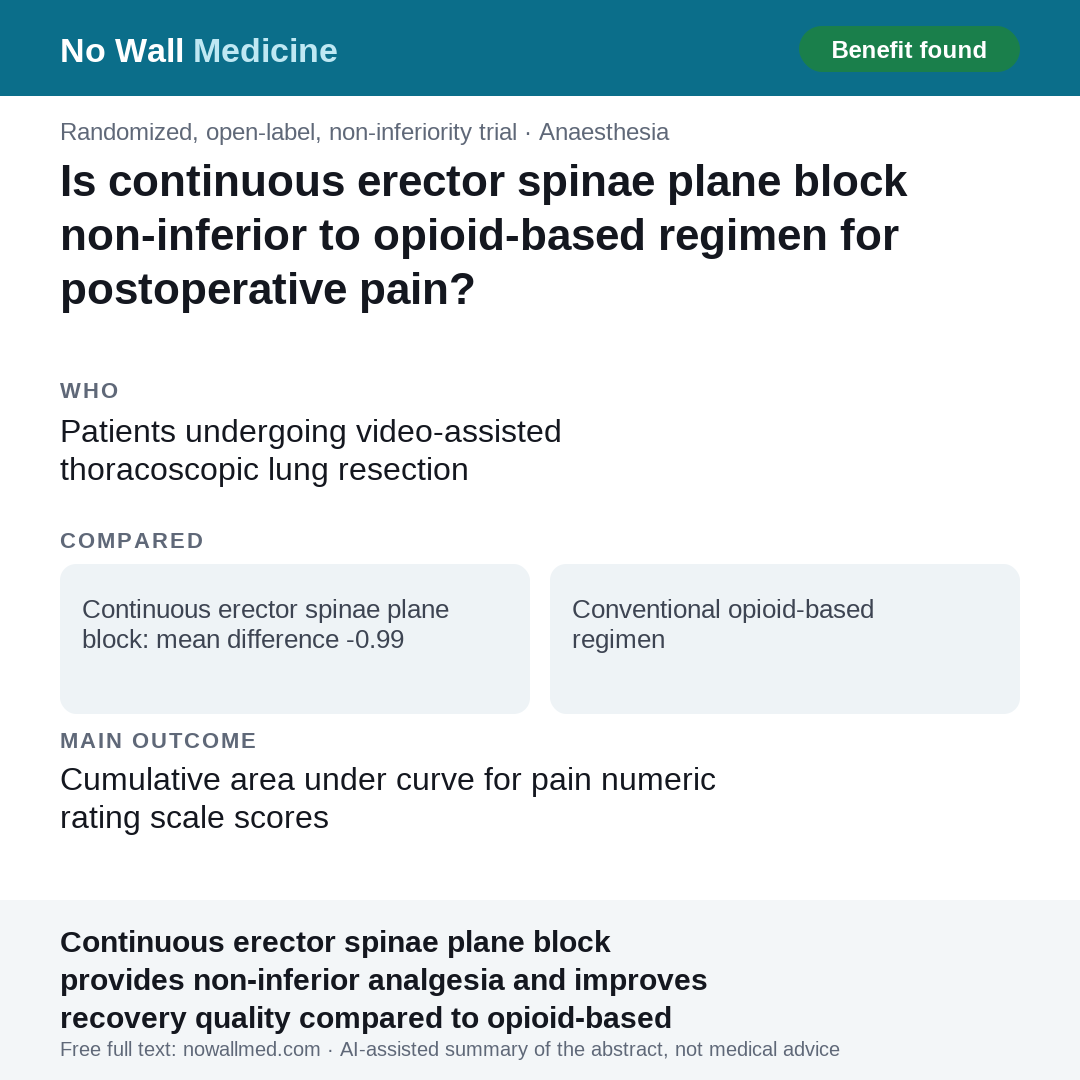
Clinical question: Is continuous erector spinae plane block non-inferior to opioid-based regimen for postoperative pain?
Why it matters: Significant postoperative pain occurs following video-assisted thoracoscopic lung resection, and clinicians need to know if continuous erector spinae plane blocks are as effective as opioids.
Key points
- Researchers randomly assigned patients undergoing video-assisted thoracoscopic lung resection to receive either a continuous erector spinae plane block or a conventional opioid-based regimen.
- The continuous erector spinae plane block was non-inferior for pain relief with a mean difference of -0.99 for the cumulative area under curve for pain scores.
- The block group showed higher quality of recovery-15 scores at 24 h and 48 h and a lower relative risk of postoperative pulmonary complications at 0.45.
Headline and key points written with AI from the paper’s abstract, with every number checked against it. Read the paper before relying on them.
Was this summary helpful?
Subject terms
Cite this article
Hu J, Zhou W, Zheng X, et al. Analgesic efficacy of continuous erector spinae plane block vs. opioid-based regimen for postoperative pain management following video-assisted thoracoscopic lung resection: a prospective, randomised, open-label, non-inferiority trial. Anaesthesia. 2025. doi:10.1111/anae.16651
Spotted a mistake? Suggest a correction