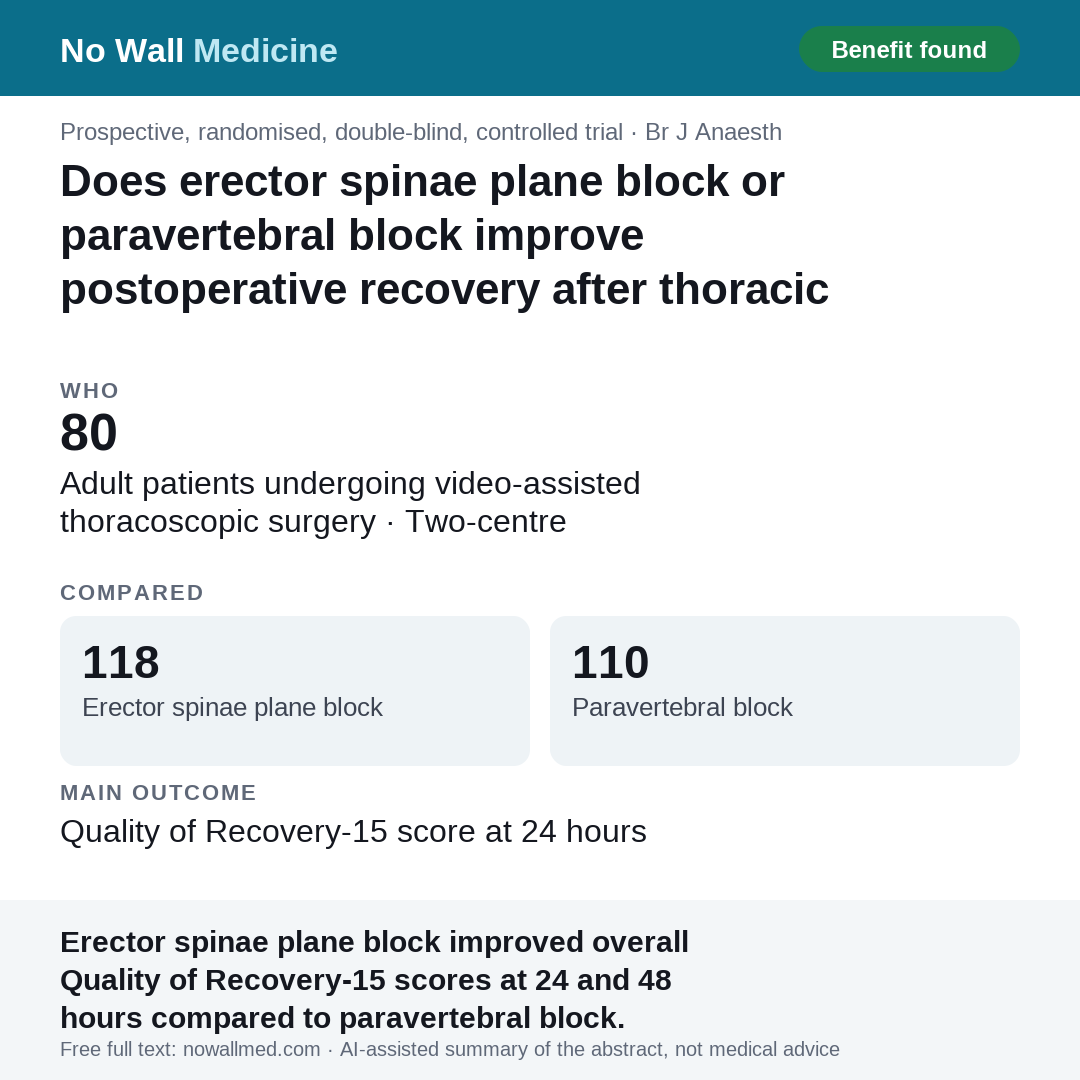
Erector spinae plane block improved recovery scores compared to paravertebral block after thoracic surgery
Postoperative recovery with continuous erector spinae plane block or video-assisted paravertebral block after minimally invasive thoracic surgery: a prospective, randomised controlled trial
Prospective, randomised, double-blind, controlled trialBenefit found
Does erector spinae plane block or paravertebral block improve postoperative recovery after thoracic surgery?
Who
80
Adult patients undergoing video-assisted thoracoscopic surgery · Two-centre
Compared
118Erector spinae plane block (106-134)
110Paravertebral block (89-121)
Main outcome
Quality of Recovery-15 score at 24 hours
Bottom line: Erector spinae plane block improved overall Quality of Recovery-15 scores at 24 and 48 hours compared to paravertebral block.
Br J Anaesth · 2022-09-13Download image
Clinical question: Does erector spinae plane block or paravertebral block improve postoperative recovery after thoracic surgery?
Why it matters: It was unknown whether ultrasound-guided erector spinae plane block or surgically placed paravertebral block provides better patient-centric recovery outcomes after minimally invasive thoracic surgery.
Key points
- Researchers compared ultrasound-guided erector spinae plane block (a nerve block near the spine) to surgeon-placed paravertebral block in 80 adult patients undergoing minimally invasive lung surgery.
- The erector spinae plane block resulted in higher median Quality of Recovery-15 scores at 24 h (118 vs 110) and 48 h (131 vs 120).
- There were no differences between the two methods regarding opioid use, hospital stay, or the 34% and 31% incidence of chronic postsurgical pain at 3 months.
Headline and key points written with AI from the paper’s abstract, with every number checked against it. Read the paper before relying on them.
Was this summary helpful?
Subject terms
Cite this article
Moorthy A, Ní Eochagáin A, Dempsey E, Wall V, Marsh H, Murphy T. Postoperative recovery with continuous erector spinae plane block or video-assisted paravertebral block after minimally invasive thoracic surgery: a prospective, randomised controlled trial. Br J Anaesth. 2022. doi:10.1016/j.bja.2022.07.051
Spotted a mistake? Suggest a correction
Top studies every Monday
The week’s key trials and guidelines in your specialties, plus any topics you follow. By email, free.
Get the weekly digest