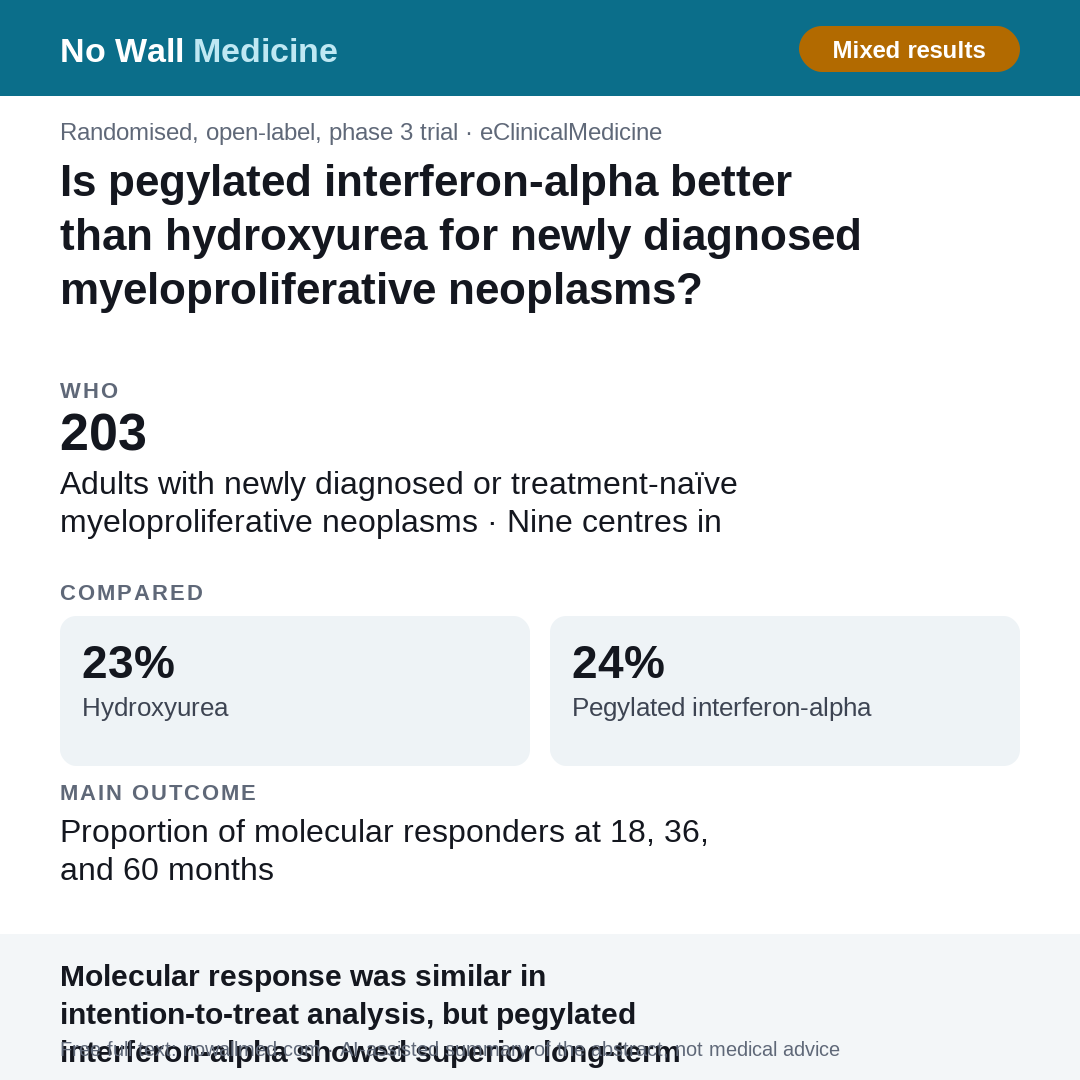
Is pegylated interferon-alpha better than hydroxyurea for newly diagnosed myeloproliferative neoplasms?
Who
203
Adults with newly diagnosed or treatment-naïve myeloproliferative neoplasms · Nine centres in Denmark
Compared
23%Hydroxyurea (at 60 months)
24%Pegylated interferon-alpha (at 60 months)
Main outcome
Proportion of molecular responders at 18, 36, and 60 months
Bottom line: Molecular response was similar in intention-to-treat analysis, but pegylated interferon-alpha showed superior long-term response among patients remaining on therapy.
Funded by: OUH-Region Sjaelland Faelles Forskningspulje and others
Clinical question: Is pegylated interferon-alpha better than hydroxyurea for newly diagnosed myeloproliferative neoplasms?
Why it matters: The optimal first-line treatment for patients with newly diagnosed myeloproliferative neoplasms remains unclear.
Key points
Researchers studied 203 adults with newly diagnosed myeloproliferative neoplasms, comparing hydroxyurea to pegylated interferon-alpha.
In the main analysis, molecular response rates were similar at 18 months (19% vs 21%), 36 months (19% vs 26%), and 60 months (23% vs 24%).
Among patients who stayed on therapy, pegylated interferon-alpha had higher molecular response rates at 36 months (23% vs 56%) and 60 months (35% vs 67%).
Headline and key points written with AI from the paper’s abstract, with every number checked against it. Read the paper before relying on them.
Prostate and pelvic nodal stereotactic body radiotherapy (SBRT) versus prostate-only SBRT for high-risk, localised prostate cancer (PACE-NODES): early adverse event results from an international, open-label, phase 3, randomised controlled trial