Intermittent calorie restriction was associated with changes in T cell subsets in people with multiple sclerosis
Intermittent calorie restriction alters T cell subsets and metabolic markers in people with multiple sclerosis
Randomised-controlled feeding studyBenefit found
Does intermittent calorie restriction alter T cell subsets and metabolic markers in multiple sclerosis?
Who
36
People with multiple sclerosis
Compared
Intermittent calorie restriction: CD4-EM: -3.82%; CD4-: -6.96%; Th1: -4.26%; CD4- naïve: 10.11%
Daily calorie restriction: No changes
Control diet: No changes
Main outcome
T cell subsets and metabolic markers
Bottom line: Intermittent calorie restriction was associated with reduction in memory T cell subsets and certain lipid markers in multiple sclerosis.
Funded by: National MS Society, NIH, Johns Hopkins Catalyst Award
eBioMedicine · 2022-07-08Download image
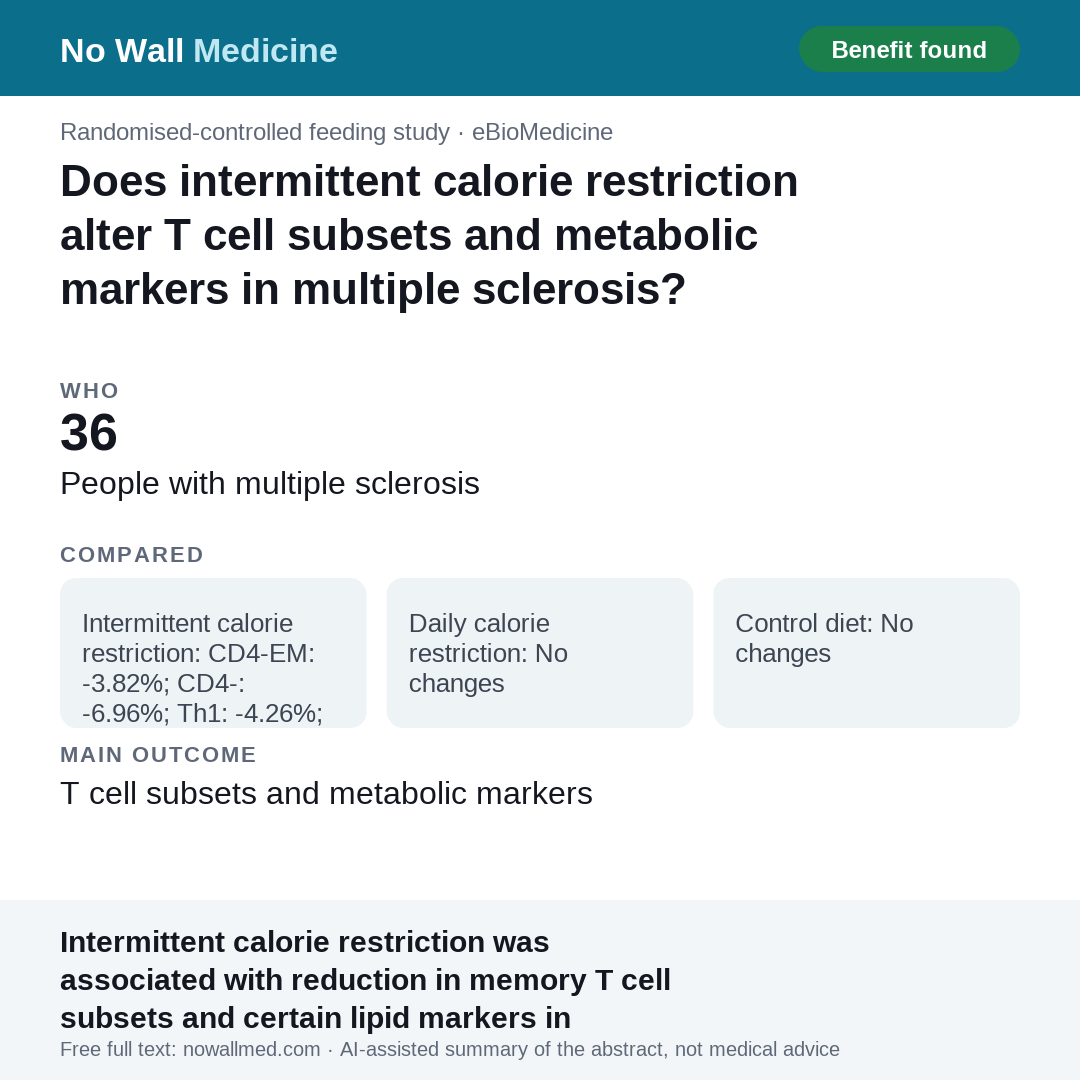
Clinical question: Does intermittent calorie restriction alter T cell subsets and metabolic markers in multiple sclerosis?
Why it matters: Data are sparse regarding whether intermittent fasting or calorie restriction diets provide anti-inflammatory and neuroprotective advantages in humans with multiple sclerosis.
Key points
- Researchers conducted a randomized-controlled feeding study of 36 people with multiple sclerosis over 8 weeks comparing a control diet, a daily calorie restriction diet, and an intermittent calorie restriction diet.
- Intermittent calorie restriction was associated with a -3.82% reduction in CD4+ effector memory T cells and a -6.96% reduction in CD4- effector memory T cells.
- The intermittent calorie restriction diet was also associated with a -4.26% reduction in Th1 subsets and a 10.11% increase in CD4- naïve T cell subsets.
Headline and key points written with AI from the paper’s abstract, with every number checked against it. Read the paper before relying on them.
Was this summary helpful?
Subject terms
Cite this article
Fitzgerald KC, Bhargava P, Smith MD, Vizthum D, Henry-Barron B, Kornberg MD. Intermittent calorie restriction alters T cell subsets and metabolic markers in people with multiple sclerosis. eBioMedicine. 2022. doi:10.1016/j.ebiom.2022.104124
Spotted a mistake? Suggest a correction
Top studies every Monday
The week’s key trials and guidelines in your specialties, plus any topics you follow. By email, free.
Get the weekly digest