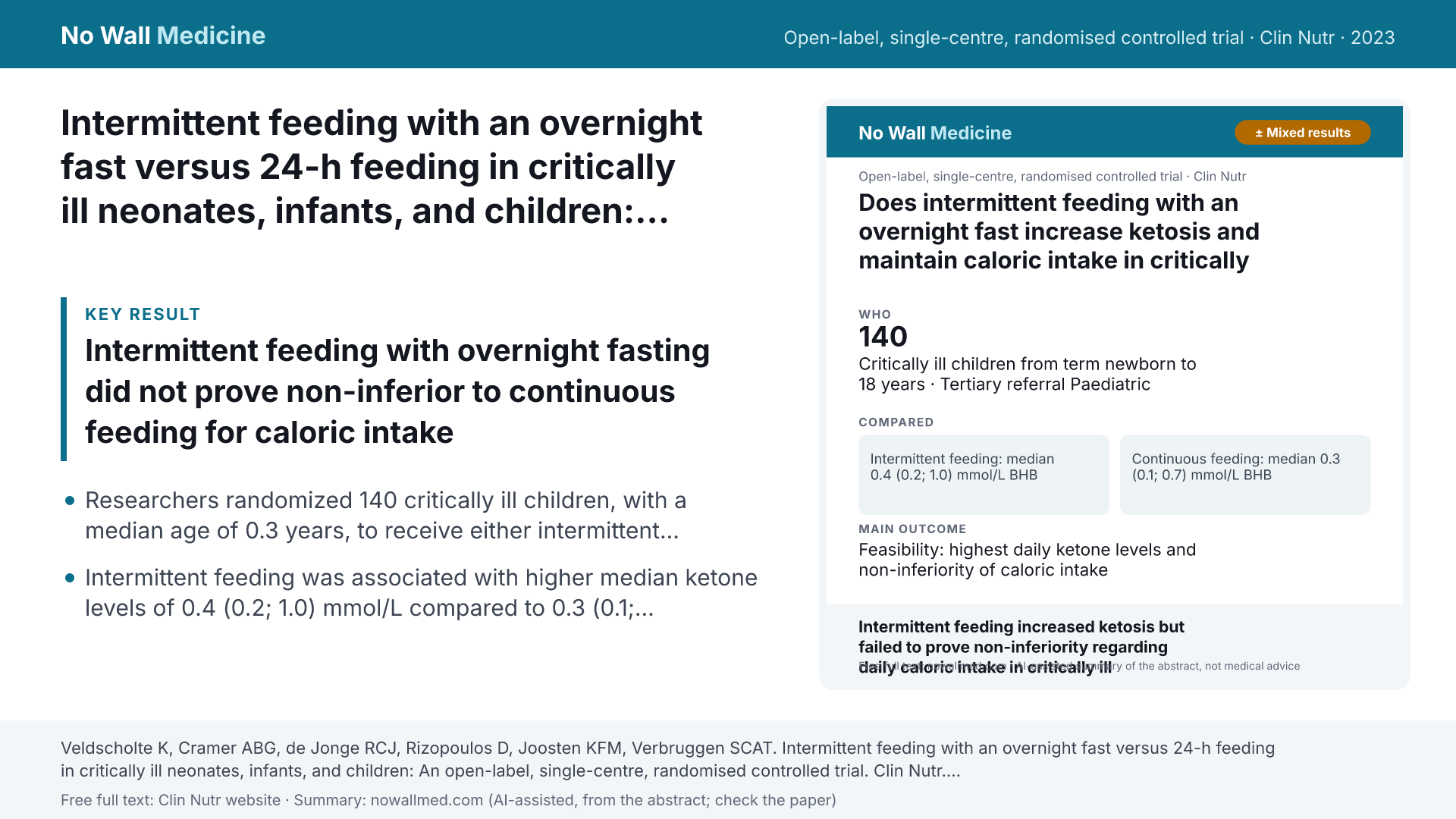
Intermittent feeding with an overnight fast versus 24-h feeding in critically ill neonates, infants, and children: An open-label, single-centre, randomised controlled trial
Key result: Intermittent feeding with overnight fasting did not prove non-inferior to continuous feeding for caloric intake
Key points
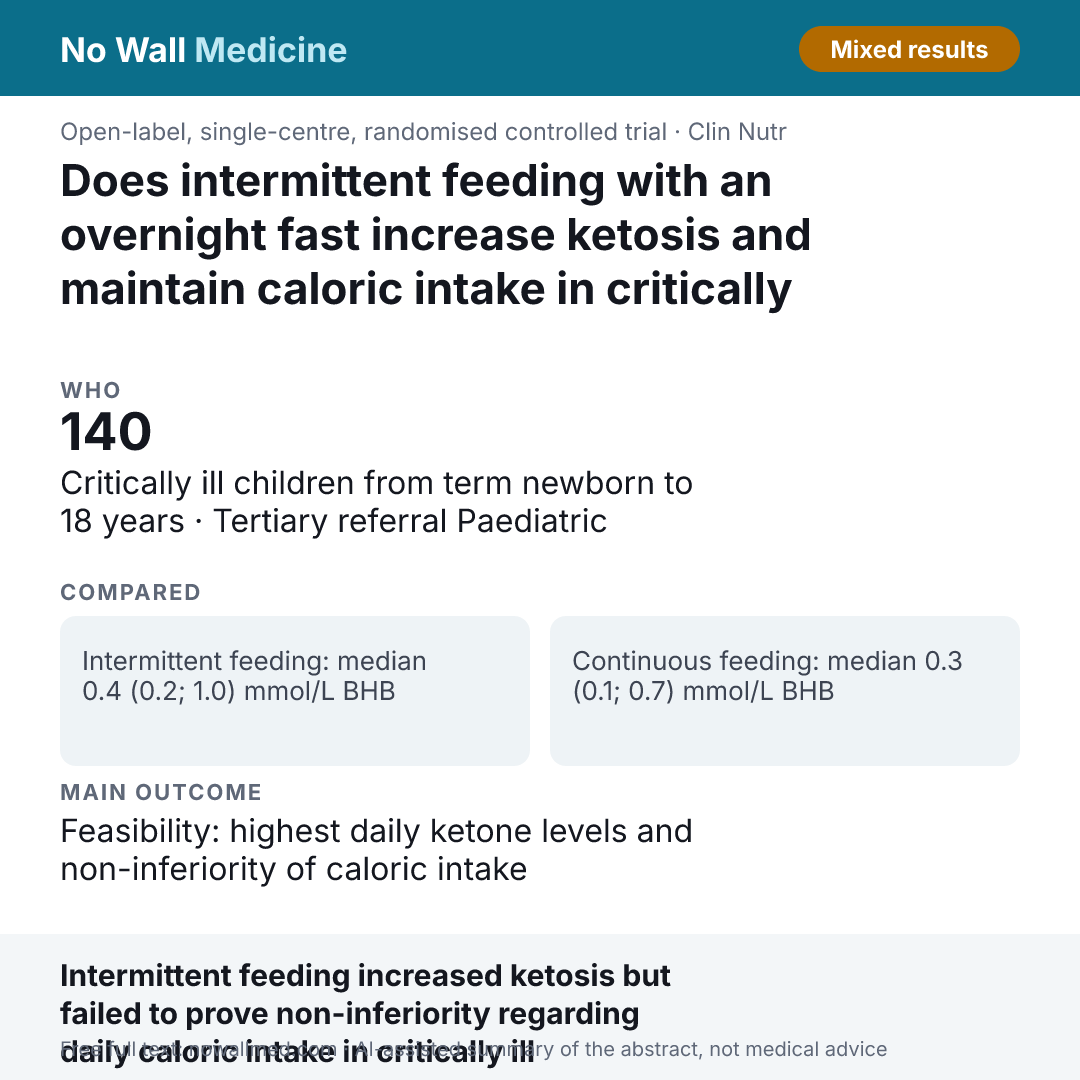
- Researchers randomized 140 critically ill children, with a median age of 0.3 years, to receive either intermittent feeding with an overnight fast or continuous day and night feeding.
- Intermittent feeding was associated with higher median ketone levels of 0.4 (0.2; 1.0) mmol/L compared to 0.3 (0.1; 0.7) mmol/L in the continuous feeding group.
- The study did not prove non-inferiority for daily caloric intake, though no severe hypoglycemia or gastrointestinal complications occurred more frequently in the intermittent feeding group.
Limitation the authors note: The study was an open-label, single-centre, randomised controlled trial.
Discussion prompts
- Would these patients look like yours? Who was left out?
- Is the main outcome one that matters to patients?
- Is the difference large enough to change what you do?
Cite: Veldscholte K, Cramer ABG, de Jonge RCJ, Rizopoulos D, Joosten KFM, Verbruggen SCAT. Intermittent feeding with an overnight fast versus 24-h feeding in critically ill neonates, infants, and children: An open-label, single-centre, randomised controlled trial. Clin Nutr. 2023;42(9):1569-1580. doi:10.1016/j.clnu.2023.07.010
Free full text: Clin Nutr website · Summary and visual abstract: nowallmed.com/a/intermittent-feeding-with-an-overnight-fast-versus-24-h-feeding-in-12aowrq/ (AI-assisted from the abstract; check the paper before relying on it).