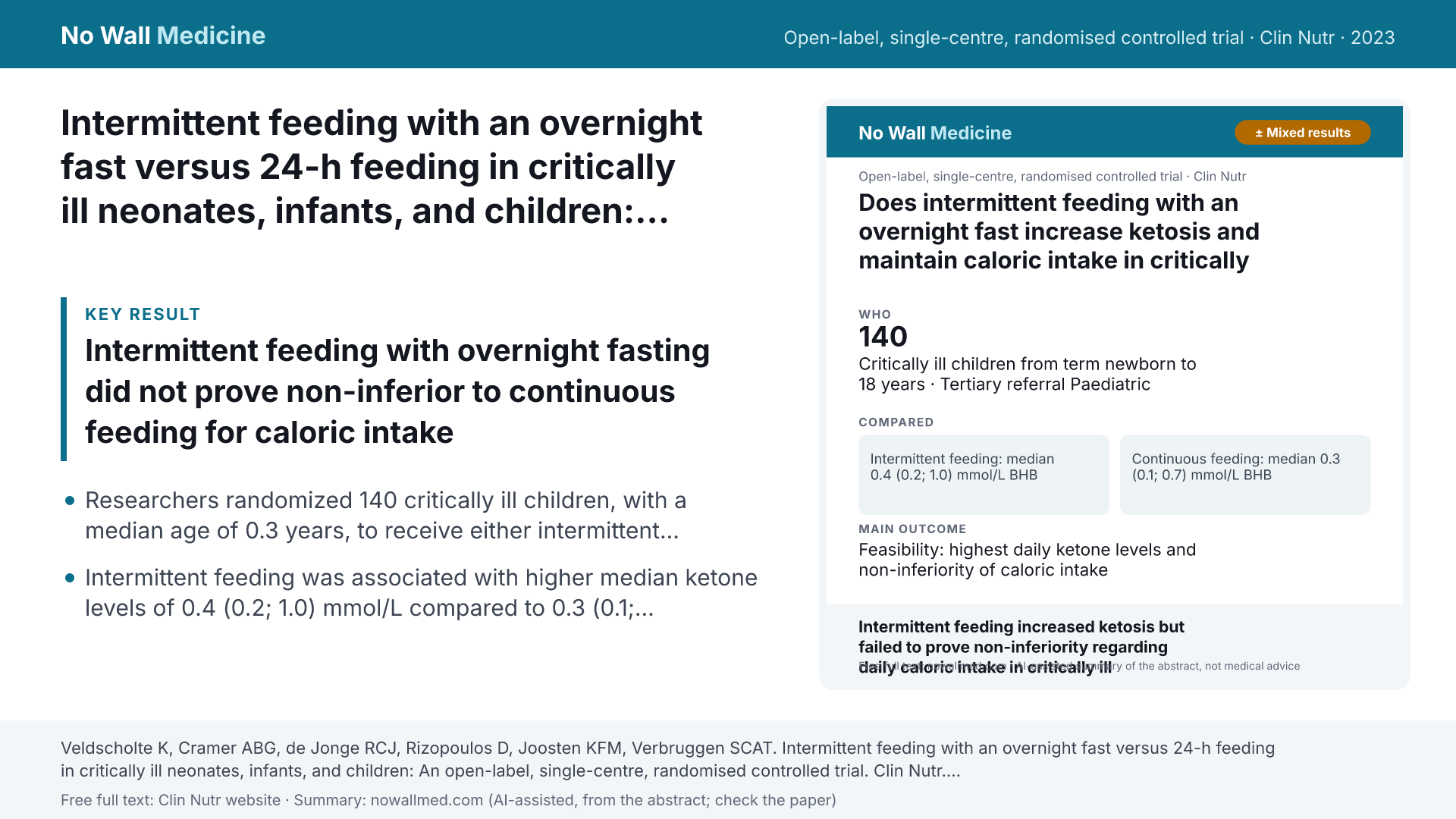
Intermittent feeding with overnight fasting did not prove non-inferior to continuous feeding for caloric intake
Intermittent feeding with an overnight fast versus 24-h feeding in critically ill neonates, infants, and children: An open-label, single-centre, randomised controlled trial
Open-label, single-centre, randomised controlled trialMixed results
Does intermittent feeding with an overnight fast increase ketosis and maintain caloric intake in critically ill children?
Who
140
Critically ill children from term newborn to 18 years · Tertiary referral Paediatric Intensive Care Unit in the Netherlands
Compared
Intermittent feeding: median 0.4 (0.2; 1.0) mmol/L BHB
Continuous feeding: median 0.3 (0.1; 0.7) mmol/L BHB
Main outcome
Feasibility: highest daily ketone levels and non-inferiority of caloric intake
Bottom line: Intermittent feeding increased ketosis but failed to prove non-inferiority regarding daily caloric intake in critically ill children.
Limitation: Non-inferiority regarding daily caloric intake was not proven, so feasibility could not be shown.
Clin Nutr · 2023-07-15Download image
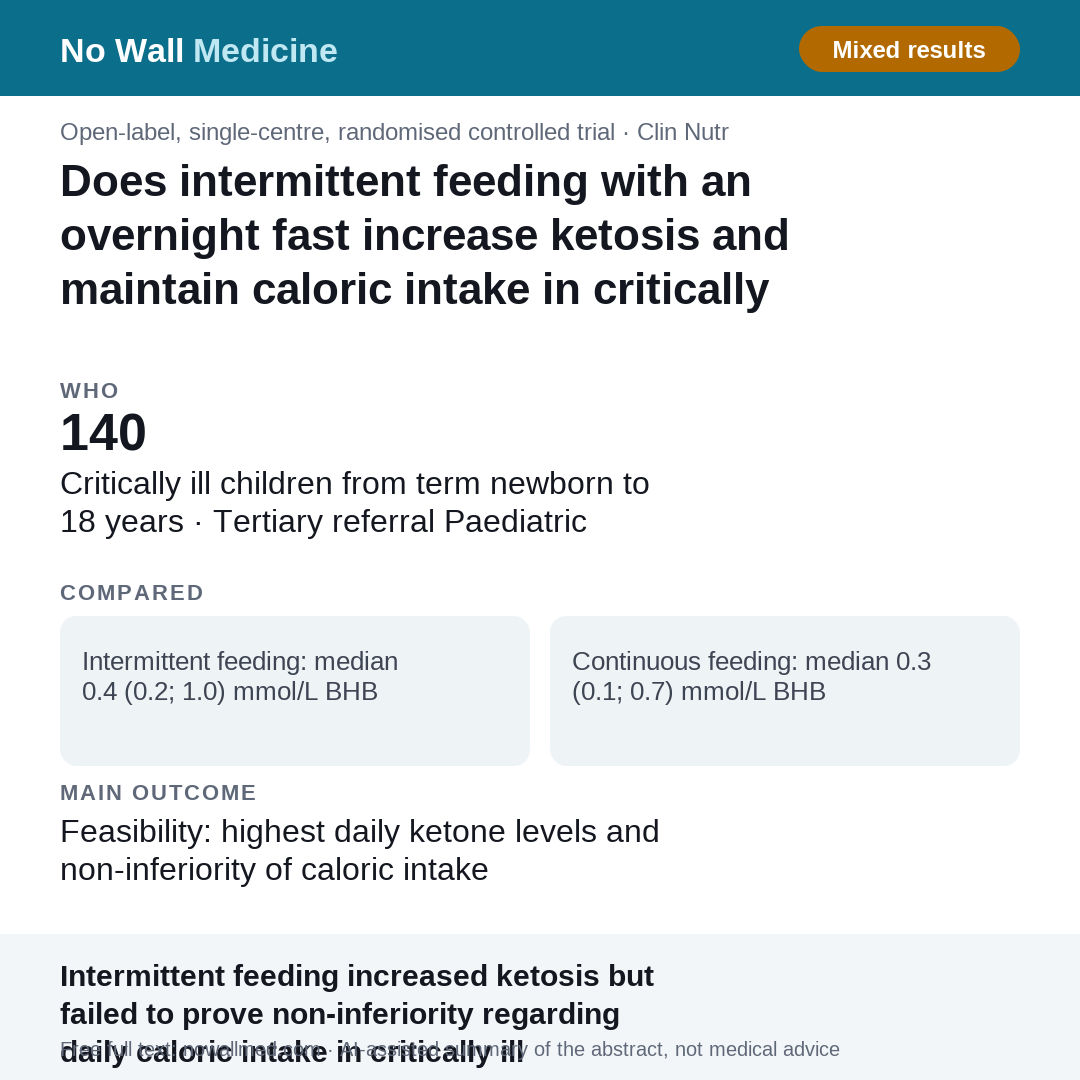
Clinical question: Does intermittent feeding with an overnight fast increase ketosis and maintain caloric intake in critically ill children?
Why it matters: It is unknown whether an overnight fast is feasible and safe for critically ill children while still meeting nutritional goals.
Key points
- Researchers randomized 140 critically ill children, with a median age of 0.3 years, to receive either intermittent feeding with an overnight fast or continuous day and night feeding.
- Intermittent feeding was associated with higher median ketone levels of 0.4 (0.2; 1.0) mmol/L compared to 0.3 (0.1; 0.7) mmol/L in the continuous feeding group.
- The study did not prove non-inferiority for daily caloric intake, though no severe hypoglycemia or gastrointestinal complications occurred more frequently in the intermittent feeding group.
Limitation the authors note: The study was an open-label, single-centre, randomised controlled trial.
Headline and key points written with AI from the paper’s abstract, with every number checked against it. Read the paper before relying on them.
Was this summary helpful?
Subject terms
Cite this article
Veldscholte K, Cramer ABG, de Jonge RCJ, Rizopoulos D, Joosten KFM, Verbruggen SCAT. Intermittent feeding with an overnight fast versus 24-h feeding in critically ill neonates, infants, and children: An open-label, single-centre, randomised controlled trial. Clin Nutr. 2023. doi:10.1016/j.clnu.2023.07.010
Spotted a mistake? Suggest a correction