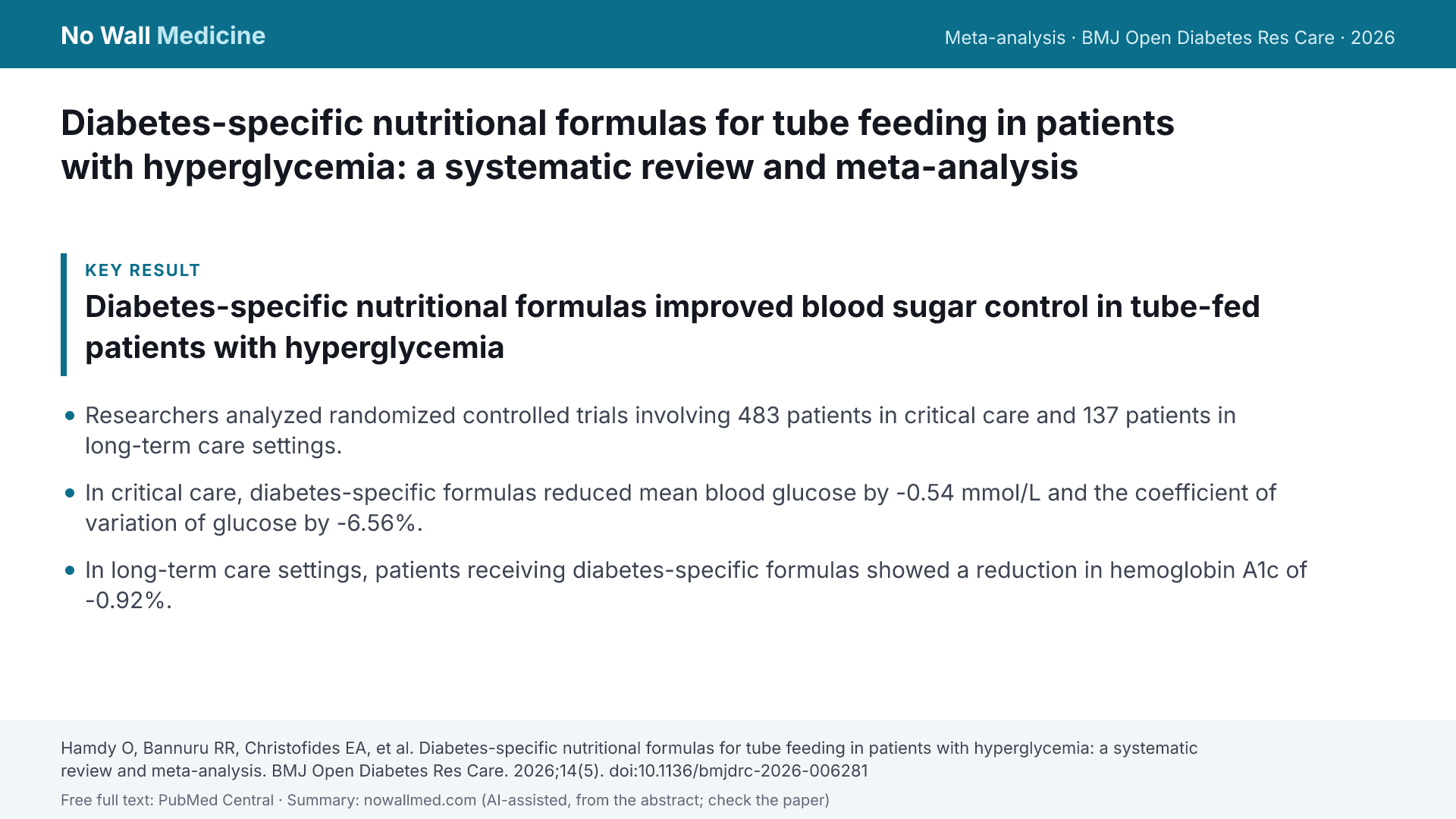
Diabetes-specific nutritional formulas improved blood sugar control in tube-fed patients with hyperglycemia
Diabetes-specific nutritional formulas for tube feeding in patients with hyperglycemia: a systematic review and meta-analysis
Key points
- Researchers analyzed randomized controlled trials involving 483 patients in critical care and 137 patients in long-term care settings.
- In critical care, diabetes-specific formulas reduced mean blood glucose by -0.54 mmol/L and the coefficient of variation of glucose by -6.56%.
- In long-term care settings, patients receiving diabetes-specific formulas showed a reduction in hemoglobin A1c of -0.92%.
Limitation the authors note: Small effect sizes, imprecision, and substantial statistical heterogeneity reduced the certainty of the evidence for most outcomes.
Headline and key points written with AI from the paper’s abstract, with every number checked against it. Read the paper before relying on them.
Was this summary helpful?
Abstract
This systematic review was conducted to evaluate the effects of diabetes-specific nutritional formulas (DSNF) in tube feeding on multiple outcomes in patients with hyperglycemia in real-world clinical settings. Randomized controlled trials (RCTs) comparing outcomes of patients receiving tube feeding with DSNF versus standard formulas were evaluated. RCTs in critical care and long-term care settings were addressed separately. Outcomes reported by two or more RCTs per clinical setting were evaluated, and those addressed by three or more RCTs were assessed using meta-analysis. Five RCTs allocating 483 patients in critical care and three RCTs allocating 137 patients in long-term care met inclusion criteria. DSNF showed advantages over standard formulas for glycemic control in both populations. Meta-analysis of studies enrolling critically ill patients found reductions in mean blood glucose (mean difference (MD) -0.54 mmol/L (95% CI -0.78 to -0.31), p<0.001; I2=9%; moderate certainty), coefficient of variation of glucose (MD -6.56% (95% CI -12.55% to -0.57%), p=0.032; I2=98%; low certainty) and SD of glucose (-0.77 mmol/L (95% CI -1.49 to -0.06), p=0.035; I2=98%; low certainty). Meta-analysis of the studies enrolling patients in long-term care found a reduction in hemoglobin A1c (-0.92% (95% CI -1.72% to -0.13%), p=0.023; I2=85%; low certainty). Findings for other outcomes were uncertain due to a lack of reporting in the included publications, inconsistent findings across studies, small sample sizes or lack of overall statistical significance. Evidence from this review demonstrated that DSNF in tube feeding provides statistically significant improvements in glycemia in both critically ill and long-term care populations with hyperglycemia compared with standard formulas. However, small effect sizes, imprecision and substantial statistical heterogeneity reduced certainty in the strength of evidence for most outcomes. DSNF is an important clinical tool to control hyperglycemia among critically ill and long-term care patients and should continue to be assessed for effectiveness in improving outcomes.PROSPERO registration numberCRD420251105442.
Abstract reproduced under the article’s CC BY NC licence.
Subject terms
Headline, design, result, key points, caveat and citation as plain text.
Cite this article
Hamdy O, Bannuru RR, Christofides EA, et al. Diabetes-specific nutritional formulas for tube feeding in patients with hyperglycemia: a systematic review and meta-analysis. BMJ Open Diabetes Res Care. 2026;14(5). doi:10.1136/bmjdrc-2026-006281
Spotted a mistake? Suggest a correction