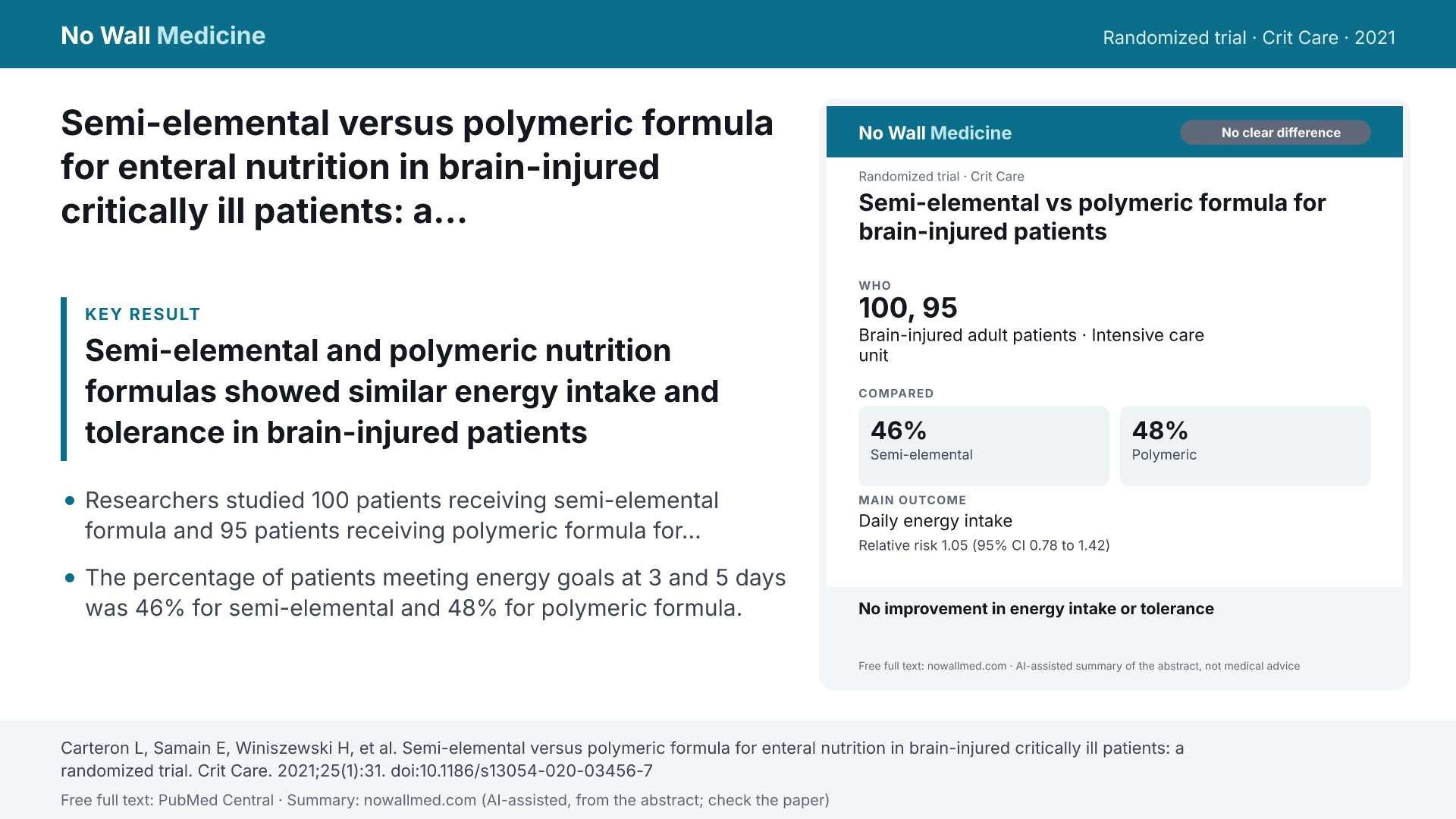
Semi-elemental and polymeric nutrition formulas showed similar energy intake and tolerance in brain-injured patients
Semi-elemental versus polymeric formula for enteral nutrition in brain-injured critically ill patients: a randomized trial
Randomized trialNo clear difference
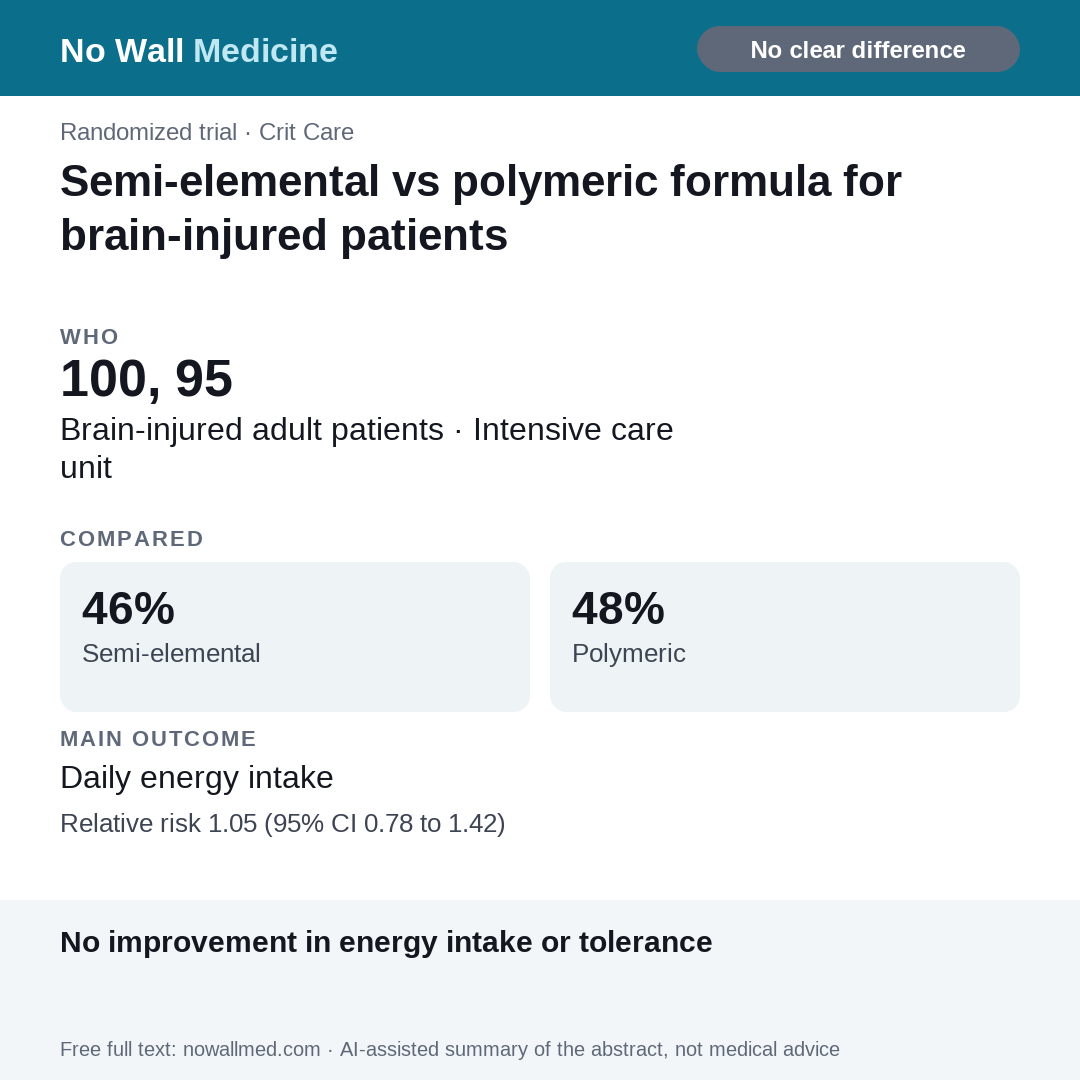
Semi-elemental vs polymeric formula for brain-injured patients
Who
100, 95
Brain-injured adult patients · Intensive care unit
Compared
46%Semi-elemental
48%Polymeric
Main outcome
Daily energy intake
Result: Relative risk 1.05 (95% CI 0.78 to 1.42)
Bottom line: No improvement in energy intake or tolerance
Crit Care · 2021-01-20Download image
Why it matters: It is unknown if semi-elemental formulas improve gastrointestinal tolerance in brain-injured patients who often suffer from delayed stomach emptying.
Key points
- Researchers studied 100 patients receiving semi-elemental formula and 95 patients receiving polymeric formula for tube feeding in intensive care.
- The percentage of patients meeting energy goals at 3 and 5 days was 46% for semi-elemental and 48% for polymeric formula.
- No difference was found in gastroparesis, which is delayed stomach emptying, or diarrhea between the two feeding groups.
Headline and key points written with AI from the paper’s abstract, with every number checked against it. Read the paper before relying on them.
Was this summary helpful?
Abstract
Background
The properties of semi-elemental enteral nutrition might theoretically improve gastrointestinal tolerance in brain-injured patients, known to suffer gastroparesis. The purpose of this study was to compare the efficacy and tolerance of a semi-elemental versus a polymeric formula for enteral nutrition (EN) in brain-injured critically ill patients. Methods
Prospective, randomized study including brain-injured adult patients [Glasgow Coma Scale (GCS) ≤ 8] with an expected duration of mechanical ventilation > 48 h. Intervention
an enteral semi-elemental (SE group) or polymeric (P group) formula. EN was started within 36 h after admission to the intensive care unit and was delivered according to a standardized nurse-driven protocol. The primary endpoint was the percentage of patients who received both 60% of the daily energy goal at 3 days and 100% of the daily energy goal at 5 days after inclusion. Tolerance of EN was assessed by the rate of gastroparesis, vomiting and diarrhea. Results
Respectively, 100 and 95 patients were analyzed in the SE and P groups: Age (57[44-65] versus 55[40-65] years) and GCS (6[3-7] versus 5[3-7]) did not differ between groups. The percentage of patients achieving the primary endpoint was similar (46% and 48%, respectively; relative risk (RR) [95% confidence interval (CI)] = 1.05 (0.78-1.42); p = 0.73). The mean daily energy intake was, respectively, 20.2 ± 6.3 versus 21.0 ± 6.5 kcal/kg/day (p = 0.42). Protein intakes were 1.3 ± 0.4 versus 1.1 ± 0.3 g/kg/day (p < 0.0001). Respectively, 18% versus 12% patients presented gastroparesis (p = 0.21), and 16% versus 8% patients suffered from diarrhea (p = 0.11). No patient presented vomiting in either group. Conclusion
Semi-elemental compared to polymeric formula did not improve daily energy intake or gastrointestinal tolerance of enteral nutrition. Trial registration
EudraCT/ID-RCB 2012-A00078-35 (registered January 17, 2012).
Abstract reproduced under the article’s CC BY licence.
Subject terms
Cite this article
Carteron L, Samain E, Winiszewski H, Blasco G, Balon AS, Gilli C. Semi-elemental versus polymeric formula for enteral nutrition in brain-injured critically ill patients: a randomized trial. Crit Care. 2021. doi:10.1186/s13054-020-03456-7
Spotted a mistake? Suggest a correction
Top studies every Monday
The week’s key trials and guidelines in your specialties, plus any topics you follow. By email, free.
Get the weekly digest